Short answer
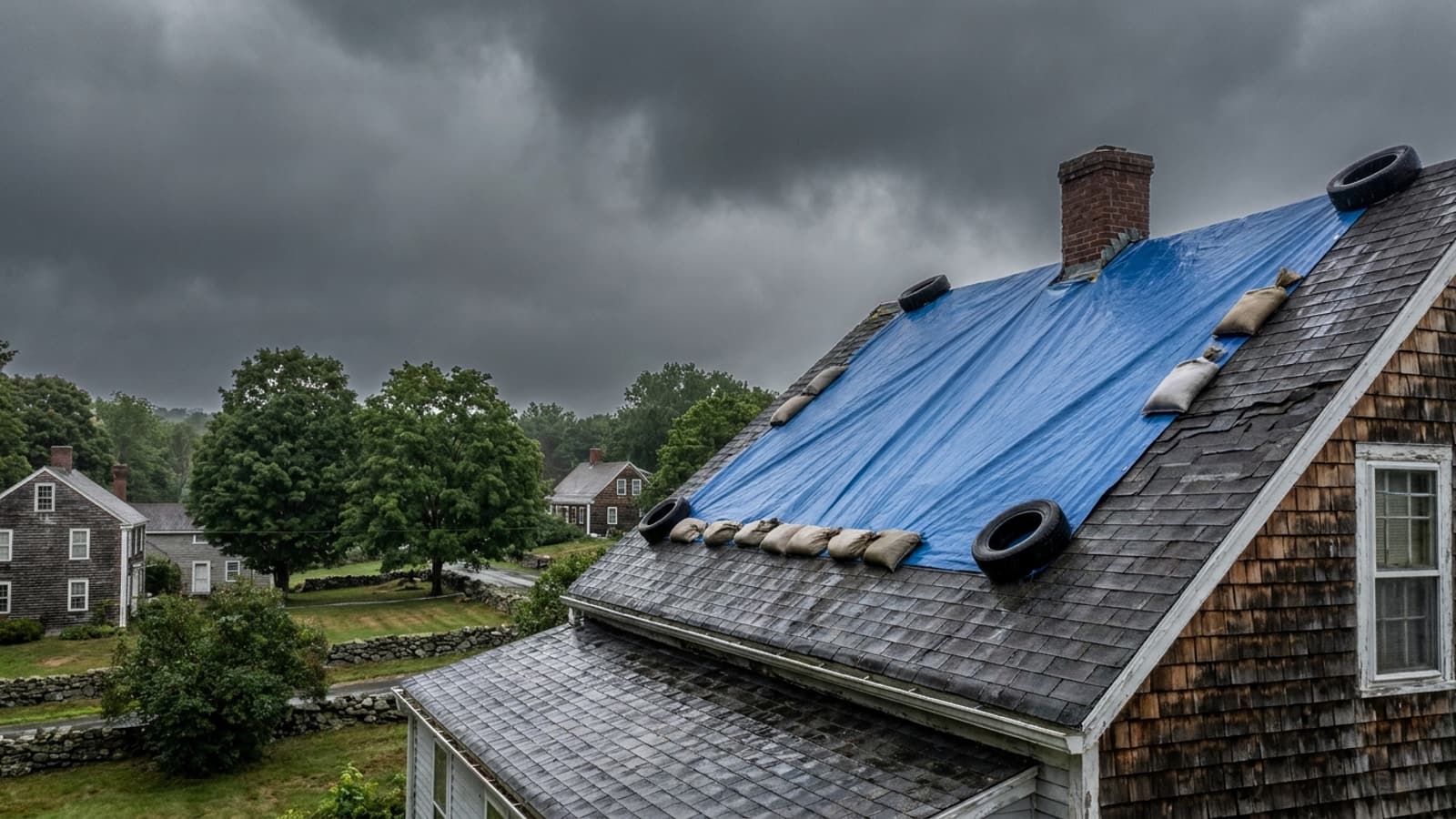
A competent crew only tears off as much roof as it can dry in and cover before the end of the day, so a passing shower usually means a pause, a tarp and a resumed schedule. Rain that lands briefly on exposed sheathing is absorbed and dries, and the real risk is water running past the edge of a tarp into the wall or ceiling below. Serious damage comes from an open roof left uncovered overnight, not from twenty minutes of rain on bare plywood.
On this page
Rain during a roof replacement is a scheduling problem far more often than it is a damage problem. The reason is simple: a crew that knows what it is doing never opens more roof than it can close before the end of the day, and never opens any roof at all on a morning the radar says otherwise.
That sentence is the whole answer. The rest of this post is about what "close" actually means, what water does to an exposed deck, what you should be able to see from the driveway, and where the genuine risk sits.
How much roof is open at one time
A full tear off does not mean the entire house is stripped to bare wood on Monday morning. On a standard asphalt job the crew works slope by slope, or section by section on a complicated roof. The sequence on each section is strip the old shingles, inspect and replace bad decking, then install drip edge, ice and water shield at the eaves and valleys, and underlayment across the field. That last stage is called drying in, and once a section is dried in it is weather resistant even without a single shingle on it.
Underlayment is not a roof. It is not rated for long exposure, it is not sealed around every penetration, and wind can get under it. But it sheds rain. A section that is dried in and tarped at the transitions will take an afternoon thunderstorm without anything reaching the house. Our page on the roof replacement process walks through the order these steps happen in.
The part of the day that matters
The decision point is early afternoon. A crew tracking the forecast stops tearing off while there is still enough daylight to dry in everything that is open. If the forecast turns, the crew stops stripping and switches entirely to drying in what is already exposed. A homeowner watching the job sees men working hard on a sunny afternoon and no new shingles going down, and sometimes reads that as slow. It is the opposite.
What rain actually does to an exposed deck
Roof decks are plywood or oriented strand board, or on older houses in Hartford, New Haven and Farmington, solid board planking. None of these dissolve in water. A deck that gets rained on for half an hour darkens, absorbs some surface moisture, and dries within a day of sun and air movement, helped considerably by the fact that the attic underneath is ventilated.
The materials differ in how forgiving they are:
| Deck type | Response to brief wetting | Response to prolonged soaking |
|---|---|---|
| Deck typePlywood | Response to brief wettingSurface darkens, dries flat | Response to prolonged soakingDelamination at edges over time |
| Deck typeOriented strand board | Response to brief wettingSurface darkens, edges can swell | Response to prolonged soakingPermanent edge swelling, telegraphs through shingles |
| Deck typeSolid board planking | Response to brief wettingAbsorbs and dries, boards may cup slightly | Response to prolonged soakingCupping and gaps that need a sheathing overlay |
OSB edge swell is the one that leaves a mark, because swollen panel edges show as ridge lines through new shingles. That is a reason a crew replaces soaked OSB rather than covering it, and a reason sheathing replacement should already be priced per sheet in your estimate.
Where water genuinely gets inside
Water reaching the house during a reroof almost never comes through the field of a dried in deck. It comes from the edges:
- A tarp laid on a slope without being lapped over the ridge, so runoff goes under it rather than over it.
- The intersection where the roof meets a wall or a chimney, after the old step flashing is off and before the new is on.
- Open valleys between a dried in section and a section still waiting.
- Vent openings and a skylight curb left unsealed overnight.
All four are managed the same way: cover the transition, run the tarp up and over the high side, weight the edges, and do not leave an open seam facing uphill.
Weather, code and the fastening that depends on dry conditions
Every town Hoffman Exteriors serves sits inside a designated hurricane-prone region under Appendix AY of the 2022 Connecticut State Building Code. Design wind speed is 120 mph in Hartford County and most of Fairfield County, and 125 mph in Guilford, Madison and New Haven. Those numbers govern how the covering is fastened, which usually means six nails per shingle in the defined nail zone for high wind coverage.
Wind ratings assume the shingles seal. Asphalt shingles seal by means of a heat activated adhesive strip, and that strip will not bond through a film of water or across a dusty wet surface. This is the technical reason a crew does not shingle in the rain. It is also why late spring through fall is the practical Connecticut window, since shingles need temperatures above 40 degrees Fahrenheit to seal properly.
Underlayment choice matters more than most homeowners expect during an interrupted job, because synthetic underlayment holds up to exposure and foot traffic better than felt once it gets wet. We compared the two in detail in our post on synthetic versus felt roof underlayment.
What a rain day costs you in schedule
Most residential roof replacements here run one to three days, longer on larger homes with dormers and steep pitches. A rain day does not simply add 24 hours, because crews are scheduled in sequence and a half day lost on Tuesday can push the finish into the following week if the next dry stretch is taken. Our post on how long a roof replacement takes covers the normal timeline.
What a rain delay should not do is change your contract price. The scope has not changed. Price changes come from conditions found after tear off, mainly rotted decking, and those should already have a per sheet number written into the estimate.
The honest case for waiting
There is a version of this where postponing is the better call, and it is worth saying plainly. If your roof is sound and you are replacing it on a planned schedule rather than after a failure, there is no reason to start a job into a three day rain forecast just because the crew is available. Nothing is gained and the house spends two extra days under tarps.
The opposite is also true. If the roof is already leaking, or a storm has torn shingles off, waiting for a perfect week makes the interior damage worse. In that situation a tarp over the damaged area is the right immediate step, and the repair or replacement follows when conditions allow. That is the work covered under storm damage response.
What to ask before the job starts
Four questions, all answerable in a sentence:
- How much roof will be opened each day, and what is the cutoff time for stopping tear off?
- What gets covered overnight, and with what, if the job runs more than one day?
- What is the per sheet price for replacing wet or rotted decking?
- Who is on site making the weather call, and will I hear from them if the job pauses?
A contractor who answers those directly is telling you how the crew is actually run. A contractor who says the weather is not a problem is telling you something too.
Hoffman Exteriors is a licensed Connecticut Home Improvement Contractor, fully insured with general liability and workers compensation coverage, and GAF certified. If you want a written price with the decking contingency and the fastening schedule spelled out, request an estimate. Someone comes out, measures the roof, and gives you an itemized quote you can compare against anyone else's.