Short answer
Most blocked soffit vents are fixed by pulling insulation back off the eaves and stapling a rigid baffle into each rafter bay, which costs very little in materials and is priced almost entirely by attic access and the number of bays. The price rises when the original wood soffit was never cut open behind new vinyl, when insulation has to be removed and reinstalled, or when there is no attic to work in at all. The cheapest moment to do any of it is during a roof replacement, when the staging and the crew are already on site.
On this page
Soffit vents are the intake half of an attic ventilation system. When blown-in insulation drifts over the eaves, or batts get shoved tight into the corner where the rafters meet the top plate, that intake closes. The ridge vent keeps pulling, finds nothing to pull from the eaves, and starts drawing air out of the house instead. The repair itself is not exotic. What it costs depends almost entirely on how hard it is to reach the eaves and whether anyone ever cut the original soffit open in the first place.
We have written separately about what attic ventilation does to roof life and about why Connecticut roofs leak in winter. This post is narrower: the intake side specifically, how to confirm it is blocked, and what drives the price of putting it right.
How the blockage happens
Almost none of these are installation mistakes on the roof. They are insulation decisions made years apart by different people.
Loose fill that migrated
Blown cellulose and fiberglass settle and move. Wind entering the soffit pushes the lightest material back up the slope and packs the rest into the eave. On a shallow pitch the rafter bay is only a few inches tall where it meets the wall, so it takes very little material to seal it.
An insulation upgrade with no baffles
The most common cause we find. A homeowner adds R-value, the installer blows the attic deep and even, and nobody stapled a baffle into each bay first. The new depth looks right from the hatch and the eaves are completely stopped.
Vinyl soffit over a solid wood soffit
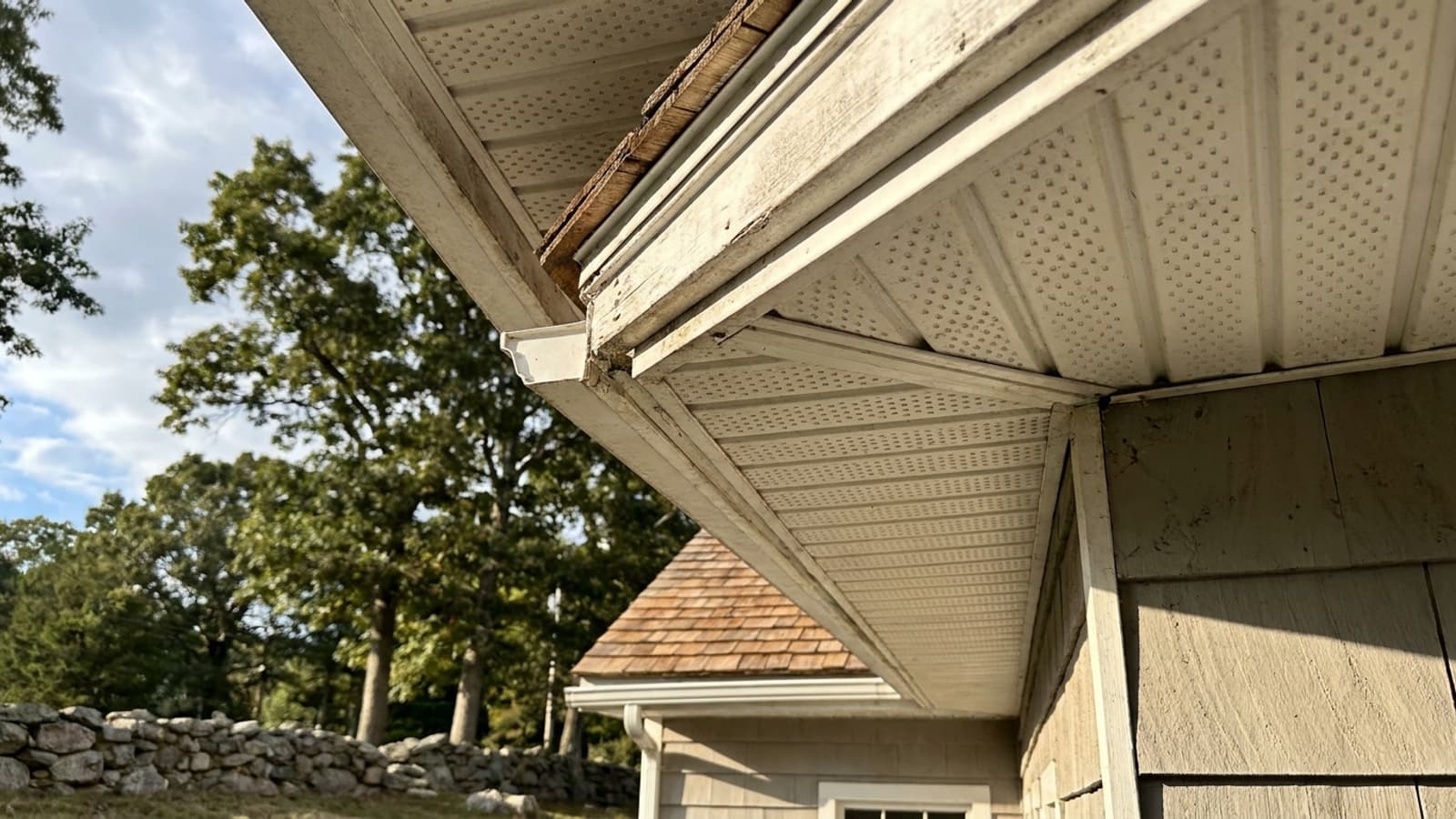
This one is invisible from the ground. Vented vinyl panels get installed under an original closed wood soffit during a siding job, and no openings are cut through the wood behind them. From the driveway the house appears to have continuous intake. In the attic there is none at all. If your soffit was covered rather than replaced, assume nothing until someone looks.
Wind washing
Even where the bay is open, air blowing across the face of exposed fiberglass strips heat out of it. A baffle solves both problems at once, which is why a proper fix always includes one rather than just raking the insulation back.
Confirming it before you pay anyone
Two checks cost nothing.
- From inside the attic on a sunny day, with a flashlight off, look along the bottom of several rafter bays on each side of the house. You want a visible line of daylight and, on a breezy day, moving air.
- Look at the underside of the roof sheathing. Dark gray or black staining, rusted nail points coming through, or frost in January all mean moist air is sitting against cold wood.
If the attic is sealed foam at the roofline by design, stop. That is an unvented assembly and adding intake would be the wrong move. Those are uncommon on older Connecticut housing stock but they exist, mostly on newer construction and conversions.
What drives the cost
Materials are the small part. A rigid baffle is an inexpensive item and a house might need forty to eighty of them. The price is access, and it varies more than most homeowners expect.
| Situation | What the work involves | Where the cost sits |
|---|---|---|
| SituationLoose fill drifted over the eaves, attic with headroom | What the work involvesRake insulation back, staple a baffle in each bay, reset depth, dam at the top plate | Where the cost sitsLabor per rafter bay, the least expensive case |
| SituationVinyl soffit installed over an uncut wood soffit | What the work involvesCut intake openings from outside, then baffle from inside | Where the cost sitsLadder or staging time outside, plus the interior work |
| SituationBatts packed into a low eave, little perimeter headroom | What the work involvesHand work on a crawl at the tightest part of the attic | Where the cost sitsAccess and time, not materials |
| SituationSolid soffit with no venting of any kind | What the work involvesNew vented panels or continuous strip vents installed, then baffles | Where the cost sitsExterior carpentry plus interior work |
| SituationVermiculite or unidentified pre-1980 loose fill | What the work involvesStop and test before anyone disturbs it | Where the cost sitsTesting, and licensed abatement if it comes back positive |
| SituationCathedral or vaulted ceiling with no attic | What the work involvesVenting has to be rebuilt into the roof assembly from above | Where the cost sitsThe most expensive case, and realistic only during a tear-off |
The honest headline is that the first row is a modest half-day item on most houses and the last row is a roofing project. Everything between is priced by how many of those conditions you have.
Why the roof replacement is the cheap moment
If the soffit needs to be opened from outside, someone has to be up there safely with staging or ladders, and panels have to come off and go back on. During a tear-off, that access already exists and the fascia and drip edge are already being handled. Rolling intake work into a roof replacement is close to the lowest incremental cost you will ever see for it. For reference, a typical Connecticut home runs roughly $10,000 to $30,000 for architectural shingles, with the spread driven by size, pitch and complexity rather than by venting details. Those are general ranges that depend on the specific house, not a quote.
The case for not spending the money yet
There is one. If your roof is within a couple of years of replacement anyway, paying separately for exterior soffit work now means paying for the same access twice. Document the condition, note it for the roofing scope, and bundle it.
There is a second case. If the attic has no ice damming, no staining on the sheathing, no moisture problem and the roof is mid-life, the intake may be adequate even if it is not generous. Ventilation is sized against attic floor area and split between intake and exhaust, with the lower half carrying its share. A roof that is performing does not need to be rebuilt to hit a ratio on paper.
What does not deserve patience is the combination of blocked eaves, a running ridge vent and recurring ice at the gutter line. That setup is actively pulling humid indoor air into a cold attic all winter.
The Connecticut angle
Ground snow load in most towns we serve is 30 psf, and Avon, Farmington and Simsbury carry 35 psf under Appendix AY of the 2022 Connecticut State Building Code. More snow sitting longer on the roof means more melt cycles above a warm attic and more opportunity for the eave to freeze. Shoreline towns have a different complication: salt air corrodes fasteners and metal soffit components faster, so when panels come off for intake work they sometimes do not go back on in usable condition.
Older housing stock matters too. Post-war Capes and Ranches in Manchester, 1920s Colonials in West Hartford and antique homes in Farmington Village often have short eaves, low attic perimeters and insulation added in two or three separate campaigns. Those are the houses where the eaves are most likely to be packed solid.
What to ask for in writing
A real scope for this work names the parts. Look for the number of rafter bays getting baffles, whether insulation is being raked back or removed and reinstalled, whether the top plate is being air sealed, and whether any soffit openings are being cut and what size. If exhaust venting is also being changed, you can read our comparison of ridge vents and box vents before you decide.
If you want someone to look before you commit to anything, we do roof and attic inspections across the towns we serve. When you are ready for a number, request an estimate: someone comes out, goes into the attic, measures, and gives you a written itemized price.