Short answer
Switching from asphalt felt to a synthetic underlayment mainly changes how the roof behaves during installation and in the years afterward as a backup layer. Synthetic resists tearing at fasteners, does not absorb water or wrinkle, and stays intact far longer if the deck sits exposed. It does not extend the life of the shingles above it, and it is not the layer that stops ice dam water.
On this page
Synthetic underlayment changes two things that matter: how the roof holds up between tear-off and the last shingle, and how much backup you have years later if wind-driven rain gets past the covering. It does not make the shingles last longer, it does not stop ice dams, and it is not required by Connecticut code. Anyone selling it as a code item is telling you something that is not true.
This post covers what each product is, what the code actually says, and where the upgrade earns its cost on a Connecticut house.
What underlayment is actually for
Underlayment has three jobs, and only one of them happens on the day you look at the finished roof.
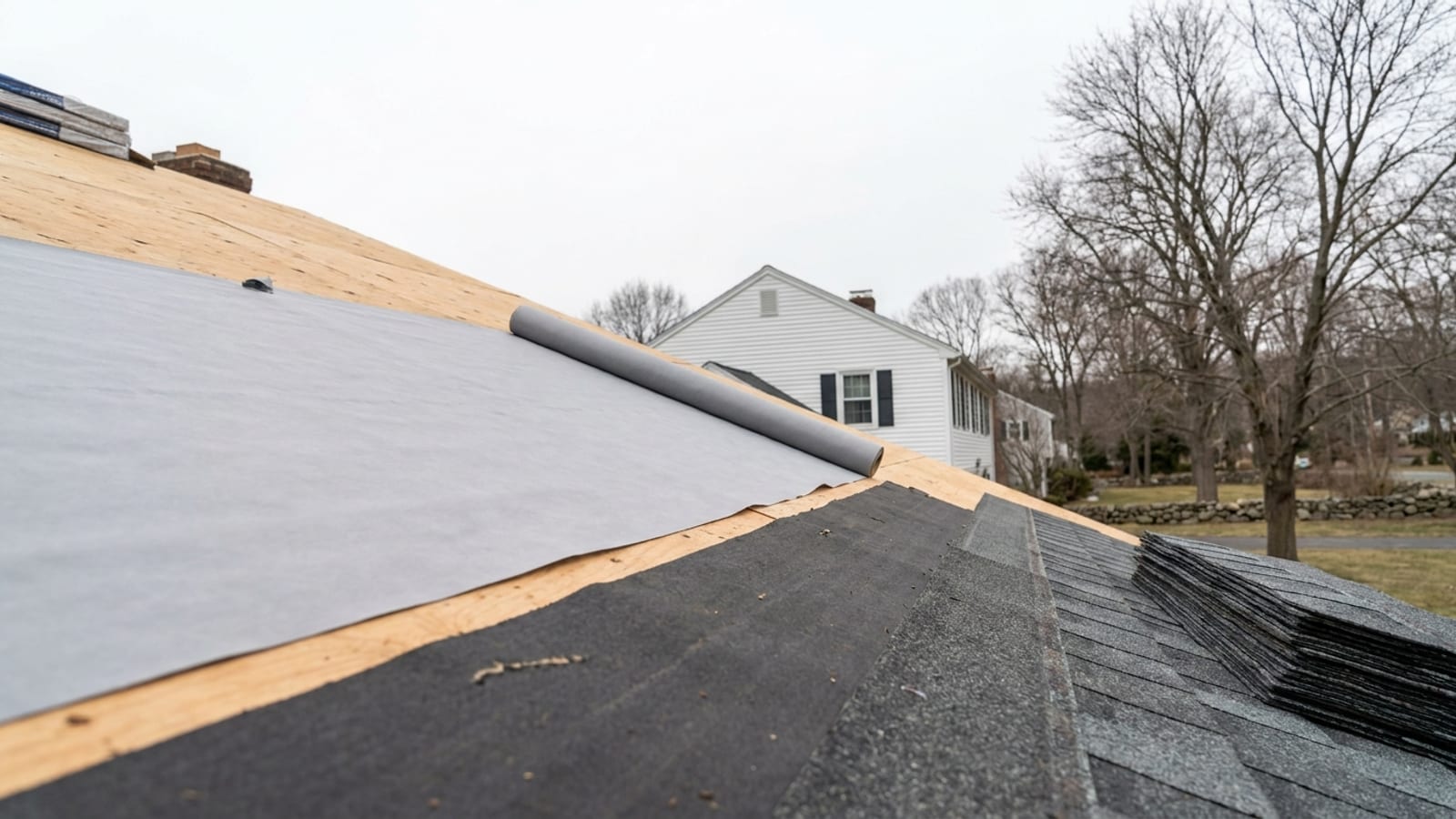
- Dry-in. From the moment the old roof comes off until the new shingles are down, the underlayment is the roof. On a one-day tear-off that window is short. On a cut-up roof with dormers, valleys and three slopes, it can run several days.
- Secondary water barrier. Asphalt shingles are a water-shedding system, not a waterproof membrane. Wind-driven rain pushed up a slope, or melt that finds a lifted tab, lands on the underlayment. That layer is what sends it back out.
- Separation. It keeps the shingle back surface off the resins and knots in the sheathing and gives the assembly a consistent substrate.
What it is not for: ice dams. That is the job of a self-adhering ice barrier membrane at the eaves, which seals around the nails driven through it. We covered how far up the slope that has to run in the post on ice and water shield coverage. Synthetic underlayment is mechanically fastened and does not seal around fasteners, so it is not a substitute.
The two products
Asphalt felt
Felt is a fiberglass or organic mat saturated with asphalt, sold as No. 15 and No. 30 under ASTM D226. A roll of 15-pound covers about four squares; 30-pound covers about two. It has been the default under asphalt shingles for generations and it works.
Its weaknesses are all about time and water. Felt absorbs moisture, and when it gets wet it wrinkles, which telegraphs through the shingles above it as visible ripples. It tears readily at the fastener heads, so a stiff wind on an exposed deck can strip courses off. It gets slick when damp or dusty, which is a crew safety issue on a steep pitch.
Synthetic
Synthetics are woven polypropylene or polyethylene with a coating, sold in large rolls that often cover eight to ten squares. They weigh a fraction of felt per square, carry much higher tear strength, absorb essentially no water, and hold their dimensions when wet. Better grades have a textured walking surface and printed nail and overlap lines, which improves the odds the laps are right.
Two things about synthetics that get glossed over. First, most manufacturers require plastic or metal cap fasteners rather than staples, and installing with staples can void the product warranty. Second, "synthetic" is not one product. A thin, slick, low-grade sheet is a worse roof than good 30-pound felt. The name on the roll matters more than the category.
| Asphalt felt | Synthetic | |
|---|---|---|
| Water absorption | Asphalt feltAbsorbs; wrinkles when wet | SyntheticEssentially none |
| Tear resistance at fasteners | Asphalt feltLow | SyntheticHigh |
| Roll coverage | Asphalt feltAbout 2 to 4 squares | SyntheticCommonly 8 to 10 squares |
| Rated UV exposure | Asphalt feltNot rated for extended exposure | SyntheticPublished limit per product, often months |
| Walking surface | Asphalt feltSlick when damp or dusty | SyntheticTextured on better grades |
| Required fastener | Asphalt feltRoofing nails or caps | SyntheticCap nails per most manufacturers |
| Relative material cost | Asphalt feltLower | SyntheticHigher |
What Connecticut code actually requires
Underlayment is required under asphalt shingles. On slopes of 4:12 and steeper a single layer is the baseline; on low slopes between 2:12 and 4:12 a doubled application is required. Both felt and approved synthetics satisfy the requirement. Synthetics are accepted on the strength of an evaluation report rather than the legacy ASTM number felt carries, and that report is what a building official looks at if anyone asks.
The high-wind rule does not apply the way it gets quoted
Here is the detail that gets misstated constantly. The residential code contains a high-wind provision for roof coverings that kicks in where the nominal design wind speed, Vasd, exceeds 110 mph. Appendix AY of the 2022 Connecticut State Building Code publishes an ultimate design wind speed, Vult, of 120 mph for most towns we serve and 125 mph for Guilford, Madison and New Haven. Those are different numbers. Converted to Vasd, our towns land around 93 to 97 mph, well under the 110 mph trigger.
So no, the code does not force a high-wind underlayment package in Guilford or Greenwich. Every town we serve does sit inside a designated hurricane-prone region, which matters for other parts of the assembly, and a shingle's wind rating is still only valid if it is fastened the way the manufacturer requires to earn it, which for high-wind coverage usually means six nails per shingle in a defined nail zone. That is a shingle question, not an underlayment question.
Where synthetic genuinely earns it
- Multi-day jobs. A complex roof with dormers, valleys and multiple slopes stays open longer. Felt exposed to a squall on day two is a real problem; synthetic shrugs it off.
- Steep pitch. The walking surface is a safety difference for the crew, and crews that feel secure do better work.
- Shoreline wind exposure during the install. On an open coastal lot, a half-covered deck in a gusty afternoon is exactly where felt strips off at the fasteners.
- Cold-weather installs. In the Farmington Valley towns carrying a 35 psf ground snow load, a deck that has to sit overnight in December benefits from a layer that will not soak and wrinkle.
- Deck aesthetics. Wrinkled felt shows through shingles on a low-pitch, high-visibility slope. Synthetic lies flat.
The honest case for felt
On a simple gable ranch that is torn off and shingled in a single day, 30-pound felt is not a defect. It is a proven material, it costs less, and it has kept water out of Connecticut houses for a very long time. If your budget is tight and the choice is between a synthetic upgrade and full deck replacement where the sheathing is soft, spend the money on the deck.
The upgrade is also small relative to the whole job. A typical Connecticut architectural shingle replacement generally runs $10,000 to $30,000 depending on size, pitch and complexity, and the underlayment line is a modest share of that. It is worth asking for, not worth agonizing over.
One caveat that can tip the decision: enhanced manufacturer warranty programs generally require that the accessories come from the same manufacturer as the shingles, underlayment included. If you are buying into that coverage, the product choice is partly made for you. The roofing materials page lists the brands we install.
What the quote should say
A quote that just says "underlayment" is not telling you anything. It should name the product and the weight or grade, state the number of layers and where, list the fastener type, and show the ice barrier as its own separate line with the coverage described. Our guide to reading a roofing quote walks through the rest of the line items that should be spelled out, including nail count and deck replacement pricing.
If two quotes on the same house differ by a few thousand dollars, the underlayment line is one of the first places to look for the reason.
Getting a number for your roof
The right underlayment depends on the pitch, the complexity, the season and how long your deck will realistically be open. If you want that assessed on your house, request an estimate. Someone comes out, measures the roof, looks at the existing conditions and gives you a written, itemized price with the underlayment named on it.