Short answer
Drip edge is required. The 2021 International Residential Code, adopted as part of the 2022 Connecticut State Building Code, requires a drip edge at both eaves and rake edges on an asphalt shingle roof, with a stated overlap, extension and fastening spacing. A quote that lists drip edge as an optional upgrade is charging you extra for something the inspector will look for anyway.
On this page
Drip edge is required, not optional. The 2022 Connecticut State Building Code adopts the 2021 International Residential Code for one- and two-family homes, and the asphalt shingle section of that code calls for a drip edge at eaves and at rake edges. It is a code-required component of the roof assembly in the same way flashing and fasteners are. If a roofing quote presents it as an upgrade line with its own price, the question to ask is what the base price assumed.
That said, not every piece of edge metal is the same, and there are real choices inside the requirement that are worth money and worth understanding. This post covers what the code actually says, what the metal does on a Connecticut house, where the upgrades earn their cost, and where they do not.
What the code specifies
The drip edge language is short and checkable. These are the requirements an inspector is working from on a shingle roof.
| Requirement | What the code specifies |
|---|---|
| RequirementWhere it goes | What the code specifiesEaves and rake edges |
| RequirementOverlap between adjacent pieces | What the code specifiesAt least 2 inches |
| RequirementExtension below the roof sheathing | What the code specifiesAt least 0.25 inch |
| RequirementFlange back onto the roof deck | What the code specifiesAt least 2 inches |
| RequirementFastener spacing | What the code specifiesNot more than 12 inches on center |
| RequirementUnderlayment at the eave | What the code specifiesInstalled over the drip edge |
| RequirementUnderlayment at the rake | What the code specifiesInstalled under the drip edge |
The over-and-under sequence is the part that goes wrong
The last two rows are where field work most often departs from the code. At the eave, the metal goes down first and the underlayment or ice barrier laps over the top of it, so any water moving down the underlayment is carried out onto the metal. At the rake, the underlayment goes down first and the metal laps over it, so water driven sideways at the gable edge cannot get behind the metal and onto the deck.
Installed backwards at the eave, the drip edge is still physically present, a photograph of the finished roof looks identical, and water running under the shingles drains behind the fascia instead of into the gutter. This is the single detail most worth asking about, because it is invisible the day after the job is done.
What the metal is actually doing
A shingle overhangs the deck edge by somewhere around three quarters of an inch to an inch and a quarter. Water leaving that edge does not always drop cleanly. Surface tension pulls a portion of it back along the underside of the shingle toward the fascia. Drip edge gives that water a stiff metal edge with a kicked-out lip to break away from, which is why the code requires a quarter inch of extension below the sheathing.
Two things follow from that on a Connecticut house.
The deck edge stays dry
The outer few inches of roof sheathing and the top of the fascia board are the parts of the roof that spend the most time wet. Repeated wetting plus freeze-thaw cycling is what turns a sound plywood edge soft and what rots a fascia from behind while the paint still looks acceptable from the ground. Soft deck at the eave is one of the common surprises found at tear-off, and it is priced per sheet on a good estimate rather than discovered as a change order.
The gutter actually catches the water
If the metal does not reach into the gutter trough, runoff can track behind the gutter and down the fascia. That is the stain homeowners describe as the gutter overflowing when the gutter is fine. If you are replacing gutters along with the roof, the edge metal and the gutter hangers are being set at the same time and the geometry is easy to get right. If the gutters are staying, say so before the job starts, because the metal has to be tucked behind an existing gutter rather than over an open edge.
What drip edge does not do
It does not stop ice dams. Edge metal manages water that is moving. An ice dam stops the water, and standing meltwater backs up under the shingles until it finds a joint. The defenses against that are self-adhered ice barrier membrane at the eaves plus an attic that is air sealed, insulated and ventilated well enough that the snow on the roof is not melting from below. We cover the membrane side of this in the post on ice and water shield coverage. Drip edge is a supporting part of the eave assembly, not the headline.
Drip edge versus gutter apron
The two names get used interchangeably on quotes, and they are not the same profile.
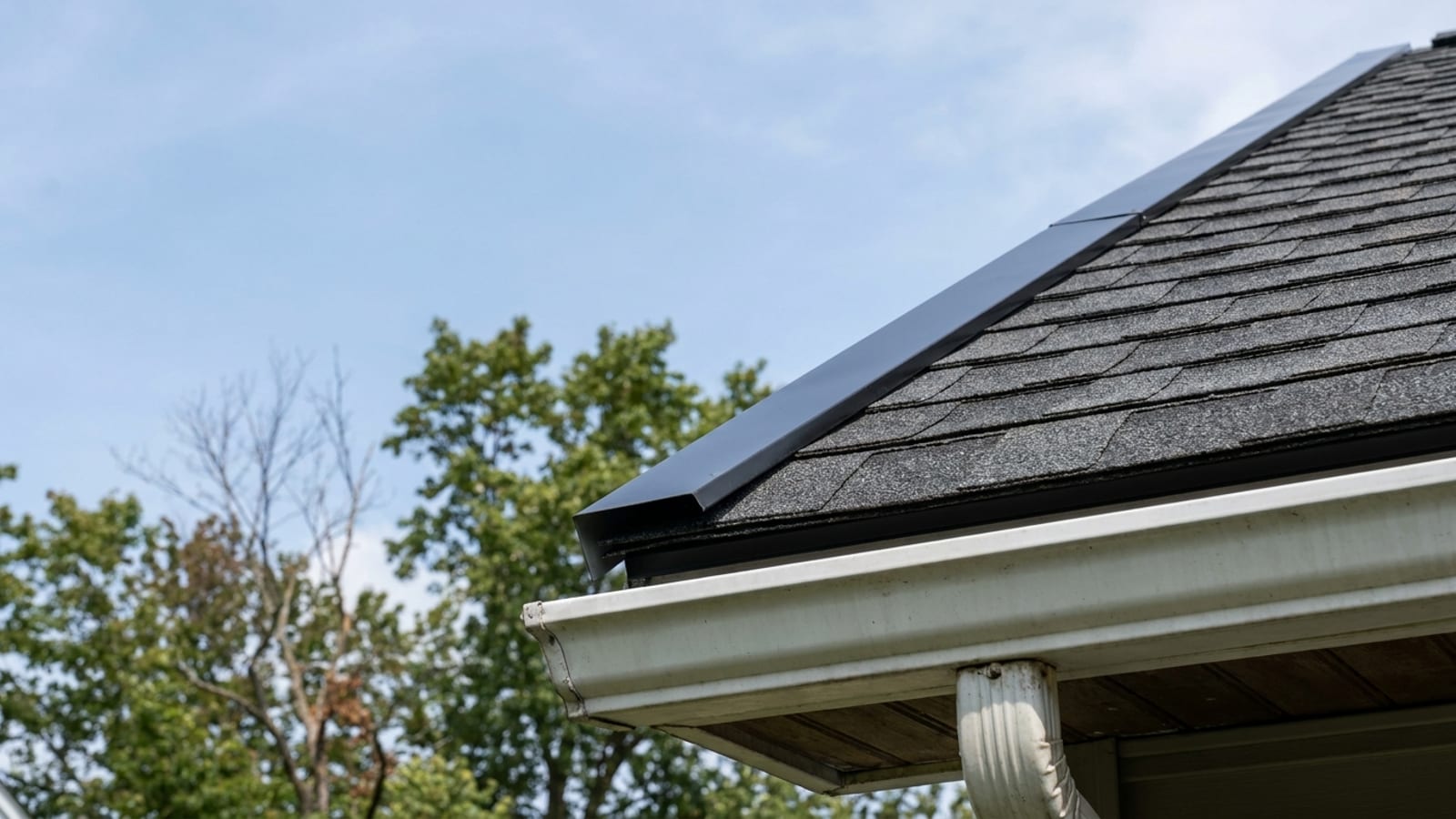
- Standard drip edge has a short vertical face and a small kick-out lip. It is the usual choice at rakes and at eaves with a normal pitch.
- Gutter apron has a longer bent leg that extends farther down and out, reaching into the gutter trough. It is the better choice on shallow-pitch eaves, where water hugs the underside more, and on houses where the fascia has already shown staining.
The honest case against the wider profile: on a conventional pitch with properly hung gutters, standard drip edge does the job the code asks of it and the upgrade is a small improvement. It is worth specifying where the eave is low-slope or where you have evidence of water tracking behind the gutter, not everywhere by default.
Material choices, and the shoreline question
Most residential edge metal here is aluminum. It does not rust, it comes in colors that can be matched to trim, and it is easy to cut and lap on site. Galvanized steel is stiffer and holds a line well over a long run, but cut ends and scratches are where corrosion starts. Copper belongs with copper, slate and some cedar work, and the cost only makes sense when the rest of the detailing justifies it.
Salt air is a real variable on the central shoreline. It attacks fasteners before it attacks the metal itself, which is why corrosion-resistant fasteners matter on roofs in Guilford and Madison. Those two towns, along with New Haven, carry a 125 mph ultimate design wind speed under Appendix AY of the state code, higher than the 120 mph assigned to Greenwich, Stamford, Westport and Fairfield. Edge metal fastened at 12 inches on center is part of what keeps the perimeter of the roof intact, and the perimeter is where uplift pressure is highest.
One correction worth making, because it gets repeated: a 125 mph Vult figure does not by itself trigger the code's high-wind underlayment attachment provisions. That trigger is keyed to Vasd, the nominal design wind speed, which works out to roughly 93 to 97 mph in these towns. The drip edge requirement is the same in every town we serve regardless.
How to check it on a quote
A complete roof replacement proposal should name the edge metal, not assume it. Look for four things.
- Eaves and rakes both listed. Rake drip edge is the piece most often skipped on a cheap number.
- The profile and material. Aluminum or steel, standard drip edge or gutter apron, and the color if it will be visible.
- The sequence. A line saying ice barrier or underlayment laps over the eave metal tells you the crew knows the detail.
- New metal, not reused. Old drip edge that comes off with the tear-off should not go back on.
If a quote has no edge metal on it at all, that is a gap, and our guide to reading a roofing quote covers the other line items that tend to go missing alongside it. On a full asphalt roof priced in the general Connecticut range of roughly $8,000 to $25,000 for three-tab and $10,000 to $30,000 for architectural shingles, the edge metal is a small share of the total. It should be included in the base price, and a company that treats it as an extra is telling you how it builds numbers generally.
Where it is genuinely optional
Two honest exceptions. On a localized repair, pulling and replacing sound existing drip edge over the whole eave is usually not worth the cost or the risk of damaging adjacent shingles. And on an older roof with no drip edge that still has years of service left, retrofitting eave metal correctly means disturbing the first courses of shingles, which is often more disruptive than the benefit justifies. In both cases the right time to correct it is at the next full tear-off.
If you want a written price that spells out the edge metal along with everything else, request an estimate. Someone comes out, measures the roof, looks at the condition of the fascia and gutters, and gives you an itemized written price you can compare against anyone else's.