Short answer
Appendix AY of the 2022 Connecticut State Building Code assigns Avon, Farmington and Simsbury a ground snow load of 35 psf, while every other town we serve carries 30 psf. That difference is structural, so it governs framing, additions and dormers far more than it governs shingle selection. On a straight like-for-like re-roof it rarely changes the material, but it does change what should be looked at before the new roof goes down.
On this page
Three of the fifteen towns we serve carry a higher ground snow load than the rest. Avon, Farmington and Simsbury are assigned 35 psf in Appendix AY of the 2022 Connecticut State Building Code. Every other town on our list — Glastonbury, West Hartford, Hartford, Manchester, Middletown, New Haven, Guilford, Madison, Greenwich, Stamford, Fairfield and Westport — carries 30 psf.
That is roughly a 17 percent difference, and it is worth understanding exactly what it does and does not change before anyone uses it to sell you something.
The figure, town by town
| Town | County | Ground snow load (pg) | Design wind speed (Vult) |
|---|---|---|---|
| TownAvon | CountyHartford | Ground snow load (pg)35 psf | Design wind speed (Vult)120 mph |
| TownFarmington | CountyHartford | Ground snow load (pg)35 psf | Design wind speed (Vult)120 mph |
| TownSimsbury | CountyHartford | Ground snow load (pg)35 psf | Design wind speed (Vult)120 mph |
| TownGlastonbury | CountyHartford | Ground snow load (pg)30 psf | Design wind speed (Vult)120 mph |
| TownWest Hartford | CountyHartford | Ground snow load (pg)30 psf | Design wind speed (Vult)120 mph |
| TownManchester | CountyHartford | Ground snow load (pg)30 psf | Design wind speed (Vult)120 mph |
| TownMiddletown | CountyMiddlesex | Ground snow load (pg)30 psf | Design wind speed (Vult)120 mph |
| TownGuilford | CountyNew Haven | Ground snow load (pg)30 psf | Design wind speed (Vult)125 mph |
| TownMadison | CountyNew Haven | Ground snow load (pg)30 psf | Design wind speed (Vult)125 mph |
The source is the same appendix that assigns each municipality its design wind speed. Both numbers come from the state, not from a contractor's judgment, and both are public.
What a ground snow load actually is
The pg value is a statistical ground figure — what the code expects snow lying on open ground in that town to weigh per square foot, based on long-term climate records. It is not what sits on your roof. The code converts ground load to roof load through a set of factors covering exposure to wind, whether the roof is heated from below, the importance of the building, and slope.
Slope sheds load
A steep roof holds less snow than a shallow one. That is why a 12-pitch gable in Simsbury and a low-slope porch roof in the same town are designed around very different numbers from the same 35 psf starting point. It is also why low-slope and flat sections are the places where snow weight most often becomes a real problem, not the main gable.
Warm roofs melt and reload
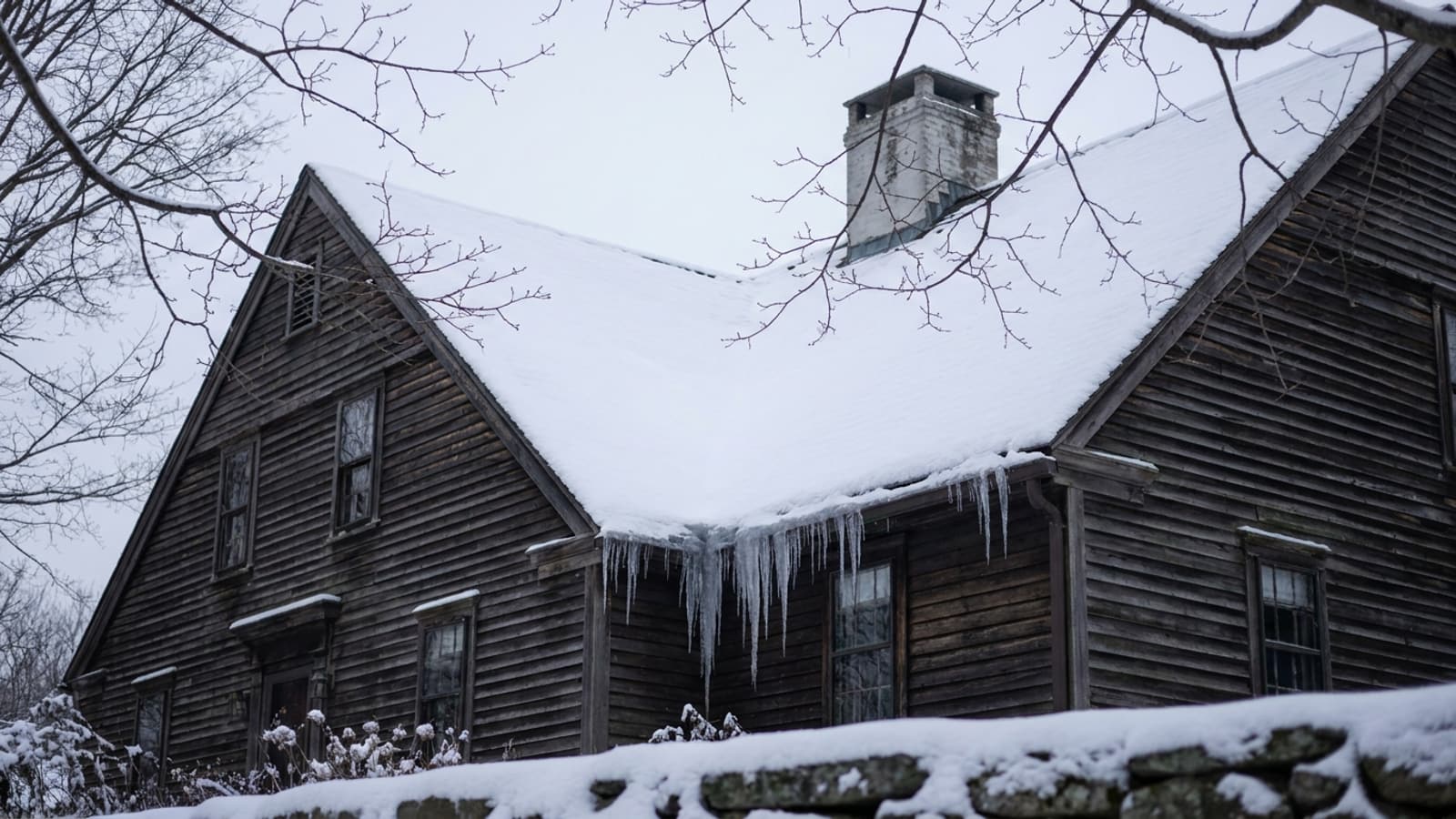
A roof with heat leaking into the attic melts the bottom of the snowpack. That water refreezes at the cold eave, and ice is dramatically heavier per inch than fresh snow. A poorly insulated roof in a 35 psf town is carrying a worse load than the code figure suggests, and it is doing it concentrated at the eave where the framing has the least to give.
Where the extra 5 psf actually shows up
Additions, dormers and structural changes
This is the honest answer most of the time: the 35 psf figure governs new framing. If you are adding a dormer, building an addition, opening up a cathedral ceiling, or replacing damaged rafters, the design has to satisfy the town's snow load, and Avon, Farmington and Simsbury ask for more than Hartford does. A truss package ordered to a 30 psf design and delivered to an Avon job is the wrong package.
On a straight like-for-like re-roof over sound framing, the extra 5 psf changes nothing about the shingle you choose. That is the case against treating this figure as a reason to spend more money, and it is a real case.
Dead load you add on purpose
What the number does affect is anything you permanently add to the roof. Going from asphalt to a heavier covering, or leaving an old layer in place and roofing over it, adds dead load to a structure already designed around a higher snow figure. In the Farmington Valley towns that argument lands harder than it does on the shoreline, which is one reason we default to a full tear-off on roofing in Avon and Simsbury rather than a roof-over.
Drift, sliding and unbalanced loads
Snow does not land evenly. It drifts against walls, piles up where an upper roof meets a lower one, and slides off steep metal or synthetic slate onto porch roofs and entry canopies below. Those local concentrations are where snow actually causes damage in Connecticut — sagging porch roofs, crushed gutters, bent entry overhangs — far more often than a whole-house structural failure. If your house has a lower roof under a tall gable, that junction deserves a look every few years.
Terrain is not the same as the code figure
Avon sits against the Talcott ridge; Simsbury and Farmington sit in the Farmington River valley with hilly, wooded terrain. Elevation and exposure are part of why these towns were assigned the higher figure in the first place. But the code value is a town-wide number. A sheltered lot surrounded by mature trees and a bare ridge-top lot in the same town get the same pg and different real-world exposure, which is handled by the exposure factor in the design, not by a different town figure.
It also means a contractor quoting to a state average instead of the town value is either over-specifying the framing or under-specifying it. Neither helps you.
What this means when you re-roof
On a re-roof in a 35 psf town, the snow figure should influence four practical things.
- Deck condition. The sheathing is part of the load path. Soft, delaminated or previously wet decking should be replaced, and a quote should state a per-sheet price in advance so the mid-job number is not a surprise.
- Ice and water shield at the eaves. This does not reduce load, but it is what keeps the backed-up water from a melt-refreeze cycle out of the house.
- Ventilation and attic insulation. A cold roof builds less ice. This is the single highest-value thing you can do in a snow-heavy town, and it is often cheaper than the upgrades people consider instead.
- Snow retention on slick coverings. If you are moving to metal or synthetic slate above a porch, walkway or door, plan for it at the time of the estimate rather than after the first slide.
We cover the fastening and material side of the code on our roofing page, including how a shingle's wind rating depends on being nailed the way the manufacturer requires to earn it.
Wind is the other number, and it is separate
Avon, Farmington and Simsbury are all 120 mph Vult, the same as Hartford and the Fairfield County shoreline. The higher wind towns in our service area are Guilford, Madison and New Haven at 125 mph. People sometimes assume the inland hill towns get hit harder on both figures. They do not. Snow and wind are assigned independently, and the high-wind underlayment trigger in the code is keyed to Vasd — in the low-to-mid 90s mph here — not to Vult, so it does not apply in these towns.
Cost context
None of this moves a typical Connecticut re-roof outside the usual ranges. Architectural asphalt generally runs $10,000 to $30,000 on a typical home and three-tab $8,000 to $25,000, with the spread driven by size, pitch, complexity and deck condition. Framing work discovered during a project — a cracked rafter, a sagging porch roof, a dormer that was never built to carry what it carries — is separate and priced on what is found.
If you own a home in one of the three 35 psf towns and want the figure applied honestly rather than used as a sales line, request an estimate. Someone comes out, measures the roof, looks at the deck and attic, and gives you a written price in itemized form.