Short answer
Almost always the flashing, not the shingles. Where a roof slope runs into a sidewall, water has to be handled by individual L-shaped pieces of step flashing woven into every shingle course and lapped over the wall's water barrier. When that detail is caulked instead of flashed, reused on a reroof, or missing its kickout at the bottom, water runs behind the siding and surfaces as a stain several feet away from where it entered.
On this page
If a ceiling or wall stains after wind-driven rain but the roof looks fine from the ground, the first place to look is where a roof slope runs into a wall. That junction is not waterproofed by shingles. It is waterproofed by step flashing, and step flashing is one of the easiest details on a house to get wrong.
This is the detail behind a large share of "mystery" leaks on Connecticut homes with a lower roof tying into a two-story wall, a porch roof against the main house, a dormer cheek, or a garage roof meeting the gable end. The shingles are often only a few years old. The flashing underneath them is the problem.
What step flashing is and how it works
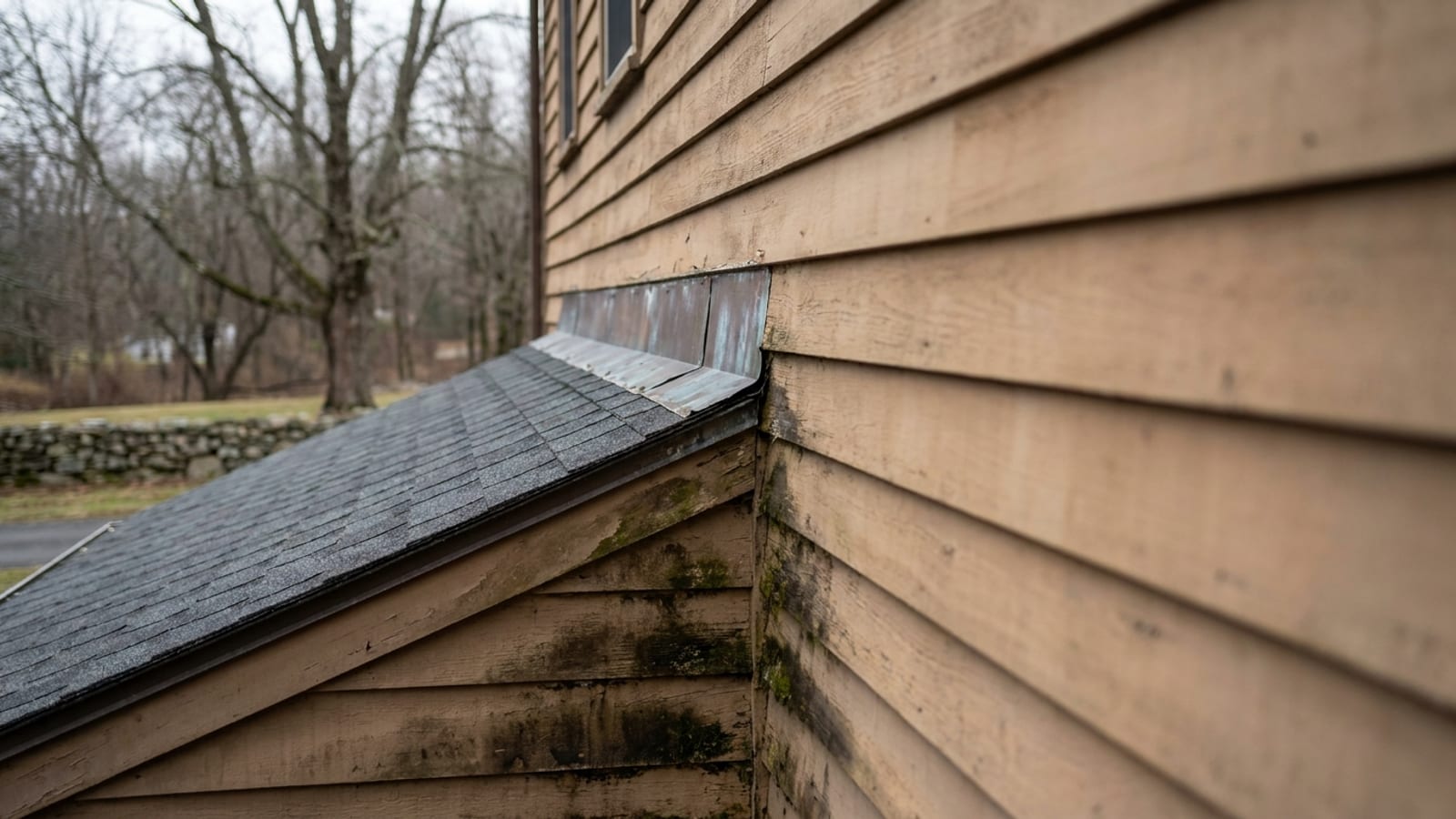
Step flashing is a series of individual L-shaped metal pieces, typically around 4 inches by 4 inches by 8 inches long for asphalt shingle work. One leg lies on the roof deck, the other leg stands up against the wall. One piece goes in with every single shingle course, so the pieces overlap each other like shingles do, stepping up the slope. Water that runs down the wall lands on a piece of metal, gets carried out onto the shingle below it, and keeps moving downhill.
Two things make that system work:
- Each piece is lapped by the one above it. No seam faces uphill.
- The vertical leg sits behind the wall's water-resistive barrier, not on top of the siding. The house wrap or felt on the wall laps over the metal, so anything running down inside the wall cavity drains onto the flashing and out.
That second point is where most failures start. If the siding and its weather barrier were installed first and the flashing was slipped on afterward, every joint is now facing the wrong way. We cover the layering logic for walls in more depth in our piece on house wrap and flashing behind siding, and it is the same principle here: water goes out, never in, at every lap.
Why a single continuous piece is the wrong answer
A long bent piece of aluminum run up the whole wall-to-roof line looks cleaner and installs faster. It also traps water. Shingles are not flat and the continuous leg forces water to travel sideways along a seam instead of stepping out onto each course. Debris packs in behind it, and the single run of nails holding it is nearly always driven through the face where water flows. Continuous flashing belongs where a roof meets a wall across the slope, at a headwall, not where it runs up the slope.
The kickout at the bottom is not optional
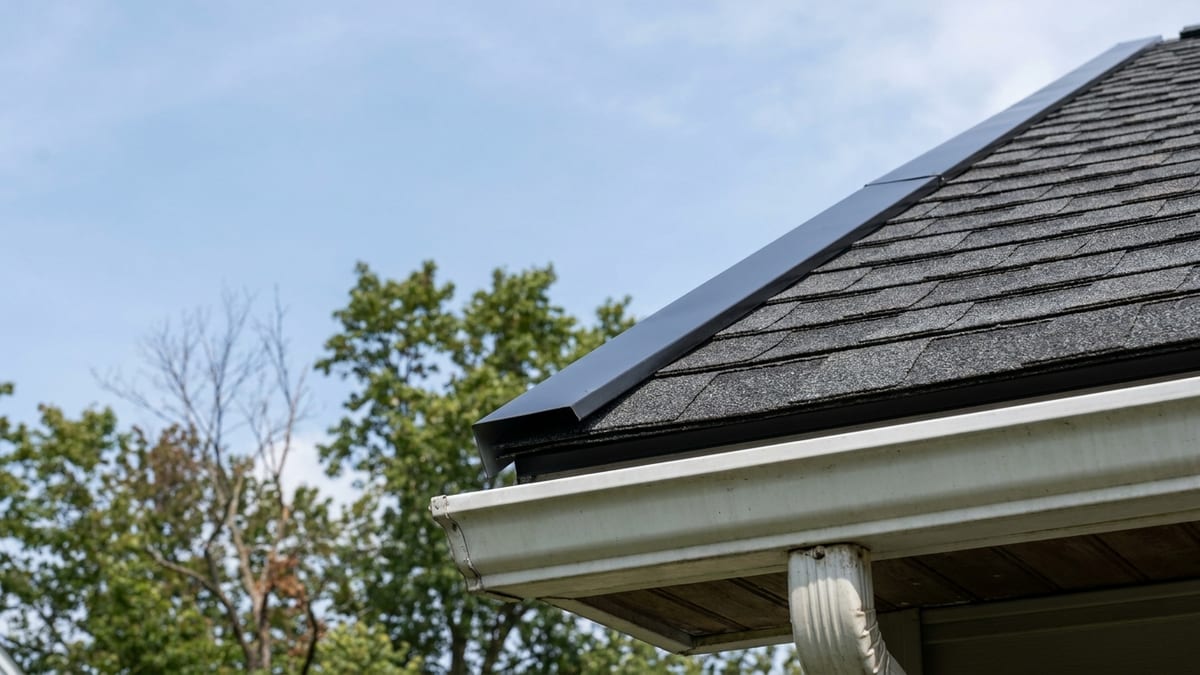
The lowest piece in the run has to be a kickout, bent out at an angle so the accumulated water from the whole slope is thrown clear of the wall and into the gutter. Leave it off and you have aimed a small downspout at the inside of the siding at one specific spot. That is why the rot found at that corner is often shocking relative to how small the ceiling stain was.
How to tell this is your leak
| What you see | What it usually means |
|---|---|
| What you seeStain appears only during driving rain, not steady rain | What it usually meansWind pushing water up behind siding or flashing laps |
| What you seeDamp or discolored siding directly above a roof-to-wall line | What it usually meansMissing kickout or reversed lapping at the bottom |
| What you seeInterior stain several feet from the wall junction | What it usually meansWater tracking along sheathing or a rafter before dripping |
| What you seeSoft trim or paint failure at the base of the wall corner | What it usually meansSustained wetting inside the wall, not a surface issue |
| What you seeCaulk bead smeared along the shingle-to-wall line | What it usually meansA previous repair that treated the symptom |
A stain that only shows up in winter is a different animal. That pattern usually points to ice damming or attic condensation rather than flashing, and we handled it separately in why Connecticut roofs leak in winter and not in storms. A leak around a masonry chimney is also its own detail with its own fix, covered in our post on chimney flashing repair versus a new roof.
Why it gets installed wrong
Sequence
Roofing and siding are often done years apart by different crews. The correct sequence is flashing first, then siding over it with a gap. When a siding crew works around an existing roof, the temptation is to run the siding tight to the shingles and seal the joint. That gap should be roughly an inch or more so the siding can drain and dry, and so the flashing can do its job.
Reuse on a reroof
Old step flashing came out of a roof whose shingle courses landed in particular places. The new courses almost never land identically, which leaves old nail holes exposed in the water path and bends that no longer align. Flashing is cheap. The labor to take the siding off twice is not.
Caulk standing in for metal
Sealant has a role at the top of a counterflashing or at a termination. It has no role as the primary water barrier on a roof-to-wall junction. Caulk at that line is a tell: it means somebody already knew there was a leak and chose the fast option.
What the repair actually involves
A correct sidewall repair is not a tube of sealant and an hour on a ladder. Expect:
- Removing the lower courses of siding along the junction, plus trim as needed.
- Stripping shingles back a few courses from the wall.
- Inspecting the sheathing and wall framing at the base, where rot concentrates.
- Setting new step flashing with the ice and water membrane turned up the wall behind it.
- Installing a new kickout at the bottom, integrated with the gutter.
- Relaying shingles and reinstalling siding with proper clearance.
Because two trades are involved, this is a job where the quote should name both. Our roof repair work treats the wall junction as a system rather than a shingle problem, and the scope should say which siding comes off and what happens if the sheathing underneath is soft.
Repair or do it with the roof
If the roof is under about 15 years old and otherwise sound, repairing the junction on its own is the economical call. If the roof is at the end of its life, doing the flashing twice makes no sense. Architectural shingle replacement on a typical Connecticut home generally runs $10,000 to $30,000 depending on size, pitch and complexity, and new wall flashing should be inside that number, not an extra. Those are general state ranges, not a price for your house.
The Connecticut angle
Every town we serve sits inside a designated hurricane-prone region under Appendix AY of the 2022 Connecticut State Building Code. Guilford, Madison and New Haven carry an ultimate design wind speed of 125 mph, higher than Greenwich, Stamford, Westport and Fairfield at 120 mph, because of exposure to open water along the central shoreline. Wind speed does not change how step flashing is formed, but it changes how often the house sees rain driven horizontally at a wall, and horizontal rain is exactly what finds a reversed lap.
Shoreline salt air matters too. Galvanized steel flashing corrodes faster near the water, which is why aluminum or a coated product is the better choice in Guilford, Madison and the beach neighborhoods of Fairfield. Remember that flashing has to be compatible with what it touches; aluminum against masonry or against copper is a problem, not a preference.
A roof replacement requires a building permit in every town we serve, and the town inspects the work. A standalone flashing repair usually does not, though scope that grows into sheathing replacement can change that. Our roofing services page lists what is covered in each case.
What to ask before you sign
- Does the quote say new step flashing at all walls, or does it say reuse existing?
- Is a kickout flashing listed at every roof-to-wall termination?
- How much siding comes off, and who puts it back?
- What is the per-sheet price if sheathing under the junction is rotted?
- What metal is being used, and is it compatible with the wall surface?
If you have a stain you cannot source, or siding that stays dark above a roof line after it rains, you can request an estimate. Someone comes out, pulls back what needs to be pulled back to see the junction, and gives you a written price for the repair and for the replacement option if the roof is close enough to the end of its life that both are worth comparing.