Short answer
A cricket is a small sloped saddle built on the uphill side of a chimney so water, ice and debris divert around the masonry instead of piling against it. The residential code adopted in Connecticut requires one on any chimney more than 30 inches wide measured parallel to the ridge, unless the chimney intersects the ridge itself. A chase is the framed and clad box that encloses a factory built metal flue, and it needs the same cricket, counterflashing and cap details a masonry chimney does.
On this page
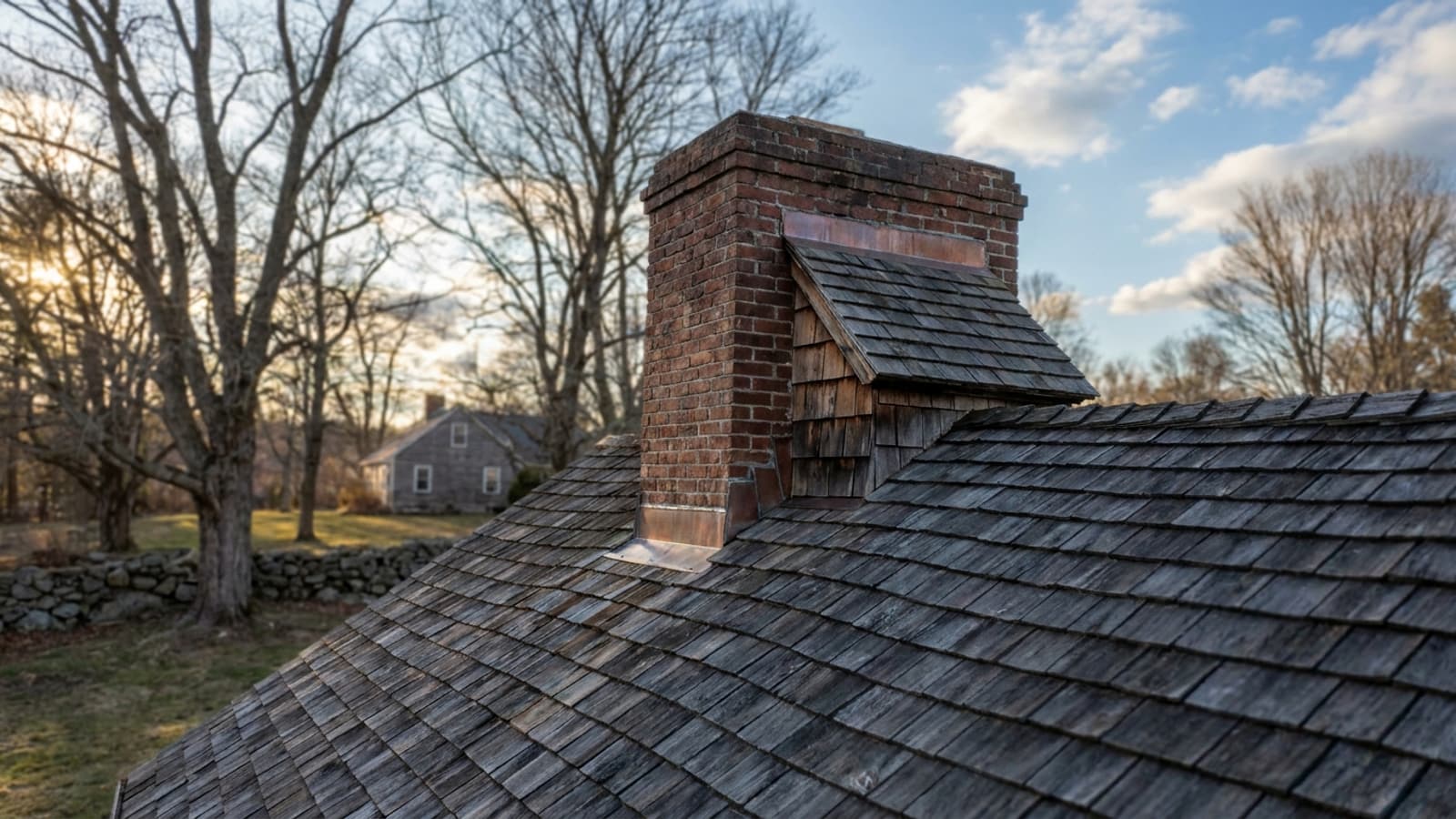
A cricket, also called a saddle, is a small peaked structure built on the uphill side of a chimney. Its only job is to split the water and snow coming down the slope and send it around both sides of the chimney instead of letting it dam up against the masonry. A chase is the framed box that encloses a factory built metal flue instead of brick or stone. Both get the same question from homeowners: does my roofer need to build one, and what should it cost.
When the code requires a cricket
The residential code in force in Connecticut requires a cricket when the chimney dimension measured parallel to the ridgeline is greater than 30 inches and the chimney does not intersect the ridgeline. That is the whole trigger. Two measurements decide it.
- Width across the slope. Not the depth, not the diagonal. Stand below the chimney, look up the roof, and measure the face that water hits.
- Where it sits. A chimney coming through at the ridge has no slope above it, so there is nothing to collect. No cricket required.
A chimney 28 inches wide on a mid slope does not require one by code. A chimney 36 inches wide in the same position does. Plenty of 1960s Colonials in Glastonbury and Manchester have wide masonry chimneys sitting halfway up a rear slope with nothing above them but a single apron of flashing, because the roof predates the requirement or the last crew skipped it.
How big the cricket has to be
The code also sizes it. The height of the cricket at the chimney is a fraction of the chimney width, set by the roof slope. Steeper roofs need taller crickets because the saddle has to match the pitch it is sitting on.
| Roof slope | Cricket height as a fraction of chimney width |
|---|---|
| Roof slope12:12 | Cricket height as a fraction of chimney width1/2 of width |
| Roof slope8:12 | Cricket height as a fraction of chimney width1/3 of width |
| Roof slope6:12 | Cricket height as a fraction of chimney width1/4 of width |
| Roof slope4:12 | Cricket height as a fraction of chimney width1/6 of width |
| Roof slope3:12 | Cricket height as a fraction of chimney width1/8 of width |
On a 6:12 roof with a 40 inch chimney, that is a cricket standing 10 inches tall where it meets the brick. It is a framed structure, not a bend in a piece of metal. Your building official has the final say on the dimension, and the inspection on your roofing permit is where it gets looked at.
Why the absence shows up as a leak years later
A wide chimney with no cricket behind it creates a flat shelf where the roof meets the masonry. Water slows down there. Leaves, pine needles and roof granules collect and hold moisture against the brick. In winter, snow sliding down the slope stops at the chimney and sits, and the melt and refreeze cycle works at the mortar joints and the flashing seam.
None of that leaks on day one. It leaks after several seasons of the same shelf staying wet, when the mortar softens, the flashing seal fails or the sheathing behind the chimney rots quietly under the shingles. By then the interior stain is usually in a closet or a second floor ceiling and nobody connects it to the chimney. We have written separately about telling a chimney flashing leak from a roof that is simply finished, and a missing cricket is a frequent root cause in that diagnosis.
What correct chimney work looks like
A cricket on its own does not waterproof anything. It redirects water toward flashing that has to be built right. The full assembly on a masonry chimney has four parts.
Step flashing on the sides
Individual L shaped pieces woven in with each shingle course up both sides of the chimney. Not a single long piece of bent metal, which is where most side leaks start. The reasoning behind that is covered in our post on step flashing at roof to wall joints.
Apron flashing at the downslope face
One piece across the low side, lapped over the shingles below it so water runs out on top of the roof.
The cricket itself
Framed, sheathed and then either shingled or covered in metal, depending on how steep the saddle is. Low slope crickets should be metal rather than shingles. Ice and water membrane belongs under the cricket and up the chimney face, which connects to the wider question of where ice and water shield should go on a Connecticut roof.
Counterflashing cut into the masonry
The vertical leg of the counterflashing should be set into a mortar joint or a saw cut and sealed there, then lapped down over the step and apron flashing. Counterflashing surface mounted to the face of the brick and held with caulk is a maintenance item from the day it goes on, because the caulk is doing the whole job.
Chimney chases are not simpler
A chase encloses a metal flue in a framed box finished with siding, trim or stucco. Because it is lighter and often newer, it gets treated as less important. It should not be. The same 30 inch rule in the roof plane applies, and the chase adds two failure points masonry does not have.
- The chase cover at the top. A flat galvanized pan collects water and rusts through. A sloped cover in stainless or heavy gauge aluminum with a drip edge and a cross break sheds it.
- The wall to roof transition. Where the chase meets the roof there is sheathing and framing behind the cladding, not brick. Water that gets past the flashing finds wood immediately.
What it costs
We do not publish a standalone price for a cricket, because the honest answer is that it depends on the chimney width, the roof pitch, access, and whether the deck behind the chimney has already gone soft. A 10 inch saddle on an accessible rear slope is a different job from a tall cricket on a steep front elevation with staging.
What matters more is how it appears on your quote. Full roof replacement on a typical Connecticut home generally runs $8,000 to $25,000 for three tab asphalt and $10,000 to $30,000 for architectural shingles, and chimney work is usually inside that number rather than beside it. Ask for it broken out anyway. A line that reads only chimney flashing could mean new step flashing, new counterflashing cut into the brick and a framed cricket, or it could mean caulk. Those are not the same price and they are not the same roof.
The case for doing nothing
If your chimney is under 30 inches wide, is positioned at or near the ridge, and the existing flashing is sound, building a cricket buys you very little. If the chimney is abandoned and you have no plan to ever use the flue, removing it down to the roof line and framing over the opening is often cheaper and permanently eliminates the detail. Be skeptical of anyone recommending a cricket on a narrow chimney without measuring it in front of you.
What to ask before you sign
- Measure the chimney parallel to the ridge and tell me the number.
- Is a cricket required here, and if so what height does the slope call for.
- Will counterflashing be cut into the masonry or surface mounted.
- Is the cricket shingled or metal, and what gauge.
- How is deck rot behind the chimney priced if it is found during tear off.
All five have short, checkable answers. A contractor who gives you the numbers in writing is telling you something useful about how the rest of the roofing work will be documented.
If you want the measurement taken and a written price for the chimney detail alongside the rest of the roof, request an estimate. Someone comes out, measures the chimney and the roof, looks at the existing flashing, and gives you an itemized written price.