Short answer
A hurricane deductible is a percentage of the dwelling coverage limit rather than a flat dollar amount, so on a house insured for $500,000 a 2 percent deductible is $10,000 before anyone discusses shingles. Connecticut law restricts when a carrier may apply one, generally requiring that the National Weather Service declare a hurricane and that sustained winds of at least 74 mph be recorded in the state. Most Connecticut wind damage is therefore settled under the ordinary deductible, but the exact trigger language on your own policy is what decides it.
On this page
A hurricane deductible is not a flat dollar amount. It is a percentage of the dwelling coverage limit on your policy, which means it scales with the value of the house rather than with the size of the damage. On a home insured for $500,000, a 2 percent hurricane deductible is $10,000 that you owe before the carrier pays anything toward a roof.
That single line on the declarations page decides whether a storm claim is worth filing at all. This post covers what triggers the deductible in Connecticut, how to read the trigger language, and how the arithmetic changes a roof decision. We have written separately about how a claim gets settled once it is approved and about the first steps after storm damage. This one is about the deductible itself.
Three different deductibles can appear on one policy
Most homeowners know one number. Many policies in Connecticut carry two or three, and they do not apply to the same losses.
| Deductible | How it is stated | When it applies |
|---|---|---|
| DeductibleAll other perils | How it is statedFlat dollar amount, often $1,000 to $2,500 | When it appliesFire, falling trees, most losses |
| DeductibleWindstorm or named storm | How it is statedFlat amount or a percentage | When it appliesWind losses, with the scope set by the endorsement |
| DeductibleHurricane | How it is statedPercentage of dwelling coverage, often 1 to 5 percent | When it appliesOnly when the policy definition of a hurricane is met |
The percentage is always calculated against the dwelling limit, not against the claim. A $14,000 roof loss on a house insured for $700,000 with a 2 percent hurricane deductible produces a deductible of $14,000. The claim nets nothing. That is not an adjuster being difficult, it is arithmetic written into the policy at purchase.
What actually triggers a hurricane deductible in Connecticut
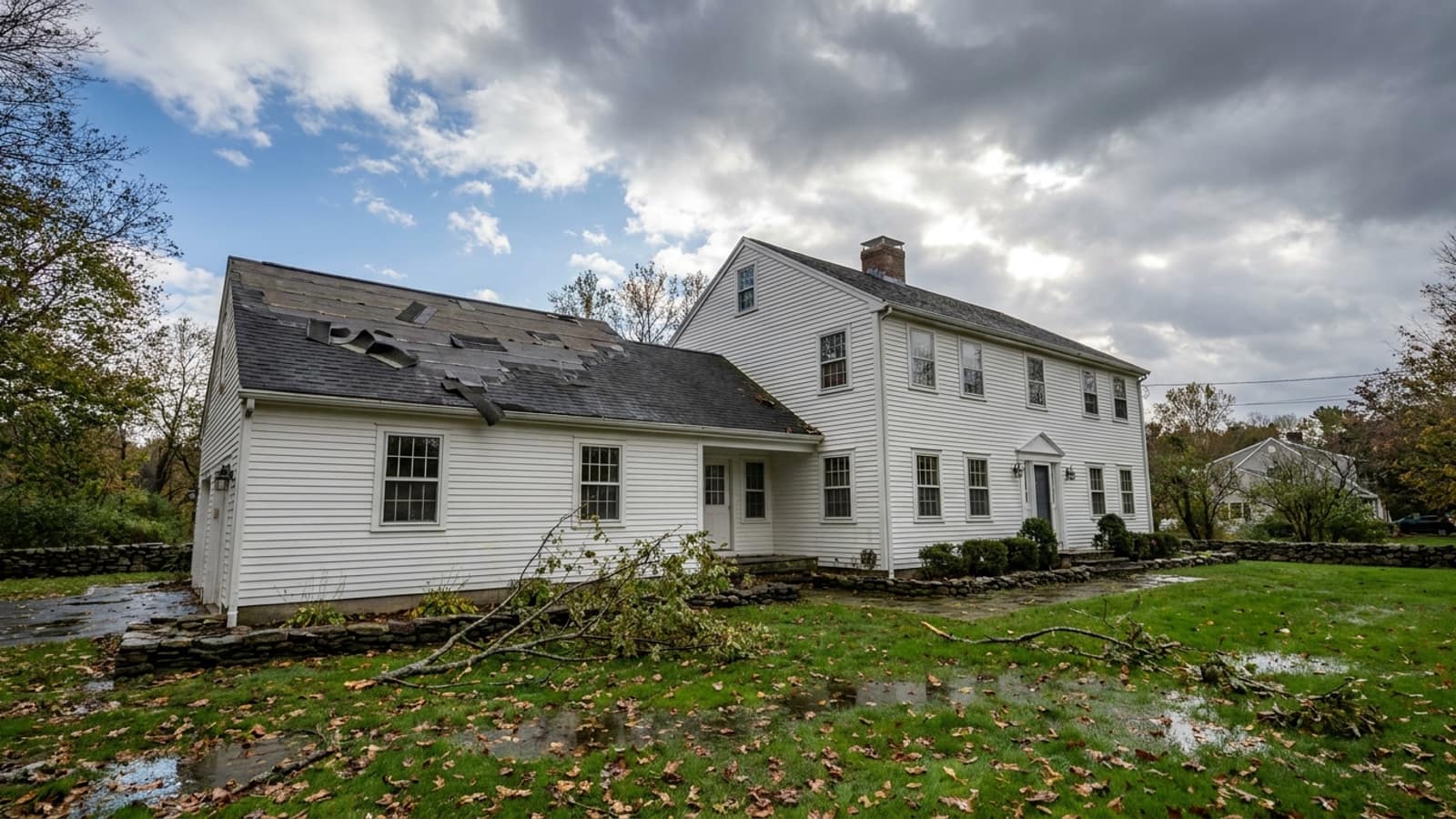
Connecticut law restricts when a carrier may apply a hurricane deductible. In general terms, the storm has to be declared a hurricane by the National Weather Service and sustained winds of at least 74 mph have to be recorded somewhere in the state during that storm. There is also a defined window around the storm, typically beginning when the hurricane warning is issued and continuing for a set period after it ends.
The practical effect is large. A strong nor'easter, a severe thunderstorm line, or a tropical storm that never reaches hurricane strength over Connecticut will not trigger the hurricane deductible. Those losses fall to the ordinary deductible or to a separate windstorm deductible if the policy has one. Most wind damage we see in Connecticut is settled on the ordinary deductible.
That does not mean you can ignore the percentage. It means you should know exactly what your policy says, because the statute sets a floor and the policy language does the rest. Call your agent and ask for the endorsement by number, then read the trigger paragraph. If anything is unclear, the Connecticut Insurance Department takes consumer questions on deductible triggers directly.
Named storm language is broader than hurricane language
Some policies use a named storm deductible rather than a hurricane deductible. A named storm trigger can include a tropical storm that the National Hurricane Center has named but that never became a hurricane. That is a meaningfully wider net. If your declarations page says named storm, assume more events will trigger the percentage than if it says hurricane.
A worked example
Assume an approved roof scope of $19,000 on a house in a shoreline town, with the figures below. The point is the last row.
| Line | Flat $2,500 deductible | 2 percent hurricane deductible |
|---|---|---|
| LineDwelling coverage limit | Flat $2,500 deductible$600,000 | 2 percent hurricane deductible$600,000 |
| LineApproved replacement cost | Flat $2,500 deductible$19,000 | 2 percent hurricane deductible$19,000 |
| LineDeductible owed | Flat $2,500 deductible$2,500 | 2 percent hurricane deductible$12,000 |
| LineCarrier pays, before depreciation holdback | Flat $2,500 deductible$16,500 | 2 percent hurricane deductible$7,000 |
Figures are illustrative. Same house, same storm, same scope, and a difference of $9,500 in what the homeowner carries. If your policy has a percentage deductible, you are effectively self-insuring the first serious wind loss, and that should shape how you budget for the roof rather than how you argue with the adjuster.
Deciding whether to file at all
A claim that nets nothing still goes on your loss history. The sequence that avoids that outcome is simple.
- Read the declarations page and write down the all other perils deductible, any wind or named storm deductible, and any hurricane percentage converted into dollars.
- Get a written repair or replacement price from a contractor who has been on the roof and photographed what is wrong.
- Compare. If the repair price is close to or below the deductible, pay for the work and keep the claim history clean.
- If the damage clearly exceeds the deductible, file, and document the condition thoroughly before anything is covered up.
We perform storm damage inspections and document damage with photographs, and we work with your insurance company through the claims process. That is covered on the storm damage section of our roofing page. What we will not do is tell you a claim is worth filing when the arithmetic says otherwise.
The code figures behind all of this
Every town we serve sits inside a hurricane-prone region as designated in Appendix AY of the 2022 Connecticut State Building Code. That is a construction designation, not an insurance one, and the two get confused constantly. The code assigns each town an ultimate design wind speed, Vult. Guilford, Madison and New Haven are 125 mph, higher than Greenwich, Stamford, Westport and Fairfield at 120 mph. Old Saybrook, where we are based, is 126 mph. Exposure to open water along the central shoreline drives those numbers more than distance from New York.
What the designation means for your roof is fastening. A shingle's wind rating is only valid if it is installed the way the manufacturer requires to earn it, which for high wind coverage usually means six nails per shingle in a defined nail zone instead of four. A quote with no nail count on it is not telling you whether the wind warranty will hold. That detail is worth more on a shoreline house in Madison or Guilford than any deductible argument, because it affects whether you have a claim next time.
What the code does not say
The high wind underlayment requirement that kicks in above 110 mph is keyed to Vasd, the allowable stress design wind speed, which works out to roughly 93 to 97 mph in these towns. It is not keyed to Vult. A contractor who tells you the 125 mph figure forces a special underlayment is reading the table wrong, and you are being charged for it.
Before the next storm
Three things are worth doing while the weather is calm. Pull the declarations page and convert every percentage into a dollar figure so you are not doing that math during a power outage. Photograph each roof slope from the ground on a clear day so you have a dated before image. And have the roof looked at if it is past twenty years, because an aged roof is harder to separate from storm damage in an adjuster's scope.
If you want a written price on a roof, or an inspection after a storm, request one through our estimate page. Someone comes out, gets on the roof where it is safe to do so, measures, and gives you an itemized written price you can set against your deductible. We work across fifteen Connecticut towns listed on our service areas page.