Short answer
Actual cash value settles a roof claim at what the old roof was worth on the day it was damaged, meaning the replacement cost minus depreciation for age and wear. Replacement cost value pays what it takes to put the same roof back, usually in two payments, with the withheld depreciation released after the work is finished and documented. Which one applies to you is printed on your declarations page, not decided by the adjuster at your house.
On this page
Two homeowners on the same street can lose the same number of shingles in the same storm and receive settlement checks that differ by thousands of dollars. Usually it is not because one adjuster was tougher. It is because one policy settles the roof at actual cash value and the other settles at replacement cost.
This post is about the mechanics of that difference, where it is written down, and how it changes what you can afford to do. We have written separately about whether insurance covers a roof replacement at all; this one assumes the claim is approved and deals with how it gets paid.
The two settlement bases, stated plainly
Every property claim starts from the same number: what it would cost today to put the damaged item back. The two settlement bases split on what happens next.
Actual cash value
Actual cash value, abbreviated ACV, is replacement cost minus depreciation. Depreciation accounts for the age and remaining service life of what was destroyed. A roof halfway through its expected life is treated as worth roughly half of a new one, and that is what the policy pays.
ACV is a single payment. There is no second check. If you had a twelve-year-old roof and you want a new one, the gap between the depreciated value and the real price of the job comes out of your pocket.
Replacement cost value
Replacement cost value, abbreviated RCV, pays what it takes to put an equivalent roof back, with no reduction for age. It is almost never paid all at once. The carrier issues the actual cash value first, holds back the depreciation, and releases that withheld amount after you complete the work and send documentation proving it was done.
That withheld amount is called recoverable depreciation. The word that matters is recoverable. On an ACV policy, the same depreciation is simply subtracted and never comes back.
A worked example
Assume an approved scope of $18,000 to replace an architectural shingle roof, a product with a twenty-five year expected life, twelve years old at the time of the loss, and a $2,000 deductible. Depreciation is applied at roughly 48 percent.
| Line | Replacement cost policy | Actual cash value policy |
|---|---|---|
| LineApproved replacement cost | Replacement cost policy$18,000 | Actual cash value policy$18,000 |
| LineLess depreciation | Replacement cost policy$8,640 | Actual cash value policy$8,640 |
| LineActual cash value | Replacement cost policy$9,360 | Actual cash value policy$9,360 |
| LineLess deductible | Replacement cost policy$2,000 | Actual cash value policy$2,000 |
| LineFirst check | Replacement cost policy$7,360 | Actual cash value policy$7,360 |
| LineRecoverable depreciation after completion | Replacement cost policy$8,640 | Actual cash value policy$0 |
| LineTotal from carrier | Replacement cost policy$16,000 | Actual cash value policy$7,360 |
| LineOut of pocket on an $18,000 job | Replacement cost policy$2,000 | Actual cash value policy$10,640 |
The figures are illustrative. The point is the last row. On the same loss, with the same adjuster and the same estimate, one homeowner owes the deductible and the other owes more than half the job.
Where this is written down
It is on your declarations page, the two or three page summary at the front of the policy, not buried in the policy form. Read it in this order.
- Coverage A, dwelling. This will say replacement cost or actual cash value for the structure as a whole.
- The endorsement list below it. This is where the roof gets treated differently from the rest of the house.
- The deductible line, including any separate wind or hurricane deductible.
Roof endorsements are the common surprise
A dwelling can be insured at replacement cost while the roof surfacing alone sits under a separate endorsement. Two forms show up often. One converts roof coverage to actual cash value once the roof passes a stated age. The other uses a payment schedule that reduces the percentage paid as the roof ages, which behaves like ACV with the arithmetic printed in a table.
Neither is hidden or improper. They are how carriers price coverage on older roofs. But a homeowner who assumes replacement cost because that is what Coverage A says can be badly wrong about a roof.
Percentage deductibles change the math
A flat dollar deductible is straightforward. A percentage deductible is calculated against the dwelling coverage limit, not the claim, so a 2 percent deductible on a house insured for $600,000 is $12,000 before anyone discusses shingles. Along the shoreline, separate windstorm or hurricane deductibles are common, and every town we serve sits inside a designated hurricane-prone region under the state building code. Check whether the separate deductible is triggered by a named storm only or by any wind event, because that single line decides whether a moderate wind claim is worth filing.
The scope matters more than the basis
Homeowners spend a lot of energy on ACV versus RCV and not enough on the estimate the percentage is applied to. Depreciation is a fraction. The number it multiplies is the carrier's scope, and that is where most of the real money sits.
Things that routinely get missed in a first scope:
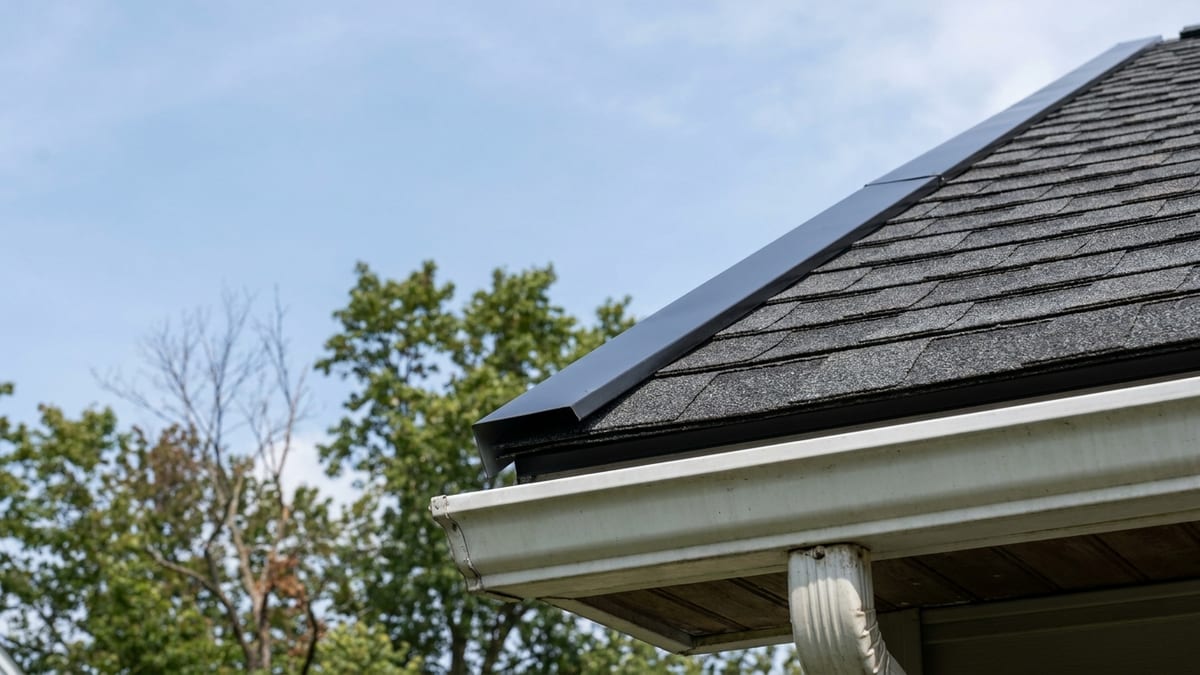
- Drip edge, which the code requires on a new roof whether or not the old one had it.
- Ice and water shield at eaves and valleys, in the width the code requires rather than a single course.
- Ridge vent replacement, step flashing, and pipe boots, which are not reusable in the way a scope sometimes assumes.
- Deck replacement, which cannot be known until the old roof is off and should be priced per sheet in advance.
- Six-nail fastening where the shingle's high-wind rating depends on it, which is a labor and material difference, not a preference.
A contractor's estimate written in the same line-item structure the adjuster uses is far easier to reconcile than a one-page total. Our guide to reading a roofing quote covers what those line items should say. Supplements for items discovered mid-job are normal and are generally handled by documenting the condition with photographs before it is covered up.
When ACV coverage is a defensible choice
The honest case against paying for full replacement cost coverage on an old roof is real. Carriers charge for it, and the premium difference over many years is not trivial. If your roof is two years from replacement anyway, you are insuring an asset with little depreciated value left and you were going to spend the money regardless. Some homeowners deliberately carry a higher deductible and an ACV roof endorsement, treat small losses as their own, and keep the premium.
That calculation only works if you know you made it. The bad outcome is discovering the endorsement after a storm, when the roof is open and the decision has already been made for you.
What to do before and after the storm
Photograph the roof and the attic while things are intact, keep the invoice from the last replacement so the age of the roof is a documented fact rather than an estimate, and read the declarations page once a year at renewal. After a loss, the sequence matters, and we lay it out in our post on first steps after storm damage. Get an independent inspection and a written scope before the adjuster's number becomes the anchor for the whole conversation. Our storm damage inspection work includes photo documentation of what we find, which is the material a supplement is built from.
One more thing. Replacing an entire roof when only one slope was damaged is a scope argument, not a settlement-basis argument. If the shingle line is discontinued and cannot be matched, say so with the manufacturer's documentation. If it can be matched, expect the carrier to pay for the damaged slope and expect that to be reasonable.
Getting a real number
Whatever your policy says, you need an accurate price for the actual work before you can judge the settlement. Request an estimate through our form and someone comes out, measures the roof, inspects the decking access and flashing conditions, and gives you a written, itemized price you can set next to the adjuster's worksheet. If the two documents disagree, at least you will know exactly which line is in dispute.