Short answer
Start from the ground: photograph the house from all four sides, photograph anything that landed in the yard, and note the date and time of the storm. Stop water getting in with a temporary cover if it is safe to arrange, keep every receipt, and have the roof assessed by someone who will put findings in writing. Whether any of it becomes an insurance payment depends on your policy language and the cause of the damage, and no contractor can tell you that in advance.
On this page
A storm passes, you see something on the roof that was not there yesterday, and the phone starts ringing with people offering to help. The useful sequence is short and it is all done from the ground.
The first 48 hours, in order
- Make the house safe. Downed wires, a leaning tree on the structure, or ceiling drywall sagging with water are reasons to keep people out of that part of the house and to call the utility or the fire department rather than a roofer.
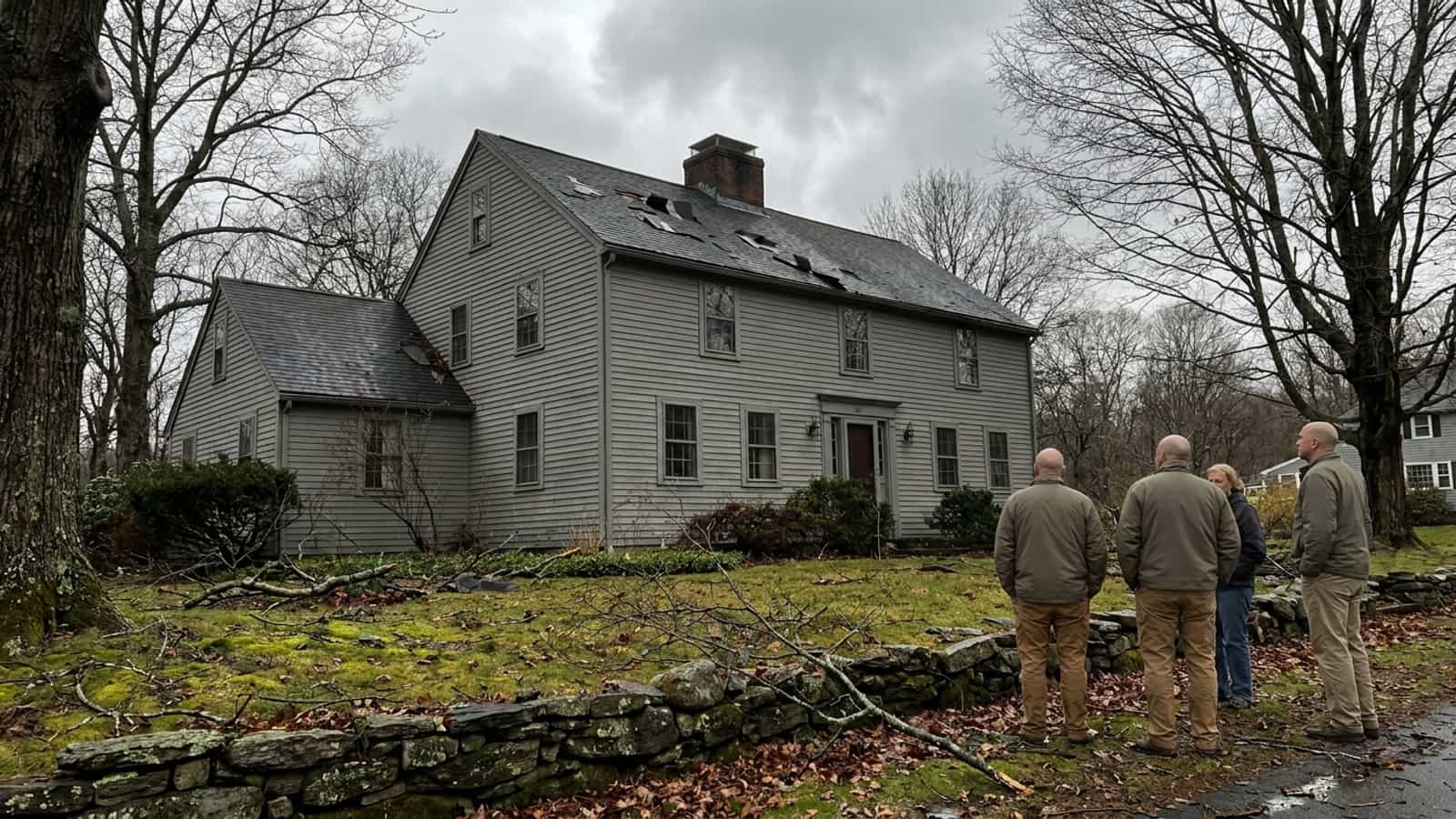
- Photograph everything, from the ground. All four elevations of the house, wide shots first. Then the yard: branches, shingle pieces, pieces of ridge cap, torn gutter, dented downspouts, damaged fence or deck boards. Debris in the yard is evidence of what the wind did.
- Photograph the inside. Any ceiling stain, wet insulation, water on a windowsill, a drip in the attic. Take these before you clean up.
- Note the date and time of the storm. Insurers work from a date of loss. Writing it down while you remember it saves an argument later.
- Stop water from entering. A tarp or a temporary cover is reasonable emergency mitigation. Keep the receipt.
- Read your policy. Find the duties after loss section and the deductible. Look for whether roof coverage is replacement cost or actual cash value, and whether there is a separate wind or hurricane deductible.
- Get the roof assessed and put in writing. A written scope with photographs is what any conversation after this point runs on.
Stay off the roof
This is not liability language. A roof that has just taken wind or hail is genuinely hazardous: wet, possibly with loosened decking, and with fasteners that may have backed out. People are seriously injured every year doing exactly this.
There is a second reason. Foot traffic on cold or heat-softened shingles causes damage that looks like storm damage but is not, and an adjuster who sees scuff marks and broken tabs in a walking path has a reason to question the whole claim. Use a zoom lens, use binoculars, use an upstairs window. Leave the rest to someone who does it with fall protection.
What storm damage actually looks like
Wind
Wind damage rarely looks dramatic. The common signals are missing tabs along a rake or ridge, shingles lifted and reseated at an angle, creased shingles where a tab folded back and flopped down again, ridge cap displaced, and exposed nail heads where a course above has moved. A crease is important because the mat is broken even though the shingle is still in place, and it will fail later.
Also look at the metal. Bent or lifted drip edge, a torn or rolled section of step flashing, a vent cap turned sideways, a gutter pulled from the fascia. Flashing damage causes leaks long before shingle loss does.
Hail
Hail on asphalt shingles leaves round bruises where granules are knocked off and the mat underneath is soft to the touch. From the ground, the fastest proxies are the soft metals: dents in gutters, downspouts, roof vents, the top of an air conditioning condenser, and mailboxes. If those are dented, hail of a meaningful size fell on the house. Granules in the gutters on their own are not proof of anything, because roofs shed granules throughout their lives.
Water inside
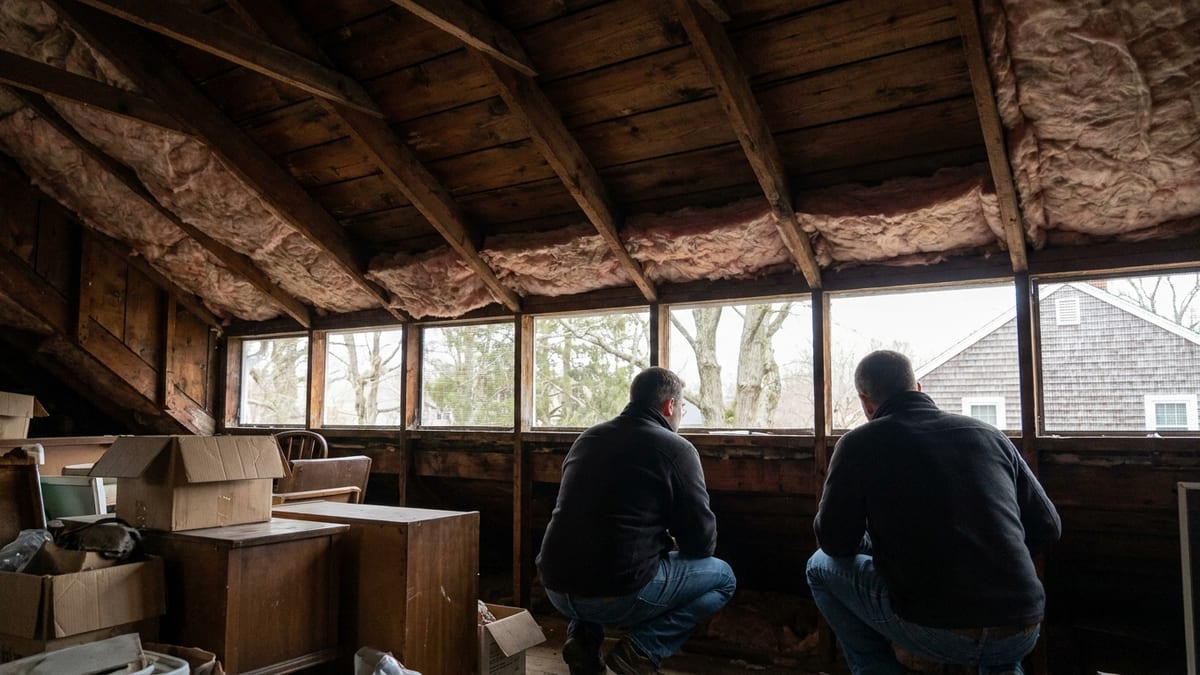
A new ceiling stain after a storm tells you water got in. It does not tell you where. Water travels along rafters and along the top of the ceiling before it finds a seam, so the wet spot in the bedroom is often several feet from the entry point. Photograph it anyway, and photograph it again as it grows.
The insurance part, stated honestly
Whether a storm claim results in a payment is determined by your policy, your deductible, and what the adjuster concludes caused the damage. A contractor can document conditions and provide a written scope and price. A contractor cannot tell you what your insurer will decide, and anyone who guarantees an outcome or offers to make your deductible disappear is describing something you do not want your name attached to.
A few things worth understanding before the call:
- Deductible. Many Connecticut policies carry a separate percentage-based wind or hurricane deductible that applies only in named storms. A percentage of dwelling coverage is a much larger number than a flat deductible.
- Replacement cost versus actual cash value. ACV settlements subtract depreciation based on the age of the roof. On a 22-year-old roof, that difference can be most of the cost.
- Wear is not a peril. Curled, brittle shingles at the end of their service life are excluded almost everywhere. A storm that finishes off a worn roof is often treated as a maintenance issue, and that is a legitimate distinction rather than an insurer being difficult.
- Partial claims. Sometimes the honest answer is that four shingles blew off, a repair fixes it, and the repair costs less than the deductible. Filing in that situation gains you nothing.
We perform storm damage inspections and document what we find with photographs, and we can be at the house when the adjuster is there so both parties are looking at the same roof. Details of that work are on the roofing page.
Every town we serve is in a hurricane-prone region
Appendix AY of the 2022 Connecticut State Building Code assigns each municipality an ultimate design wind speed, and all fifteen towns we cover sit inside a designated hurricane-prone region.
| Towns | Design wind speed, Vult |
|---|---|
| TownsGuilford, Madison, New Haven | Design wind speed, Vult125 mph |
| TownsGreenwich, Stamford, Westport, Fairfield | Design wind speed, Vult120 mph |
| TownsHartford, West Hartford, Glastonbury, Manchester, Avon, Farmington, Simsbury, Middletown | Design wind speed, Vult120 mph |
The central shoreline figure is higher than the Fairfield County shoreline figure, which surprises people. Open water exposure drives it, not distance from New York. One code point gets misquoted constantly after storms: the high-wind underlayment provisions triggered above 110 mph are keyed to Vasd, the allowable stress design wind speed, which works out to roughly 93 to 97 mph in these towns. That trigger does not apply here. The full explanation of both code numbers is in our post on the two code numbers every Connecticut roof must meet.
What does matter for wind performance is fastening. A shingle earns its wind rating only when it is nailed the way the manufacturer requires, which for high-wind coverage usually means six nails per shingle placed in a defined nail zone rather than four. If a section of roof lost shingles while the rest held, nailing pattern is one of the first things worth checking.
Repair, replacement, and the pressure in between
After a large storm, crews arrive from out of state, knock on doors, and ask for a signature. Some are competent. The behavior to refuse is the same regardless of who is standing there: a contract that assigns your insurance claim, a price with no scope attached, a demand for a deposit before anything is written down, or urgency built around a roof that has been standing there fine for a week.
Anyone pulling a roofing permit in Connecticut has to be a registered Home Improvement Contractor, and a roof replacement requires a permit in every town we serve. That requirement is covered in detail in our post on roof permits in Connecticut, and it is a quick filter: a company unwilling to pull the permit in its own name is telling you something.
Also accept that a repair may be the right answer. A dozen shingles off a 9-year-old roof is a repair. The full case for each is in repair or replacement.
Getting it looked at
We inspect roofs across the towns listed on our service areas page, document what we find with photographs, and provide a written, itemized scope. If you want that started, request an estimate and someone will come out, get on the roof properly, measure, and leave you with a written price you can compare against anything else you have. It is a sales appointment, and the paperwork you keep from it is useful either way.