Short answer
Repair is the right call when the damage is localized, the rest of the roof is sound and the roof still has years of service left. Replacement becomes the honest answer when the shingles are at the end of their life, when there are already two layers, or when the deck underneath has been wet long enough to soften.
On this page
There is an obvious conflict of interest in asking a roofing contractor whether you need a new roof. So here is the reasoning laid out, including the parts that argue for spending less.
When repair is the right answer
Repair makes sense when three things are true at once:
- The damage is localized. A section of flashing, a few shingles, one valley, a boot around a vent pipe.
- The rest of the roof is sound. Shingles still flexible, granules still on them, no widespread curling or cracking.
- The roof has real service life left. Repairing a roof with two years in it is spending money to defer a decision by two years.
Most single leaks are flashing, not field shingles. Where a roof meets a wall, a chimney, a skylight or a dormer, there is a metal detail doing the waterproofing. Those details fail long before the shingles do. A leak in a ceiling near a chimney is a flashing conversation, not a roof replacement conversation.
When replacement is the honest answer
The shingles are at the end of their life
Look at what is in the gutters. Asphalt shingles shed granules as they age, and heavy granule loss means the mat underneath is now exposed to sunlight. Curling edges, cracking across the face, and shingles that have gone brittle instead of flexible all point the same way.
There are already two layers
Connecticut has a lot of houses carrying two layers of shingles. Once there are two, a third is not a sensible option, and the second layer has to come off regardless. At that point you are paying for a tear-off no matter what, so the calculation changes.
The deck is soft
If water has been getting in long enough to soften the plywood or board sheathing, no amount of new shingle fixes it. Roofing over a compromised deck means the fasteners have nothing solid to bite into — which is a wind problem, not just a rot problem.
The leak keeps moving
A roof that has been patched three times in three different places is telling you the failures are not isolated. Systemic failure looks like a sequence of unrelated leaks.
The signals that get oversold
Two things get pointed at more often than they should:
Algae streaking. The dark streaks running down a north-facing slope are algae. They are cosmetic. They do not mean the roof is failing.
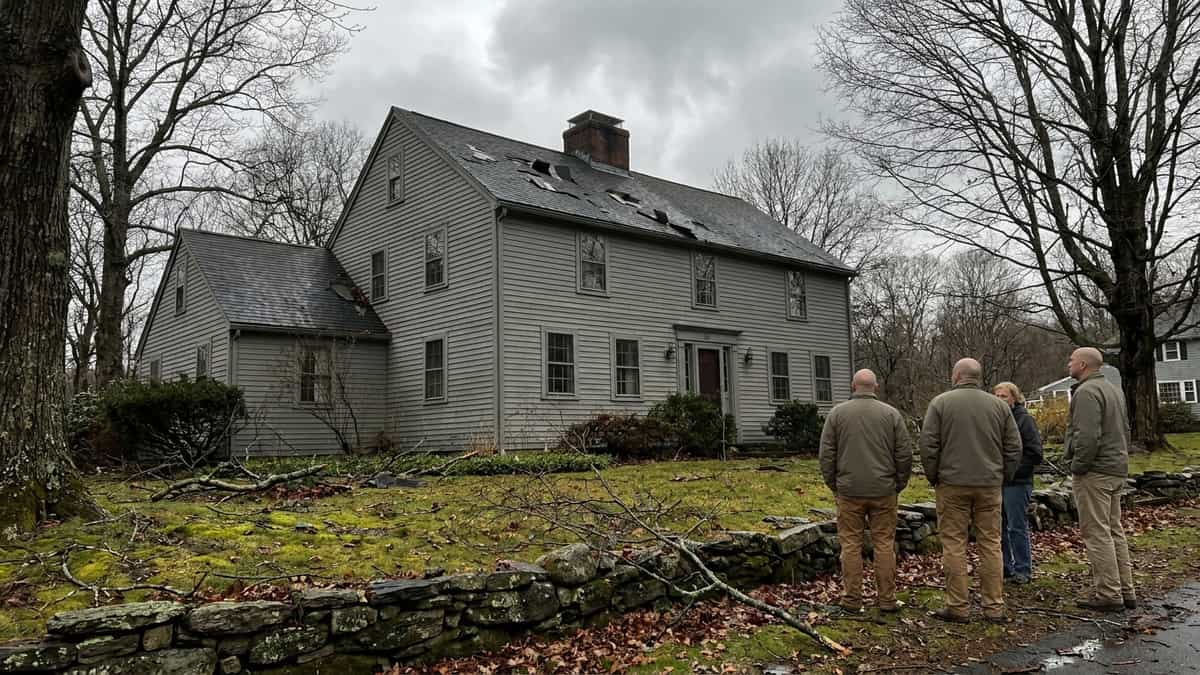
A single storm-damaged area. Wind lifts shingles in the exposed part of a roof — usually an edge or a corner — while the rest is untouched. That is a repair, unless the roof was already near the end.
What Connecticut adds to the picture
Two local factors change the calculus.
Ice damming. Winter here produces the freeze-thaw cycle that builds ice at the eaves and pushes water backward, uphill, under the shingles. Shingles are designed to shed water flowing down, not to hold back water sitting still. That is what ice and water shield membrane at the eaves is for. A roof with recurring ice dam leaks and inadequate membrane coverage is a replacement candidate even if the shingles look acceptable, because the leak path is under them.
Wind exposure. Every town we serve sits in a designated hurricane-prone region, with design wind speeds of 120 or 125 mph depending on the town. If shingles are lifting repeatedly, it is worth checking how the existing roof was fastened. A roof nailed with four nails where the product needed six will keep failing at the edges, and no repair fixes the underlying spec. We go through the figures in The Two Code Numbers Every Connecticut Roof Must Meet.
Ventilation: the thing nobody checks
Attic ventilation shortens or lengthens roof life more than almost anything else, and it is nearly always ignored during a repair-or-replace decision.
Intake at the soffits, exhaust at the ridge. If that path is blocked — commonly by insulation pushed into the soffit bays during an energy upgrade — the attic runs hot, and the shingles bake from underneath. A roof that failed early on the south slope with a hot attic underneath will do it again on the same schedule if the ventilation is not corrected when it is replaced.
If you are replacing, the ventilation gets fixed as part of the job. If you are repairing, it is still worth knowing, because it tells you how much life the repair is actually buying.
How to decide
Get the roof looked at by someone who will tell you when the answer is repair. Ask for photos. Ask what the granule condition is, whether the deck is sound, how many layers are up there and what the ventilation looks like.
Then decide with the numbers in front of you. If it is a repair, it should be quoted as one. If it is a replacement, our post on what a new roof costs in Connecticut covers what drives the price.
Either way, a free inspection and estimate is the starting point — and we will tell you if what you need is the smaller job.