Short answer
Most vent pipe boot leaks are a small repair, because the rubber collar cracks years before the shingles around it wear out. Replacing the boot, or fitting a retrofit collar over the pipe, is a short job on a sound roof. It turns into a roof conversation when the deck underneath has softened, when the surrounding shingles are too brittle to lift without breaking, or when several boots are failing at once on a roof already past twenty years.
On this page
A leaking plumbing vent boot is one of the few roof problems that is almost always smaller than it feels from inside the house. The rubber collar that seals around the pipe is the shortest-lived part of an asphalt roof system. It fails from ultraviolet exposure and temperature swing, not from the shingles wearing out, and it commonly cracks a decade or more before anything else on the roof is ready to be replaced.
The decision is not usually repair versus replacement. It is whether the boot is the only thing wrong.
What a vent boot actually is
Every bathroom, kitchen and laundry drain in the house ties into a vent stack that runs up through the roof. Where that pipe passes through the deck, a boot does the sealing: a flat metal or plastic flange that lies on the deck and gets woven into the shingle courses, with a flexible collar molded or clamped to it that grips the pipe.
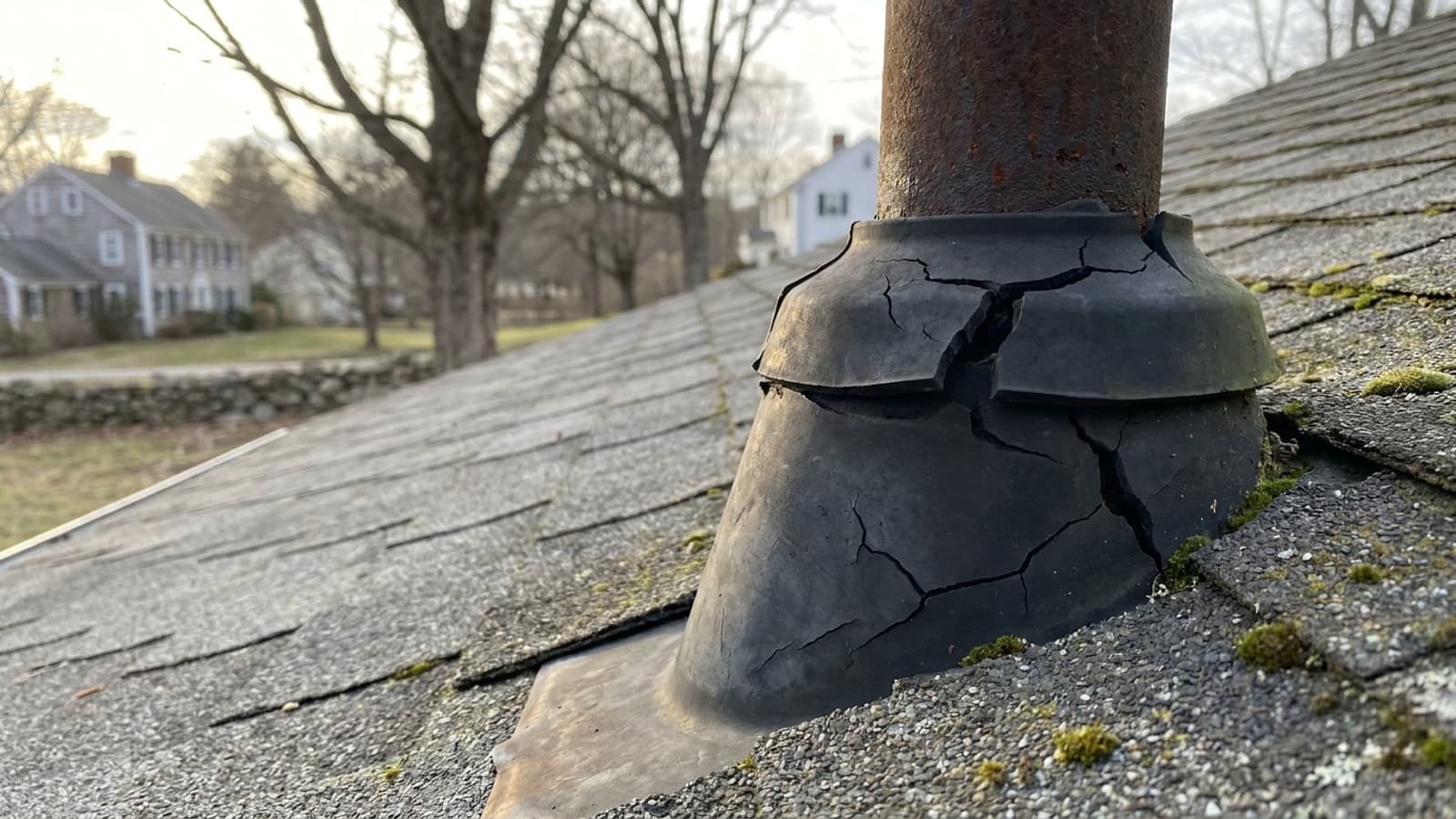
The flange is rarely the problem. The collar is. Black neoprene or EPDM sitting in direct sun on a south or west slope hardens, shrinks, and eventually splits in a ring around the pipe. Once that ring opens, water runs down the outside of the pipe, through the hole in the deck, and into the ceiling below.
Why it leaks in some rains and not others
Homeowners often describe a boot leak as intermittent and conclude it must be something else. It behaves that way because a split collar only takes on water when rain is driven at the pipe from the right angle, or when enough volume runs down the slope to overtop the crack. A long, steady soaking rain with wind will produce the stain. A brief shower will not.
How to tell it is the boot
The stain inside is almost never directly under the entry point. Water travels along rafters and across the top of the ceiling before it finds a seam, so it can land several feet away and on the wrong side of a wall. Our post on reading a ceiling stain correctly covers the difference between a true leak and condensation, which is worth ruling out first.
From the attic, with a flashlight, look for:
- A dark halo on the underside of the deck around a pipe penetration.
- Rust streaks on nail shanks near the pipe.
- Staining running down the outside of the vent pipe itself, which is close to conclusive.
- Compressed, darkened insulation directly below the pipe.
From the roof, a failed boot is usually visible from a ladder at the eave or from the ground with binoculars. The collar looks crazed, like old tire rubber, or has a visible gap where it should grip the pipe.
The three tests that decide repair or replacement
The deck test
Press the deck around the penetration from the attic side. Plywood or board sheathing that flexes, feels spongy, or shows delamination has been wet long enough that a new boot alone will not solve it. Soft decking has to be cut out and replaced, and once the shingles have to come up to do that, the scope grows. One soft sheet is still a repair. Several, spreading across a slope, is the start of a replacement conversation.
The age test
Architectural asphalt shingles typically last twenty-five to thirty years in Connecticut, and freeze-thaw cycling shortens that where ventilation was never right. A boot on a twelve-year-old roof is a repair with no argument. A boot on a twenty-six-year-old roof sits in a field of shingles that are brittle enough to crack when a crew lifts them to slide a new flange under the course above. The repair is still possible, but it damages the shingles around it, and you are spending money on a roof that is near the end anyway.
The count test
All the boots on a house are usually the same age and the same product. When one fails, the others are not far behind, and the same is true of the other rubber-gasketed parts: exhaust fan flashings, satellite mount seals, and the gaskets on any fasteners that were exposed. If a roofer finds three cracked collars and two skylight seals on the same inspection, the roof is telling you something about its remaining service life. The honest framing of that decision is covered in repair or replacement on a Connecticut roof.
What the repair involves
There are three normal fixes, in increasing order of thoroughness.
- Retrofit collar. A rubber or silicone collar slides over the pipe and clamps down over the existing flange. No shingles are disturbed. Fast, and appropriate when the flange and surrounding shingles are sound.
- Full boot replacement. The shingle courses above the flange are carefully lifted, the old boot comes out, a new one goes in, and the shingles are re-bedded and re-fastened. This is the standard fix.
- Boot replacement plus deck repair. The same, with the sheathing around the penetration cut back to the rafters and replaced before anything is sealed.
A detail that separates good work from a callback: the new flange has to sit under the shingles upslope of it and over the shingles downslope. A boot slathered in sealant on top of all the shingles is a leak waiting to happen, because the only thing holding water out is a bead of caulk with a service life of a few years.
What it costs
A boot replacement is a service call, not a project. We do not publish a flat figure for it, because the honest price depends on roof pitch, how high the penetration sits, whether the crew can reach it from a ladder or needs staging, and whether anything under it has to be replaced. On a walkable slope with sound decking it is a short visit. On a steep third-story slope it is not.
What is useful is the comparison. These are the general Connecticut ranges for the alternative, which depend heavily on the specific house:
| Scope | General Connecticut range |
|---|---|
| ScopeSingle boot replacement | General Connecticut rangePriced as a repair visit, by pitch and access |
| ScopeThree-tab asphalt roof replacement | General Connecticut range$8,000 to $25,000 on a typical home |
| ScopeArchitectural shingle replacement | General Connecticut range$10,000 to $30,000 on a typical home |
| ScopeCedar shake | General Connecticut range$20,000 to $50,000 and up |
The gap between those two rows is the reason it is worth finding out which one you are actually looking at before you agree to anything. Any company that inspects a cracked collar and quotes a full roof without showing you a soft deck or a field of failing shingles has skipped the diagnosis. Roof repair and roof replacement are different services with different evidence behind them.
Connecticut specifics worth knowing
Every town we serve sits inside a designated hurricane-prone region under the 2022 Connecticut State Building Code. The design wind speed is 120 mph in most of our towns and 125 mph in Guilford, Madison and New Haven, which is higher than the Fairfield County shoreline. That matters at a penetration because wind-driven rain is what exploits a split collar, and because the shingles disturbed during the repair have to go back with the fastening pattern the manufacturer requires. A shingle that is hand-sealed and re-nailed sloppily around a new boot becomes the next problem in the next storm.
Along the shoreline, add salt air. It corrodes exposed metal flashing and fasteners faster, so an aluminum flange with a rusted-out seam around the pipe is more common on a Guilford roof than on one in the Farmington valley. Lead flashings and copper hold up far better in that exposure and are worth asking about if the house is near the water.
A single boot repair does not require a permit. A full roof replacement does, in every town we serve, and the permit and inspection are part of what the price should include.
What to do next
If you have a stain and a suspicion, get up into the attic with a flashlight during or just after a long rain. Finding water on the outside of a vent pipe settles the question in about five minutes and saves you from paying someone to guess.
If you want it looked at properly, you can request an estimate. Someone comes out, gets on the roof, inspects the penetration and the deck underneath, and gives you a written price for the repair, along with an honest read on how much life the rest of the roof has left. If a boot is all that is wrong, that is what we will tell you.