Short answer
A roof leak stain generally appears or grows within a day of rain or snowmelt, has a defined edge or ring, and traces back to a penetration, valley or eave directly above it. Condensation staining shows up in cold weather without rain, covers a broader and vaguer area, and tends to sit under a bath fan, along nail lines or on the coldest slope of the attic. Identifying which one you have matters because a roof covering repair and an attic air sealing job are entirely different pieces of work.
On this page
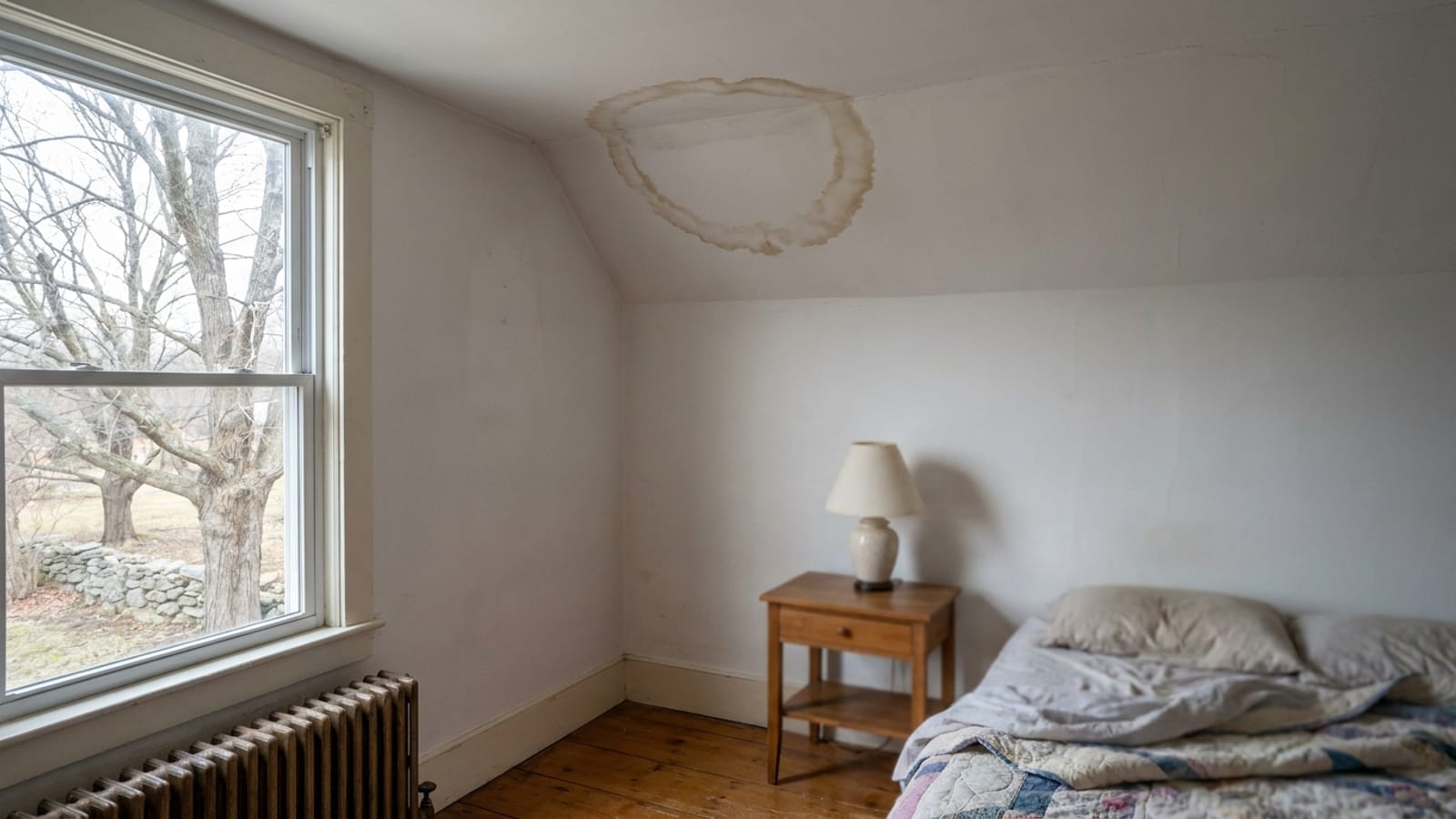
A brown ring on a bedroom ceiling is a symptom, not a diagnosis. Two entirely different problems produce nearly identical stains, and the fix for one does nothing for the other. One is water coming in through the roof. The other is water condensing on the underside of the roof deck inside your own attic and dripping back down onto the ceiling.
Before anyone quotes you a roof, the question worth settling is which of those two you have.
Start with when the stain appeared
Timing separates the two causes faster than anything else.
The rain test
A roof leak is event-driven. It appears, or visibly grows, within hours of rain, wind-driven rain or a rapid snowmelt. If you can connect the stain to a specific weather event, or you can watch it darken during a storm and stop afterward, you are dealing with water entering from outside.
A useful habit: photograph the stain with a coin or a piece of tape at its edge for scale. After the next heavy rain, photograph it again from the same spot. A leak grows. A dried condensation stain does not.
The cold test
Condensation is temperature-driven. It shows up in January and February on clear, cold nights, often with no rain in the forecast at all. The mechanism is simple: warm indoor air carrying moisture from showers, cooking, laundry and people leaks into the attic, hits roof sheathing that is well below freezing, and deposits frost on the underside of the deck and on the nail points poking through it. When the sun warms the roof the next day, that frost melts all at once and rains down inside the attic.
Homeowners describe this as a leak that happens on a sunny day. That description is close to a diagnosis on its own.
What each cause looks like on the ceiling
| Clue | Points to a roof leak | Points to condensation |
|---|---|---|
| ClueTiming | Points to a roof leakDuring or right after rain or snowmelt | Points to condensationCold weather, often after a clear night, no rain |
| ClueShape | Points to a roof leakDefined edge, concentric rings, one focal point | Points to condensationBroad, diffuse, vague border, sometimes several patches |
| ClueLocation | Points to a roof leakBelow a chimney, vent pipe, skylight, valley or eave | Points to condensationUnder a bath fan, along the north slope, near the ridge |
| CluePattern | Points to a roof leakUsually one spot that keeps returning | Points to condensationOften repeats in a scatter across a whole ceiling plane |
| ClueSmell | Points to a roof leakMusty near the stain | Points to condensationMusty across the whole attic, sometimes with visible frost |
| ClueAttic evidence | Points to a roof leakA wet track on one rafter or a stained path down the deck | Points to condensationFrost, dark mold blotches or rusted nail points over a wide area |
No single row decides it. Three rows pointing the same way usually does.
Where attic condensation comes from in Connecticut houses
Connecticut's heating season runs long enough that any attic taking in moist indoor air will show it eventually.
Air leaks, not humidity alone
The moisture is carried by air, and air moves through gaps. The usual suspects are the attic hatch, recessed light cans, the chase around a chimney or flue, plumbing and wiring penetrations, and the top plates of interior walls. Insulation does not stop air movement. A foot of blown cellulose over an unsealed top plate slows heat loss and does very little about the moist air rising through it.
Bath fans ducted into the attic
This one is common in houses where a bath fan was added after construction. The duct ends in the attic instead of at an exterior vent, or it runs to a vent that was never actually cut through the sheathing. Every shower sends a plume of warm, saturated air straight at cold plywood. The stain that results is almost always in the room adjacent to or below that bathroom.
Ventilation that is out of balance
An attic needs intake at the soffits and exhaust at the ridge, and the two have to work together. Insulation stuffed into the eaves blocks the intake, and then the ridge vent pulls conditioned air up out of the house instead of outside air across the deck. Mixing vent types on one attic, such as a powered fan plus a ridge vent plus gable vents, can short-circuit the airflow so that most of the deck sees no movement at all.
Roof leaks that are not the shingles
When the evidence does point outside, the shingle field is rarely the culprit on a roof under twenty years old. Penetrations and transitions are.
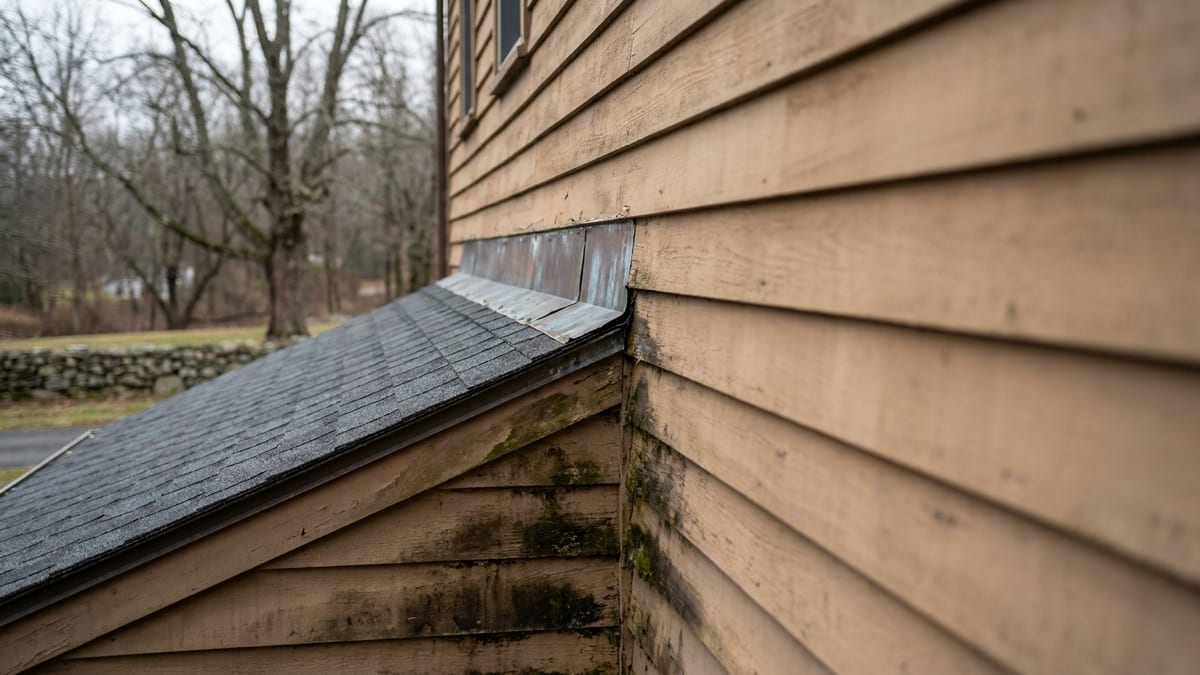
- Step flashing at a wall-to-roof intersection, especially where siding was installed over it rather than the flashing being woven with the courses.
- Chimney counterflashing that has pulled out of the mortar joint.
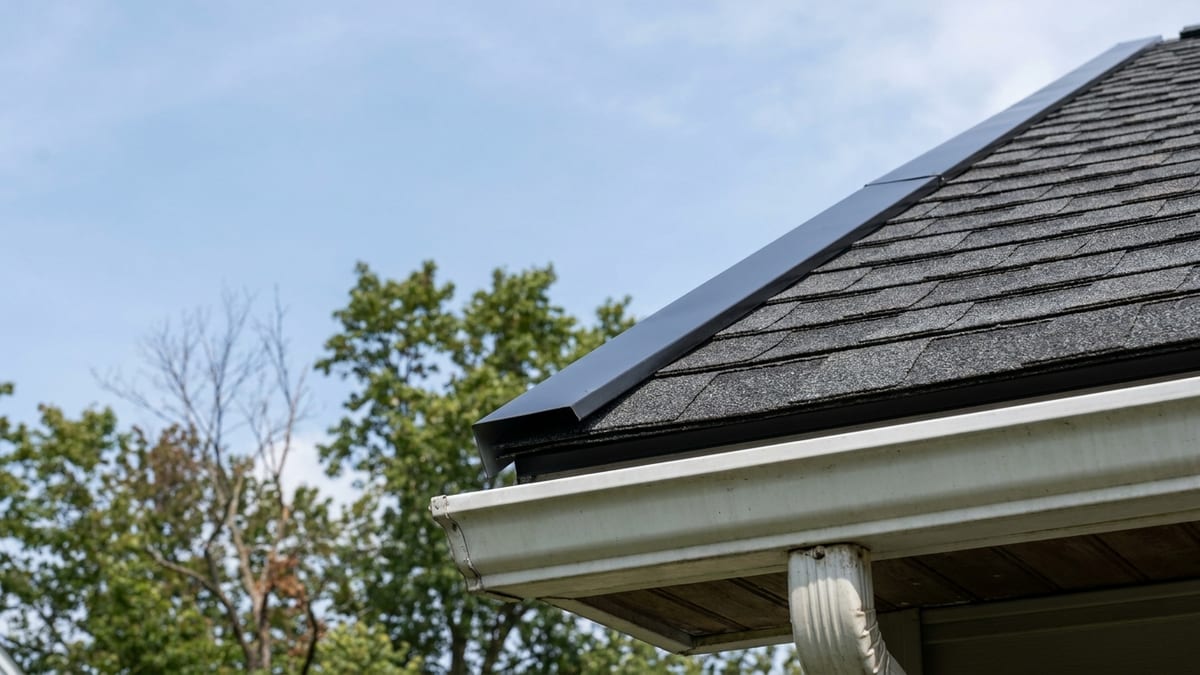
- Pipe boots with split rubber collars, which fail from ultraviolet exposure long before the shingles wear out.
- Skylight head flashing and the curb corners.
- Valleys carrying debris, which holds water long enough for it to back up.
- Ice dams at the eaves, which are their own category and are covered in detail in our post on why Connecticut roofs leak in winter and not in storms.
Water rarely falls straight down from the entry point. It runs the slope of the deck or the side of a rafter until it hits a nail, a seam or a piece of blocking. A stain several feet away from the failed flashing is the normal case, not the exception.
How to trace it before anyone opens the ceiling
From inside the attic
Go up with a flashlight on a cold morning, not a warm afternoon. Look at the underside of the sheathing. Frost spread evenly across the whole north-facing plane is condensation. A single dark track running down one rafter bay from a specific penetration is a leak. Check whether the insulation is wet on top, which means water came from above, or damp underneath, which points to vapor moving up from the living space.
Also look at the nail points. Rust on hundreds of them across a wide area is a condensation signature. Rust on a handful in one spot is not.
From outside
From the ground with binoculars you can usually see the obvious candidates: a lifted pipe boot, a shifted ridge cap, missing counterflashing, a valley packed with leaves. What you cannot see from the ground is the condition of the flashing underneath siding or behind a chimney, and that is where most persistent leaks live. A proper roof inspection includes those details and should come with photographs of what was found rather than a verbal summary.
The cost difference is the reason this matters
A failed pipe boot or a section of step flashing is a targeted repair. An attic moisture problem is air sealing, duct correction and ventilation work, and it may not involve the roof covering at all. Neither one resembles the price of a full replacement, which in Connecticut generally runs $10,000 to $30,000 for architectural shingles depending on size, pitch and complexity of the roof.
The expensive mistake runs in one direction: replacing a roof to solve a stain that was condensation all along, and finding the stain back the following February on a brand-new roof. If the diagnosis is condensation, ask for the sealing and ventilation work to be specified before any shingle conversation starts. Older housing stock in Hartford and similar dense neighborhoods, where attics were often finished, insulated and re-insulated over several decades, produces this situation regularly.
What to do next
Dry the area, mark the edge of the stain, and note the date and the weather. Wait for the next rain and check it again. If it grows with rain, you have a leak to find. If it grows after a cold snap with no precipitation, get into the attic before you get on the roof.
If you want a second set of eyes, someone from our team will come out, inspect the roof and the attic side where it is accessible, and give you a written price for whatever the evidence actually supports. You can request an estimate online or by phone, and the visit is a measured assessment followed by a written number, not a diagnosis given from the driveway.