Short answer
Vinyl siding is sold in nominal panel thicknesses from roughly 0.040 inch at the economy end to about 0.055 inch at the premium end, and that gauge drives rigidity, the strength of the nail hem and lock, and the price. Thicker panels hold their profile, show fewer waves along the wall and tolerate wind better. What thickness does not do is prevent buckling, which is almost always caused by panels nailed so tight they cannot move.
On this page
Panel thickness is the first thing that separates two vinyl siding quotes that otherwise look identical, and it is usually the number nobody writes down. Vinyl for residential walls is manufactured at nominal thicknesses from about 0.040 inch up to roughly 0.055 inch. Every step up buys rigidity, a stronger nail hem, a deeper lock and a flatter looking wall. None of it buys immunity from bad installation.
What thickness actually means on a vinyl panel
The gauge quoted by a manufacturer is the nominal thickness of the vinyl itself, measured on the face of the panel. ASTM D3679, the standard that governs rigid vinyl siding, sets a minimum nominal thickness of 0.035 inch. Anything sold as siding meets that floor, which is exactly why the floor is not useful for choosing. The useful range sits above it.
A panel is also more than a flat sheet. Three parts of the extrusion change with grade:
- The face, which is what you see and what waves if the panel is thin.
- The nail hem along the top, which is what the fasteners hold. Better panels roll the hem over so the fastener passes through a double thickness of vinyl.
- The butt lock along the bottom, which snaps over the course below. A deeper, tighter lock keeps the bottom edge from rattling and resists a gust trying to peel the course open.
The grades you will see on a quote
| Nominal thickness | How it is usually sold | What you notice on the wall |
|---|---|---|
| Nominal thickness0.040 in | How it is usually soldBuilder or economy grade | What you notice on the wallFlexible face, visible waves in raking light, shallow shadow line |
| Nominal thickness0.042 to 0.044 in | How it is usually soldStandard residential | What you notice on the wallReasonably stiff, acceptable on broken-up walls with lots of trim |
| Nominal thickness0.046 in | How it is usually soldThicker standard | What you notice on the wallHolds a straighter line, better lock engagement, common upgrade point |
| Nominal thickness0.050 to 0.055 in | How it is usually soldPremium | What you notice on the wallRigid, deep profile projection, heaviest nail hem, best wind numbers |
Profile matters alongside gauge. A double 4 inch clapboard has a stiffening break every four inches. A single 7 or 8 inch panel, or a Dutch lap with a wide flat, has more unsupported face and shows thinness sooner. If you are choosing a wide profile, do not choose it in a thin gauge.
What the extra thickness buys
Rigidity, and how the wall reads in low sun
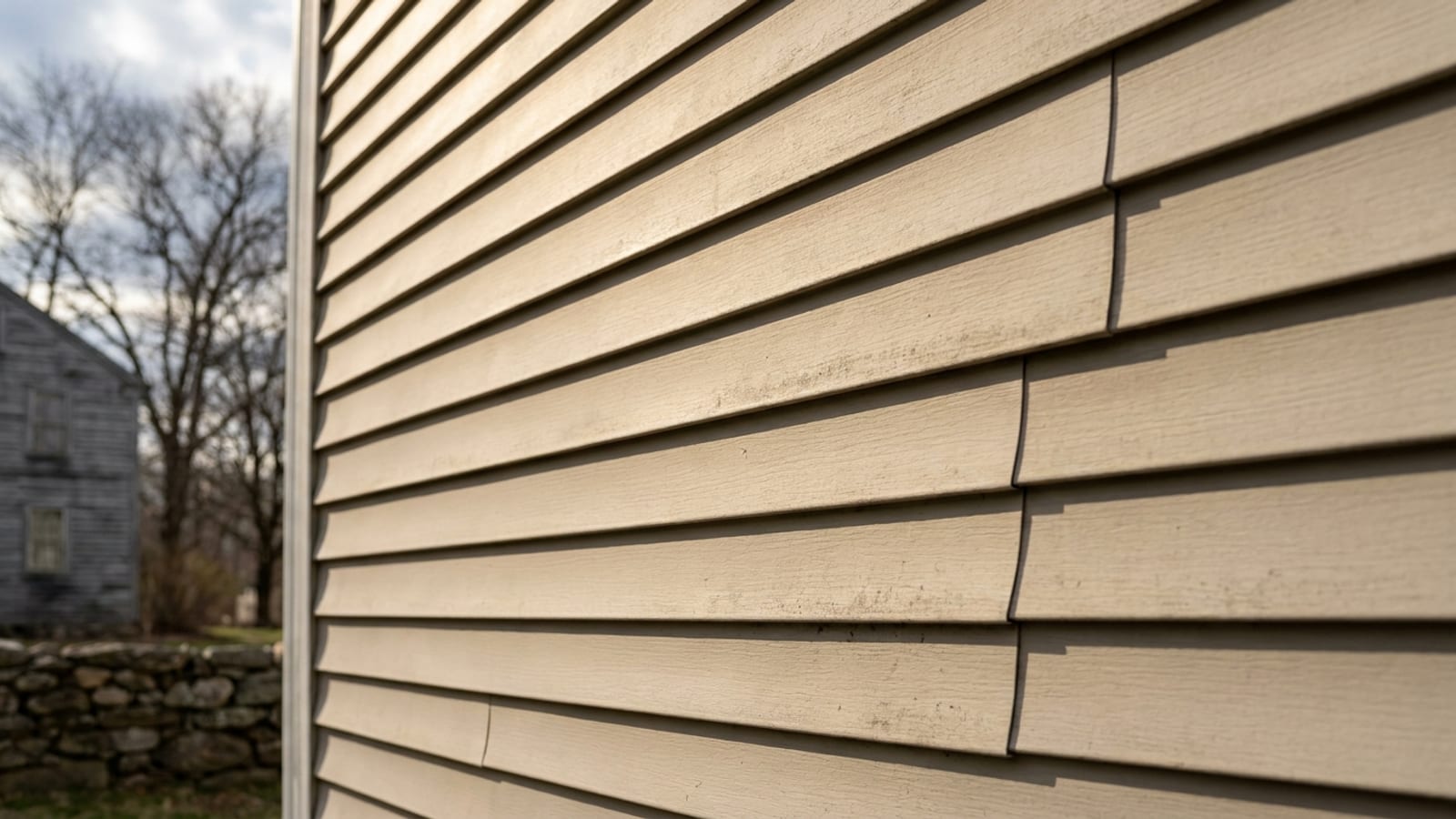
The complaint about vinyl is almost never the color. It is the wavy look along a long wall in late afternoon light, which installers call oil canning. Thin panels telegraph every irregularity in the sheathing behind them and every slight over-driven fastener. A rigid panel bridges those irregularities. On a 1960s Colonial with a two-story gable end and few windows, gauge is the single biggest factor in whether the finished wall looks flat.
Thicker vinyl also holds the depth of the profile, so the shadow line at each course looks closer to a painted wood lap. That is a straightforward appearance decision, and it is legitimate to pay for it. Our vinyl siding page shows the profiles we install most often.
Wind performance
Every town we serve sits in a designated hurricane-prone region under the 2022 Connecticut State Building Code. The ultimate design wind speed is 120 mph in the Hartford County and Fairfield County towns on our list and 125 mph in Guilford, Madison and New Haven, where exposure to open water along the central shoreline drives the figure higher than in Greenwich or Westport.
Siding is tested for transverse wind load under ASTM D5206, which pulls on the panel until the nail hem fails or the lock releases. The rated pressure a manufacturer publishes belongs to a specific panel installed a specific way, with a stated fastener type and spacing. A heavier hem and a deeper lock raise that number. So does nailing at the spacing the manufacturer requires rather than the spacing that goes up fastest. If wind rating matters to you, ask for the tested pressure of the exact panel being quoted, not a brand-level claim.
On the shoreline there is a second issue that has nothing to do with gauge. Salt air corrodes fasteners. Corrosion-resistant nails are not optional on a house in Madison or Guilford, because a perfectly good panel comes off a wall when the fasteners holding it give up.
Vinyl has to be hung so it can float
This is the part that decides whether the job looks right in five years, and it is independent of what you paid per square.
Vinyl expands and contracts with temperature. A 12 foot panel can change length by as much as roughly half an inch between a January morning and a July afternoon. The system is designed around that movement. Panels hang from fasteners and slide sideways behind trim. They are not fastened down.
What a correct installation looks like
- Fasteners centered in the nail slot, not at one end.
- Fastener heads left about 1/32 inch off the nail hem, so the panel can slide. The correct test is that you can move a hung panel side to side by hand.
- Fasteners driven straight, penetrating at least 3/4 inch of nailable material, at the spacing the manufacturer specifies.
- Nothing nailed through the face of a panel except where the manufacturer explicitly allows it.
- A gap of about 1/4 inch left where a panel enters a corner post or J-channel, widened to about 3/8 inch when installing in cold weather.
- Laps around one inch, oriented away from the main view where possible.
- A level starter strip, because every course above it repeats whatever error is in it.
Why buckling is almost always the installer
Waves that run in a long horizontal ripple, gaps that open at a corner post in winter, a course that pops its lock in summer heat, panels that clatter in wind. Each of these traces to a fastener driven tight, a panel forced hard into a channel, or a course locked so aggressively that it cannot move. Thicker vinyl resists a little longer before it shows the fault, which is one reason thin panels get blamed for problems they did not cause.
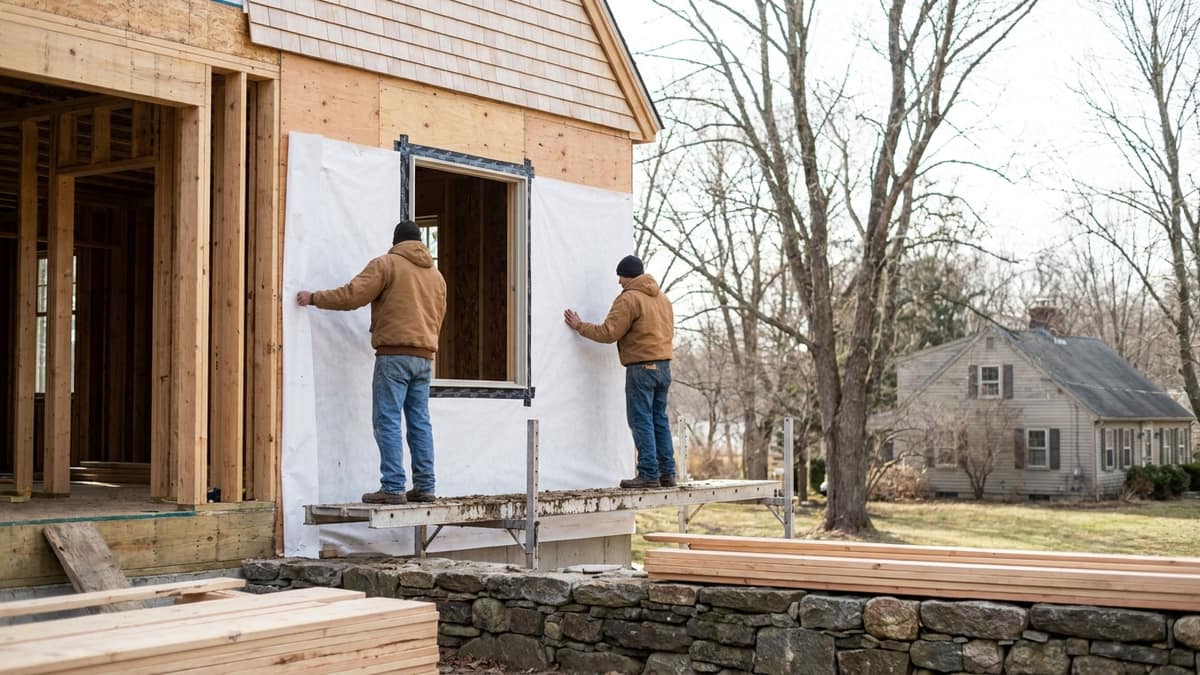
What happens behind the panels matters just as much. Vinyl is a rain screen, not a water barrier, and the drainage plane behind it is what keeps the wall dry. We covered that in detail in the post on house wrap and flashing behind siding.
Foam-backed insulated vinyl
Insulated panels have contoured rigid foam bonded to the back. The foam fills the void behind the profile, which makes even a mid-gauge panel behave like a much stiffer one and produces the flattest wall vinyl can produce. It adds a modest amount of R-value, and it deadens sound.
The honest cautions: it costs more per square, it thickens the wall so window and door trim details change, and because it is exterior insulation it can push a like-for-like siding replacement into permit territory in some towns. Most straightforward siding replacements in Connecticut need no permit, so that is a real change in scope worth knowing about before it appears on an invoice.
When the thicker panel is not the right spend
- You are selling within a couple of years. A standard 0.044 inch panel in good condition presents fine, and the premium gauge is not something a buyer prices.
- The walls are heavily broken up. A Cape with dormers, bays and lots of trim has short panel runs, and short runs do not wave much regardless of gauge.
- The money is needed behind the siding. Rotten sheathing, missing kickout flashing or a failed water-resistive barrier will cost you more than a gauge upgrade ever saves. Fix the wall first.
- You actually want dimension and paintability. If the reason you are considering premium vinyl is that you want the look of painted wood, compare it honestly against fiber cement. Our James Hardie versus vinyl comparison lays out both sides.
- It is a rental or an outbuilding. Standard grade, installed correctly, is a defensible choice.
Two Connecticut details to confirm before you order
If your house sits in a local historic district, Connecticut General Statutes Sec. 7-147f(a) does not require a Certificate of Appropriateness to replace siding with similar material, but changing the material type, such as wood to vinyl, does. That review happens on a commission's meeting schedule, not yours.
Second, get the gauge and the profile written on the estimate. A quote that says only "premium vinyl siding" is not comparable to anything. A quote that says the manufacturer, the profile, the nominal thickness, the fastener type and the trim details is.
When you are ready, request an estimate and someone will come out, measure the walls, look at the condition of what is behind the old siding, and give you a written price with the panel spelled out. You can compare that against anything else on your kitchen table.