Short answer
An insert window sits inside the existing frame, keeps the interior and exterior trim, and installs faster for less money, but it costs you glass area on every side. A full-frame replacement removes the old frame down to the rough opening, restores the full size, and lets the crew see and correct the sill and flashing behind the trim. Most Connecticut houses are candidates for either, and a single job can use both.
On this page
Two contractors can quote the same brand, the same glass package and the same NFRC numbers on your house and be describing two different jobs. One is planning to slide new units inside the frames that are already there. The other is planning to take the frames out. That single decision changes the price, the schedule, the mess inside your rooms, and how much daylight you end up with.
Here is the trade-off without the sales language around it.
What each method actually is
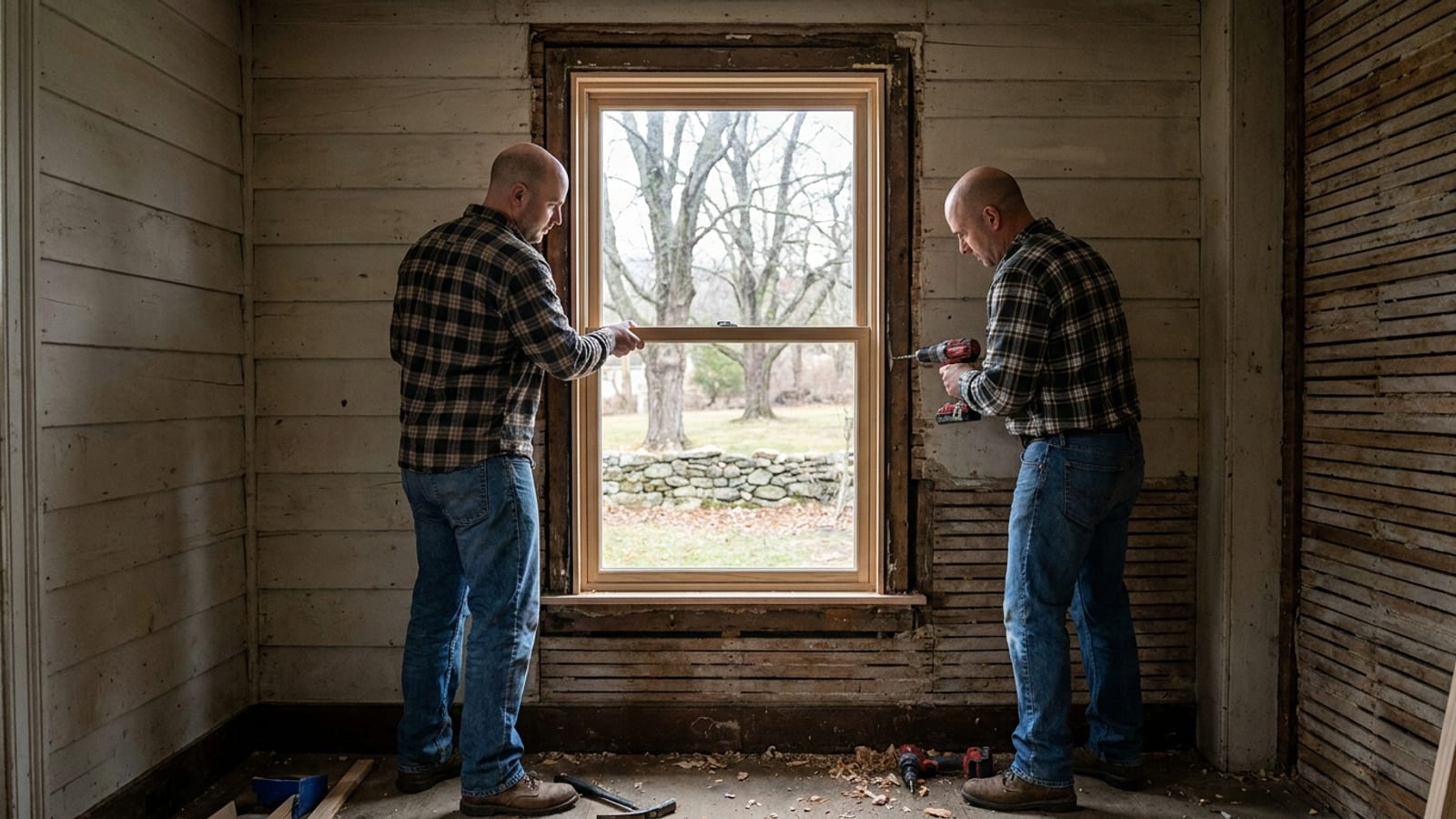
An insert replacement, sometimes called a pocket or frame-in-frame replacement, keeps the existing window frame in the wall. The sashes, the balances and the parting stops come out. A complete new window, with its own frame, goes into the cavity that is left. The interior casing, the exterior trim and the brickmold all stay where they are. From outside, the profile barely changes.
A full-frame replacement removes everything: sashes, jambs, sill, and usually the exterior trim. The crew works back to the rough opening in the framing. The new window is installed against the studs, flashed to the water-resistive barrier, insulated, and then trimmed inside and out.
The method is independent of the brand. Marvin, Andersen and Pella all build units for both approaches, and so do the value lines. It is a question about your walls, not about the window.
The cost of an insert is glass
The new unit has to fit inside the old frame, and the new unit has its own frame. That thickness comes off the daylight opening on all four sides.
| What changes | Insert | Full-frame |
|---|---|---|
| What changesGlass area | InsertReduced on all four sides | Full-framePreserved, sometimes slightly larger |
| What changesInterior casing | InsertStays | Full-frameRemoved and reinstalled or replaced |
| What changesExterior trim | InsertStays | Full-frameRemoved and replaced |
| What changesSill and framing condition | InsertNot seen | Full-frameFully exposed |
| What changesFlashing to the house wrap | InsertNot addressed | Full-frameCan be corrected |
| What changesTime per opening | InsertShorter | Full-frameLonger |
| What changesInterior patching and paint | InsertMinimal | Full-frameExpect some |
How much glass you lose depends on the frame thickness of the unit being installed. It is not dramatic on a wide picture window. It is very noticeable on a narrow bathroom or stairwell window, and it is noticeable on a bank of small double-hung units in a Colonial where the sashes were already modest. Ask for the clear opening dimensions in writing and compare them to what you have now. That is an arithmetic question with a real answer, and any quote should be able to produce it.
Where an insert is the right call
Inserts are not a compromise product. They are the correct method on a large share of Connecticut houses, and pretending otherwise is how homeowners get talked into spending more than the house needs.
An insert makes sense when the existing frame is sound, square and dry, when the exterior trim is in good condition, and when the interior casing is original and worth keeping. That last point matters in older stock — the 1920s to 1960s Colonials and Tudors around West Hartford, the Victorians in Middletown, the antique Colonials near the Guilford Green. Removing original casing to install a window is a permanent trade. Sometimes the trim is worth more than the extra inch of glass.
Inserts also finish faster, which means fewer open holes in the wall and less interior repair. On a whole-house job of ten to fifteen units, that difference is felt.
The case against inserts
An insert covers up whatever is behind the trim. If the sill is soft, if the sheathing under the window has been wet, if the original flashing was a bead of caulk, none of it gets found and none of it gets fixed. You have wrapped a new window around an old problem and paid for the privilege.
Where full-frame earns the extra money
Full-frame is the honest answer in a specific set of conditions:
- Visible rot or soft wood at the sill, jambs or the wall below the window.
- Water staining on the interior below the window, or paint that will not hold on the stool and apron.
- Frames that are out of square enough that the old sashes bind. An insert installed inside a racked frame inherits the rack.
- Steel or aluminum frames, or old wood frames with weight pockets you want insulated.
- An egress opening that is already close to the minimum.
- You want the glass back. On a house where the openings were small to begin with, full-frame is the only way to get the daylight opening you actually have in the wall.
Full-frame also allows the window to be integrated with the water-resistive barrier the way a new window would be — flashing tape at the sill, shingled laps, sealant where it belongs. That detail is invisible forever and it is the part that keeps water out of the wall for thirty years.
Egress is not a preference
Every bedroom needs at least one window meeting egress dimensions. An insert reduces the clear opening. On a window that was already sized close to the minimum, that reduction can quietly take a compliant bedroom out of compliance, which is a problem at resale and a much larger problem at three in the morning. We wrote about this in detail in how a replacement window can break bedroom egress, and it is the one place where the insert-versus-full-frame decision is made for you by the numbers rather than by budget.
Measure the existing clear opening in every bedroom before you sign anything. If a bedroom window is marginal, that opening goes full-frame even if the rest of the house does not.
Cost, in general Connecticut terms
Published ranges for Connecticut run roughly $300 to $700 per window installed for standard vinyl units, $800 to $1,500 or more per window for premium wood and fiberglass, and $5,000 to $20,000 or more for a full house of ten to fifteen. Large or custom units, common on bigger homes in Greenwich and Westport, run $1,000 to $2,500 or more each. Those are general ranges that depend on the specific house, not a quote.
Full-frame sits toward the upper end of whatever band your window choice puts you in, because it adds demolition, flashing, insulation, exterior trim and interior finish work to every opening. The unit price is the same window. The labor line is not.
Permits, historic districts and the paperwork
Most Connecticut towns do not require a permit for a like-for-like window replacement where the opening size does not change, and that is true for full-frame as well as insert work. A permit is generally required when an opening is resized, a window is added, or a header is altered.
In a local historic district, Connecticut General Statutes Sec. 7-147f(a) is the governing line. Replacing windows with similar materials does not require a Certificate of Appropriateness. Changing the material type — wood to vinyl — or changing the configuration does. Full-frame work often changes the exterior trim profile, so it is worth confirming with the commission before ordering.
Mix the two
The most useful thing to know is that this is not a whole-house decision. A crew can full-frame the three openings with rot and the one bedroom that fails egress, and use inserts on the other eleven where the frames are sound. That is normal, it is cheaper than full-frame everywhere, and it puts the money where the wall actually needs it.
When you compare quotes, look for the method listed per opening, not as a single word at the top of the page. A quote that says "replace 14 windows" without saying how is not comparable to anything.
What to do next
Go around the house with a tape measure and a screwdriver. Note the clear opening of each bedroom window. Press the point of the screwdriver into the sill and the bottom of each jamb — if it sinks, that opening is a full-frame candidate. Note which rooms have interior casing you would be unhappy to lose.
Bring that list to the estimate. You can see the unit types and glass packages we install on our window services page, and the local details for your town on the New Haven windows page and the others like it. When you are ready, request an estimate and someone will come out, measure every opening, and give you a written price that says which method each window is getting and why.