Short answer
Yes, and it happens without anyone noticing. Every bedroom needs at least one window meeting egress dimensions, and an insert replacement sits inside the existing frame, which reduces the clear opening. On a window already close to the minimum, that reduction can take a compliant bedroom out of compliance.
On this page
This is the most avoidable serious problem in window replacement, and the reason it keeps happening is that everything about the job looks like it went well.
What egress means
A bedroom needs at least one window an occupant can escape through, and a firefighter can get in through wearing equipment. That requirement is measured on the clear opening — the actual hole once the sash is fully open — not on the size of the window as ordered, and not on the size of the hole in the wall.
Frame size and clear opening are different numbers. Only one of them keeps you compliant.
Why insert replacement shrinks it
There are two ways to replace a window.
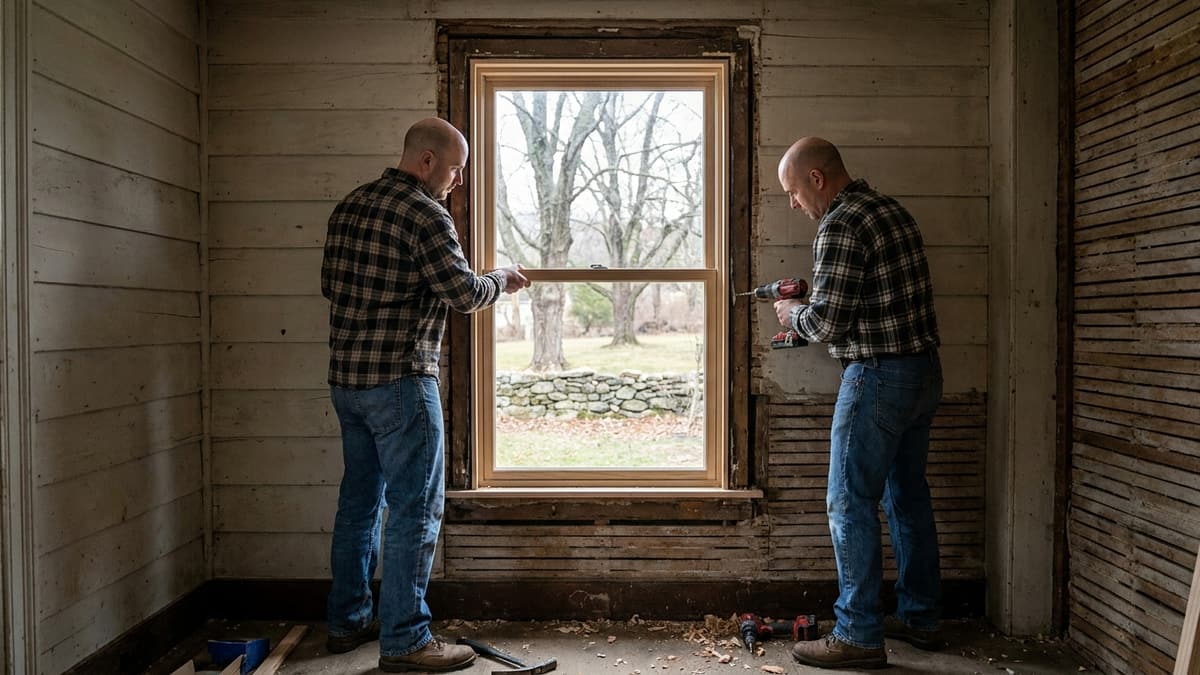
Insert replacement removes the old sashes and fits a complete new window inside the existing frame. It is faster, cheaper and less disruptive, it keeps your interior and exterior trim intact, and on most windows in most rooms it is the sensible choice.
It also means there is now a new frame sitting inside the old frame. Everything that new frame occupies comes out of the glass area and out of the clear opening. Depending on the unit, that can be a couple of inches in each direction.
Full-frame replacement takes the whole assembly out back to the rough opening. It costs more and needs re-trimming inside and out. It preserves the opening size, and it lets the installer see the condition of the framing and flashing behind the trim.
Why nobody catches it
Follow the sequence:
- A like-for-like window replacement generally needs no permit in most Connecticut towns, because the opening size is not changing.
- No permit means no plan review and no inspection.
- The finished job looks excellent. New windows, clean trim lines, better draft performance, everything operating smoothly.
- The clear opening in a bedroom is now smaller than the minimum, and there is no document anywhere that records it.
The problem surfaces later — during a sale, during an appraisal, or in the situation the requirement exists for. There is no moment during a well-run installation where anyone is prompted to measure it.
Which windows are at risk
Not all of them. The risk concentrates where the existing opening was not generous to begin with:
- Older Capes and ranches with modest bedroom windows. Connecticut has a great many of these, and they were built to earlier requirements.
- Basement and lower-level bedrooms. These are the most common problem case, because the original window frequently was not sized for escape at all.
- Dormer bedrooms, where the window is often small and the wall short.
- Casement conversions. Swapping a casement for a double-hung changes the geometry substantially — a double-hung only ever opens half its height, while a casement opens fully.
That last one is worth stressing. A double-hung sash slides up over the lower half, so the clear opening is roughly half the window's height. A casement swings clear. Replacing a casement with a double-hung of the same overall size can cut the clear opening dramatically even in a full-frame replacement.
How to handle it properly
Before ordering:
- Identify which window in each bedroom is the egress window. It is usually the largest one.
- Ask for the clear opening dimensions of the specific unit proposed, in both directions.
- Ask whether the quote is insert or full-frame for that particular window.
If the numbers are tight:
- Use full-frame replacement for that window, and insert for the rest of the house. There is no rule saying every window in a job has to be done the same way, and this is a good reason not to.
- Consider a different operating style for that opening. A casement gives more clear opening than a double-hung of the same size.
- If the original opening was already undersized, enlarging it is a permitted, inspected job — resizing an opening or altering a header does require a permit. That is a bigger project, but it is the honest fix.
The wider point about window quotes
Egress is the sharpest example of a general truth: window quotes are compared on brand and price, and the things that decide whether the job was done well are elsewhere. The clear opening, the flashing at the sill, how the gap around the frame is insulated, and whether the unit sits square in the opening matter more to the outcome than which of three good manufacturers made it.
The NFRC numbers are the other half of that picture — Connecticut sits in the ENERGY STAR Northern zone, where the requirements are a U-factor of 0.22 or lower and an SHGC of at least 0.17. We cover those in The Only Two Window Numbers That Matter in Connecticut.
Ask us for the number
We install Marvin, Andersen and Pella, and we measure bedroom openings as part of quoting a job rather than after installing one. If a bedroom is close to the line we will say so and price the alternative.
Request a free estimate, or read more about our window replacement work and the towns we serve.