Short answer
An emergency tarp is temporary mitigation priced as a service call plus materials, so the cost tracks the size of the covered area, the pitch and height of the roof, how hard the access is, and whether the crew is going up in daylight or in weather. It is worth paying for when water is actively entering the house and the permanent repair cannot happen yet. It is not worth paying for when the leak is coming from ice damming or flashing, or when the roof can simply be repaired the same week.
On this page
A tarp is a rain jacket for a roof. It keeps water out of an opening for a short, defined period while you arrange the real work. It does not repair anything, it does not restore the wind rating of the roof, and it does not stop a leak that is not coming from the hole you covered.
That last point is where most of the wasted money goes. Homeowners call for emergency tarping when the ceiling is staining, and about a third of the time the ceiling is staining for a reason a tarp cannot touch.
What drives the price
We do not publish a flat tarp price, and you should be careful with any company that quotes one over the phone before seeing the roof. Tarping is a service call plus materials, and four things move it.
| Factor | Why it changes the price |
|---|---|
| FactorCovered area | Why it changes the priceA tarp over one slope section is one job. A tarp that has to wrap the ridge and land on both slopes is closer to two. |
| FactorPitch and height | Why it changes the priceA walkable 6:12 on a ranch is a ladder job. A steep slope on a three-story Victorian means roof jacks, planks and fall protection. |
| FactorAccess | Why it changes the priceTrees, power drops, a deck or sunroom under the damaged slope, or a limb still resting on the roof all add setup time. |
| FactorConditions | Why it changes the priceDark, wet, windy, or icy all slow the work down and raise the risk, and the price reflects the crew time it actually takes. |
Materials are the smallest line. A heavy reinforced poly tarp and a bundle of furring strips cost real money but not job-changing money. What you are paying for is two people, a truck, and an hour or several on a roof in conditions nobody chose.
What a tarp job should include
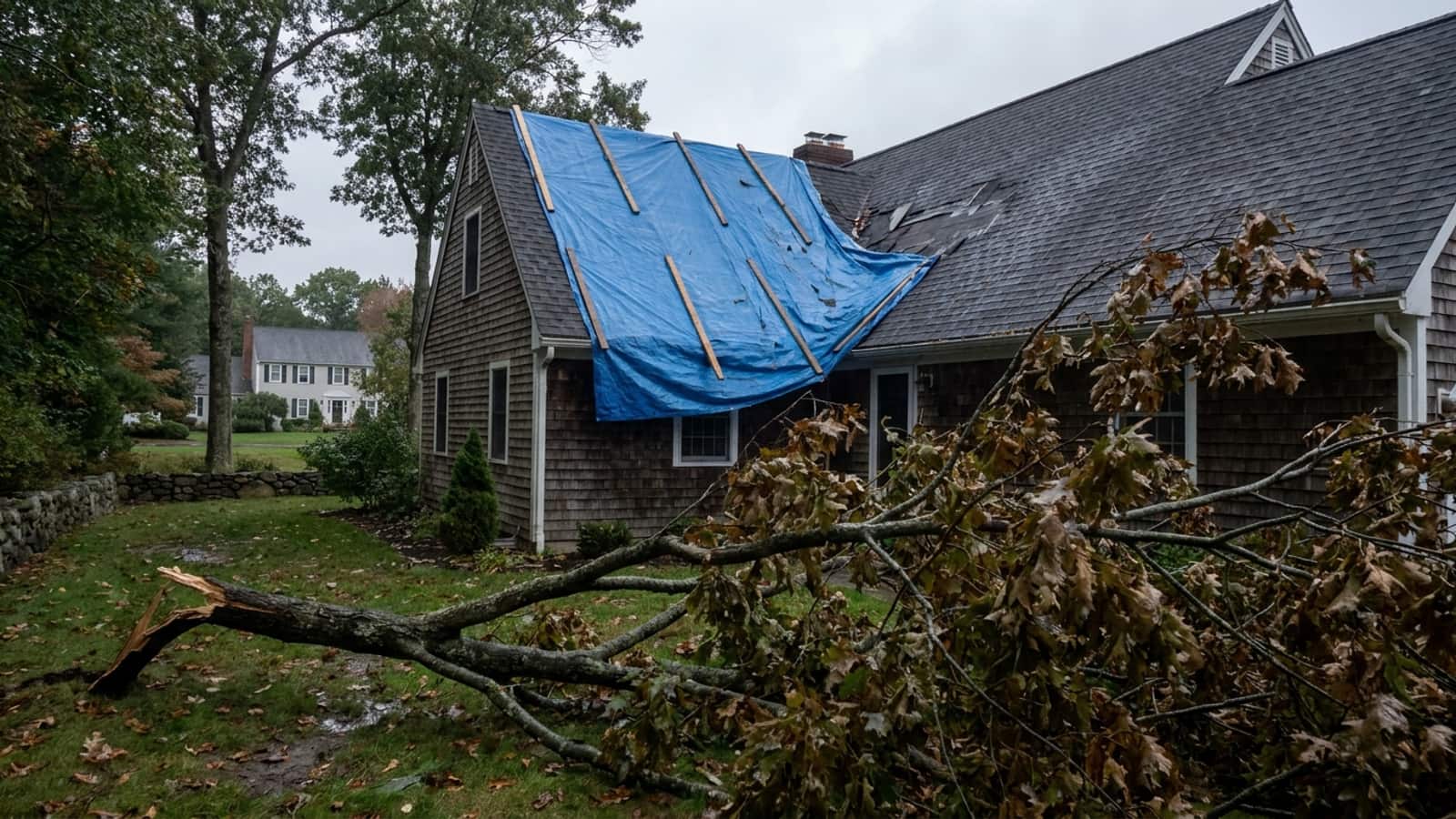
- A tarp that runs over the ridge where the geometry allows, so water cannot run under the top edge.
- Wood battens screwed through the tarp into the deck, with the tarp edge rolled around the batten rather than laid flat under it.
- No low spots where water can pond. A pool of standing water on poly finds every fastener hole eventually.
- Photographs of the damage taken before the tarp goes on.
A tarp held down by sandbags, bricks or loose lumber is a common shortcut. It survives calm weather and fails in the next gust, sometimes taking intact shingles with it as it drags. Every town we serve sits inside a designated hurricane-prone region under the state building code, with ultimate design wind speeds of 120 or 125 mph, and the shoreline towns of Guilford, Madison and New Haven carry the higher figure. A loose tarp in that environment is a sail.
When tarping is worth paying for
- Open deck. A limb punched through, or shingles and sheathing are gone and you can see daylight from the attic. Cover it now.
- Active water entry with more rain coming. The damage is known, the repair is scheduled, and there are two more days of weather between here and then.
- You are waiting on the adjuster. Nobody expects you to leave the house open while a claim is processed. Mitigation is normally the homeowner's obligation, not a favor to the insurer.
- Winter. Asphalt shingles need temperatures above roughly 40 degrees to seal properly. A February tear-off can be done, but a tarp bridging to a stretch of better weather is sometimes the better call.
- Material or permit lead time. If the shingle is backordered or the town is a few days out on the permit, a tarp covers the gap.
If a tree is still on the roof, do not tarp around it. That is a different sequence, and we have written it out separately in our guide on what to do when a tree falls on the roof.
When a tarp does not help
Ice dam leaks
Water backing up under shingles from an ice dam at the eave is not entering through a hole. A tarp over the field of the roof does nothing, and a tarp laid over the eave can trap meltwater against the sheathing. The fix is inside the attic, not on the roof surface.
Flashing and penetration leaks
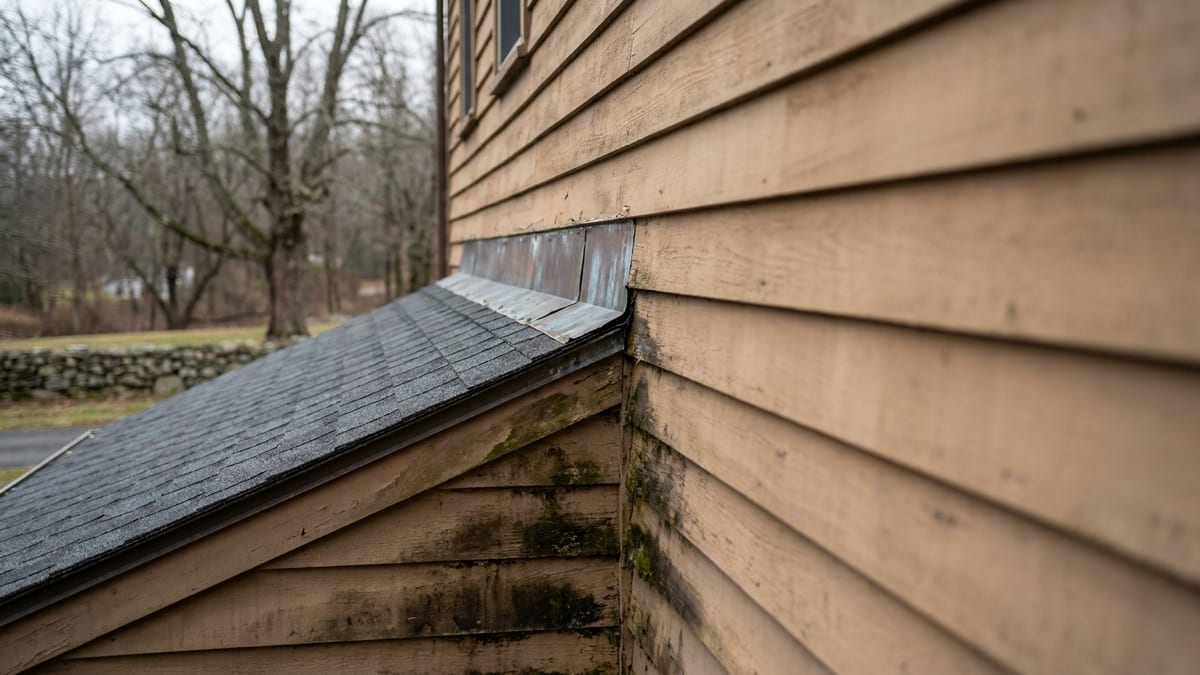
Chimney counterflashing, a failed pipe boot, a skylight curb, a step-flashed sidewall. These leaks are small, specific and usually repairable in an hour of dry weather. Paying a storm-call rate to tarp a two-foot square around a chimney is money spent to delay a cheaper job. That is ordinary roof repair work.
Low-slope and flat roofs
Tarps and ponding water do not coexist. On an EPDM or TPO roof, a patch bonded to the membrane is faster, holds longer, and does not require fastener holes through the deck.
A roof already scheduled
If the crew is coming Thursday and the forecast is dry, the tarp is a cost with no benefit. An honest contractor will say so.
Interior mitigation matters as much
Before anyone gets on the roof, do the inside work. Move furniture and electronics out of the room. Put containers under active drips. A ceiling bulging with trapped water should be relieved deliberately with a small hole over a bucket rather than allowed to let go on its own. Kill the power to any circuit near the water. Photograph everything, including the ceiling, the attic, and the wet insulation, with timestamps.
That documentation is worth more later than the tarp is. Our post on first steps after storm damage walks through the order.
What comes after the tarp
The tarp is a clock, not a solution. Use the weeks it buys to get real numbers. A tarped roof still needs either a repair or a full replacement, and that decision should be made on the condition of the whole roof, not on the one section that failed. General Connecticut replacement ranges run roughly $8,000 to $25,000 for three-tab asphalt and $10,000 to $30,000 for architectural shingles, with the spread driven by size, pitch, complexity and what is found once the old roof is off. Those are ranges for the state, not a quote for your house.
If you are dealing with wind, hail or tree damage, our storm damage work starts with an inspection and photo documentation, and we deal with the insurance carrier directly through the claim.
When the emergency part is over and you want a real price for the permanent work, request an estimate. Someone comes out, gets on the roof, measures it, and gives you a written itemized price. That appointment is free and it is also a sales appointment, which is what any on-site estimate is.