Short answer
An insert replacement sits inside the existing window frame and normally leaves your interior casing, stool and apron in place, with a new stop or small trim piece added at the perimeter. A full frame replacement removes the old frame, so the interior trim comes off and often does not survive the removal intact. Ask which method is being quoted, because that answer decides whether you are also buying trim carpentry and paint.
On this page
Interior trim is the part of a window project homeowners think about last and notice first. The glass is behind a curtain most of the day. The casing is at eye level in your living room, and if it comes back out of square, painted a slightly different white, or caulked in a thick bead to hide a gap, you will see it every day for as long as you own the house.
This post covers what actually happens to the wood inside your room during a window replacement, which installation method disturbs what, and the specific lines to look for on a quote. We have written separately about the broader choice between insert and full frame replacement; this one stays inside the room.
The parts, by name
Using the right words makes a quote much easier to read.
- Casing. The flat boards framing the opening on the wall face, mitered or butted at the corners.
- Stool. The interior shelf at the bottom, the piece people call the sill. The actual sill is on the outside and slopes away.
- Apron. The short piece of trim directly under the stool.
- Jamb extension. Filler that bridges from the window frame out to the plaster or drywall face when the wall is thicker than the unit.
- Stop. The thin strip holding the sash in place on an older double hung, and on an insert job often the only new interior wood installed.
A quote that names these parts tells you the estimator looked at your walls. A quote that says "trim as needed" tells you nothing.
Insert replacement: the trim usually stays
An insert, sometimes called a pocket replacement, removes the sashes, the parting bead and the balance system, then sets a complete new window inside the existing frame. The exterior gets capped in aluminum. Inside, the casing, stool and apron typically stay on the wall.
What changes inside:
- The old interior stop comes off and new stop goes back, because the new unit sits proud of where the sash used to run.
- A small gap between the new frame and the old jamb gets insulated and then concealed, often by that new stop plus caulk.
- Your visible glass area shrinks, because the new frame is nested inside the old one. On a window that was already close to the minimum, this is how a bedroom can quietly fall out of egress compliance.
The honest downside of the insert method is not trim damage. It is that you keep whatever the old frame has become. If the sill framing is soft, an insert hides the problem behind a new window rather than solving it.
Full frame replacement: the trim comes off
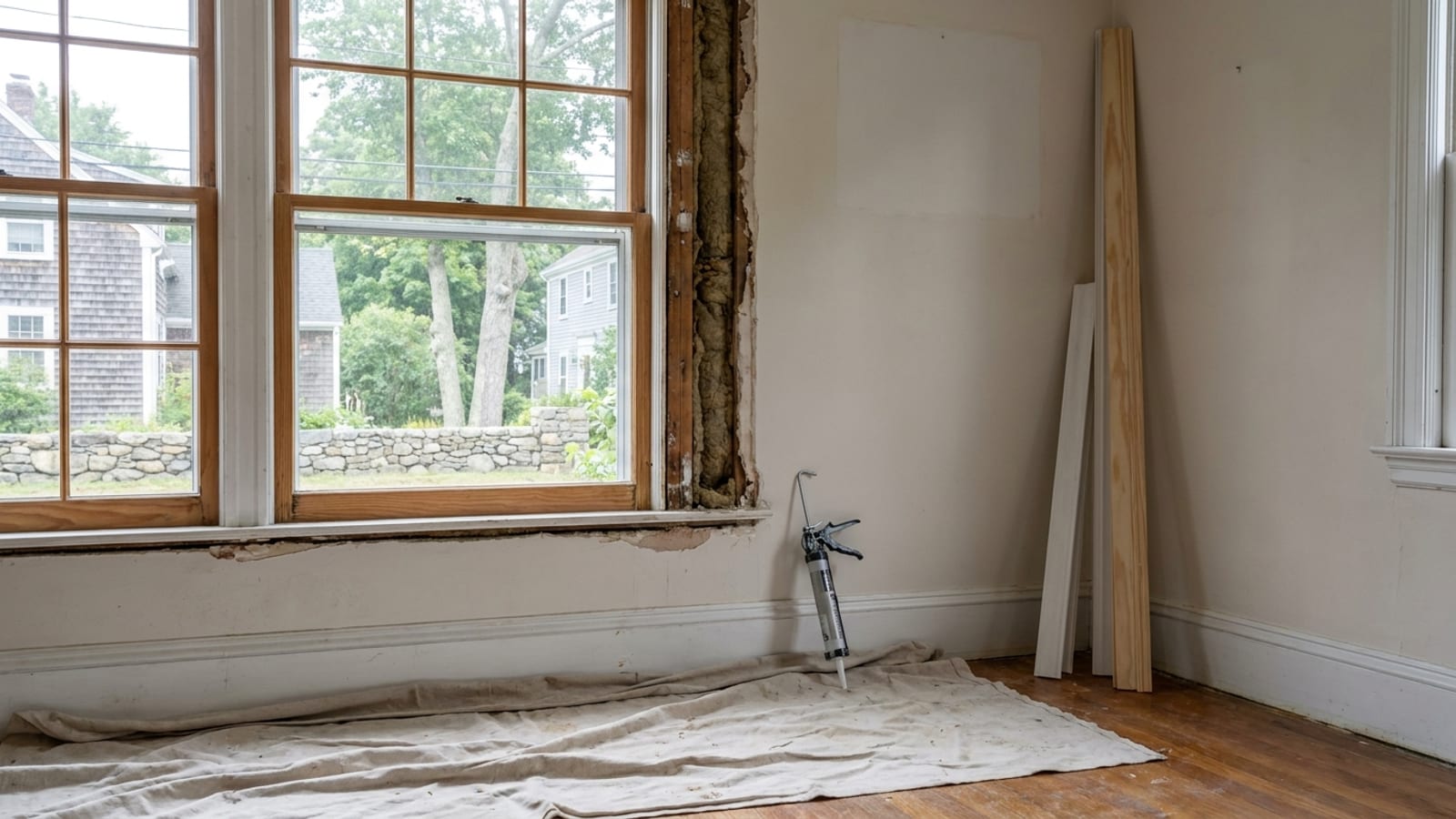
A full frame job removes the sashes, the jambs, the old sill and everything back to the rough opening. To get there, the interior casing has to come off. There is no version of this that leaves your trim untouched.
Whether the old trim can be reused depends on what it is. Thick, solid stock from a 1920s Colonial in West Hartford or an antique house in Farmington often comes off cleanly if the installer scores the paint line first and pulls the finish nails through the back rather than hammering them out the face. Thin modern casing, finger jointed trim and anything with five layers of brittle paint tends to split at the miters.
What a reasonable crew does
- Scores the caulk and paint joint with a blade before prying, so the paint film does not peel a strip of wall with it.
- Labels pieces by opening if they are being reused, because trim cut for one window rarely fits the next one in an old house.
- Protects the floor and furniture, and controls dust at the opening rather than after the fact.
- Insulates the gap between frame and rough opening with low expansion foam or dense packed fiberglass, not with caulk alone.
Comparing the two inside the room
| Interior item | Insert replacement | Full frame replacement |
|---|---|---|
| Interior itemCasing | Insert replacementUsually stays in place | Full frame replacementRemoved, reused if it survives |
| Interior itemStool and apron | Insert replacementUsually stay | Full frame replacementNormally removed |
| Interior itemJamb extensions | Insert replacementRarely needed | Full frame replacementOften needed and new |
| Interior itemInterior stop | Insert replacementNew | Full frame replacementNew |
| Interior itemPaint touch up | Insert replacementLocalized, around new stop | Full frame replacementFull perimeter, sometimes wall |
| Interior itemWall or plaster repair | Insert replacementUncommon | Full frame replacementPossible at the trim edge |
| Interior itemRough opening inspected | Insert replacementNo | Full frame replacementYes |
Neither column is the right answer for every house. Inserts make sense when the existing frames are sound and square. Full frame makes sense when they are not, when you want the lost glass area back, or when the trim was going to be redone anyway.
Paint and the match problem
Two practical realities catch homeowners off guard.
First, new primed trim next to twenty year old painted trim will not match even if the color code is identical. Old paint has yellowed, and sheen changes with age. On a room where only some windows are being done, plan on painting all the trim in that room or accept a visible difference.
Second, stained wood casing cannot be touched up the way painted casing can. If you have natural oak or chestnut trim, say so early. Matching species, grain and stain is finish carpentry work, and most window quotes do not include it unless it is written in.
Lead paint changes the procedure
If the house was built before 1978, disturbing painted trim falls under the federal Renovation, Repair and Painting rule. That means containment, specific work practices and cleanup verification, and it applies to interior casing removal just as it applies to exterior work. It affects schedule and price. Our post on the RRP rule in Connecticut covers what the homeowner actually sees on site.
This matters disproportionately here because so much of the housing stock predates it, from Hartford multi families to shoreline cottages in Guilford and Madison.
What the quote should say
While you are checking trim scope, check the two performance numbers as well. All of Connecticut is in the ENERGY STAR Northern climate zone, and under version 7.0, effective October 2023, a qualifying window needs a U-factor of 0.22 or lower and a solar heat gain coefficient of at least 0.17. The SHGC is a minimum, not a maximum, because in a heating dominated climate a window that blocks too much sun throws away free winter heat. Both numbers print on the NFRC label.
On the trim side, look for these lines:
- Installation method stated as insert or full frame, per opening.
- Interior stop, jamb extension and casing listed with material, primed or unprimed.
- Who paints, and how many coats.
- Caulk and insulation detailed at the perimeter.
- Debris removal and daily cleanup.
- A stated allowance or unit price for hidden sill or framing repair found after the old unit comes out.
For context on cost, standard vinyl replacement windows in Connecticut generally run $300 to $700 per window installed and premium wood or fiberglass units $800 to $1,500 or more, with a full house of ten to fifteen windows landing anywhere from $5,000 to $20,000 or more. Those are general ranges, not a quote, and interior finish carpentry sits on top of them. Our window service page and the installation process outline describe how the measuring, ordering and trim finishing steps fit together.
The practical takeaway
If your frames are sound and you want the least disruption inside the room, an insert is the lower impact choice and your casing most likely stays where it is. If you want the opening opened up, the framing inspected, and the glass area restored, accept that the trim is coming off and budget for carpentry and paint as part of the project rather than as a surprise at the end.
When you are ready for real numbers, request an estimate. Someone comes out, measures each opening, looks at the trim you have, and gives you a written price that says which method is being used and what happens to the wood inside your room.