Short answer
A complete replacement window quote names the brand, product line, frame material, glass package and NFRC numbers for every unit, and states in writing whether screens, locks and lifts, interior and exterior trim, insulation, caulking and debris removal are included. Screens and hardware normally come with the window, but half screen versus full screen and standard versus upgraded hardware are specification choices that belong on the page. Anything not written down is either a line you get billed for later or a line you simply do not get.
On this page
A replacement window quote is one page that has to answer about a dozen separate questions. Most of the disputes that come up later are not about price. They are about something that was discussed out loud at the kitchen table and never written on the page: which screen, which hardware finish, who fixes the rotted sill, who hauls away the old sash, and whether the trim on the inside gets replaced or painted around.
This post is a checklist of what belongs on the document before you sign it. It is deliberately narrow. If you are still deciding between installation methods, the comparison of insert versus full-frame replacement covers that question in depth, and the two performance numbers that matter in Connecticut are covered separately as well.
The unit itself
The quote should name the manufacturer and the product line, not just the brand. Every major manufacturer sells several tiers. "Andersen windows" could mean two very different windows at two very different prices. The line name is what makes the price checkable.
Alongside it you should see:
- Frame material — vinyl, fiberglass, composite, clad wood or wood.
- Window type and operation for each opening — double-hung, casement, slider, picture, awning, bay or bow.
- Size, by opening, usually as a per-window schedule rather than one lump count.
- Exterior and interior color or finish, because those are ordered, not chosen on install day.
- Grille pattern, if any, including whether grilles are between the glass or applied.
A schedule with a line per opening also protects you at measurement. Replacement windows are custom-ordered to the opening, and a quote that says "12 windows" without sizes is a quote nobody can verify against what arrives on the truck.
Glass and performance numbers
All of Connecticut sits in the ENERGY STAR Northern climate zone. Under version 7.0, effective October 2023, a qualifying window needs a U-factor of 0.22 or lower and a solar heat gain coefficient of at least 0.17. The SHGC figure is a minimum. In a heating-dominated climate, glass that blocks too much solar gain throws away free winter heat.
Both numbers are printed on the NFRC label of the unit being quoted, which means they can be written into the quote. If the glass package is described only as "Low-E with argon," ask for the two numbers. Manufacturers offer several Low-E coatings with meaningfully different results.
Screens
Screens are included with almost every operable replacement window, so the question is never whether, it is which.
- Half screen. Covers the lower sash opening on a double-hung. This is the standard inclusion on most lines.
- Full screen. Covers the full height, so the upper sash can be lowered for ventilation. Usually an upcharge per unit.
- Screen mesh. Standard fiberglass mesh is the default. Finer insect mesh and higher-visibility mesh cost more per unit.
- Casement screens sit on the interior and are a different part entirely. On a casement window the screen is in front of the crank, which is worth seeing in person before you commit to a houseful of them.
Picture windows and other fixed units do not get screens because they do not open. If a quote lists a screen allowance for a fixed unit, that is a clerical item worth catching.
Hardware
Standard locks, lifts and tilt latches come with the window at the base price. What is priced separately:
- Hardware finish upgrades beyond the standard white, almond or bronze offered in the line.
- Window opening control devices, sometimes specified on upper-floor bedrooms.
- Crank handle upgrades, including folding handles that clear a blind or shade.
- Keyed or child-resistant locks where they are wanted.
None of these are large numbers individually. Across fourteen windows they add up enough to notice, which is exactly why they belong on the page rather than in a conversation.
Installation scope, which is where the money actually is
Two quotes using the same window can differ by thousands because they are describing different amounts of work. The quote should state, in plain terms:
| Line item | What a clear quote says |
|---|---|
| Line itemInstallation method | What a clear quote saysInsert into existing frame, or full-frame tear-out to the rough opening |
| Line itemInterior finish | What a clear quote saysExisting casing reused, or new casing, stool and apron, primed or finished |
| Line itemExterior finish | What a clear quote saysAluminum coil wrap, new PVC or wood trim, or existing trim left in place |
| Line itemAir sealing | What a clear quote saysLow-expansion foam or fiberglass at the perimeter, and flashing details |
| Line itemCaulking | What a clear quote saysExterior sealant type and where it is applied |
| Line itemRot and framing repair | What a clear quote saysPriced per unit in advance, or billed as discovered at a stated rate |
| Line itemDebris removal | What a clear quote saysOld sash, frames, screens and packaging hauled off |
| Line itemCleanup | What a clear quote saysDaily and final, including glass and fastener pickup |
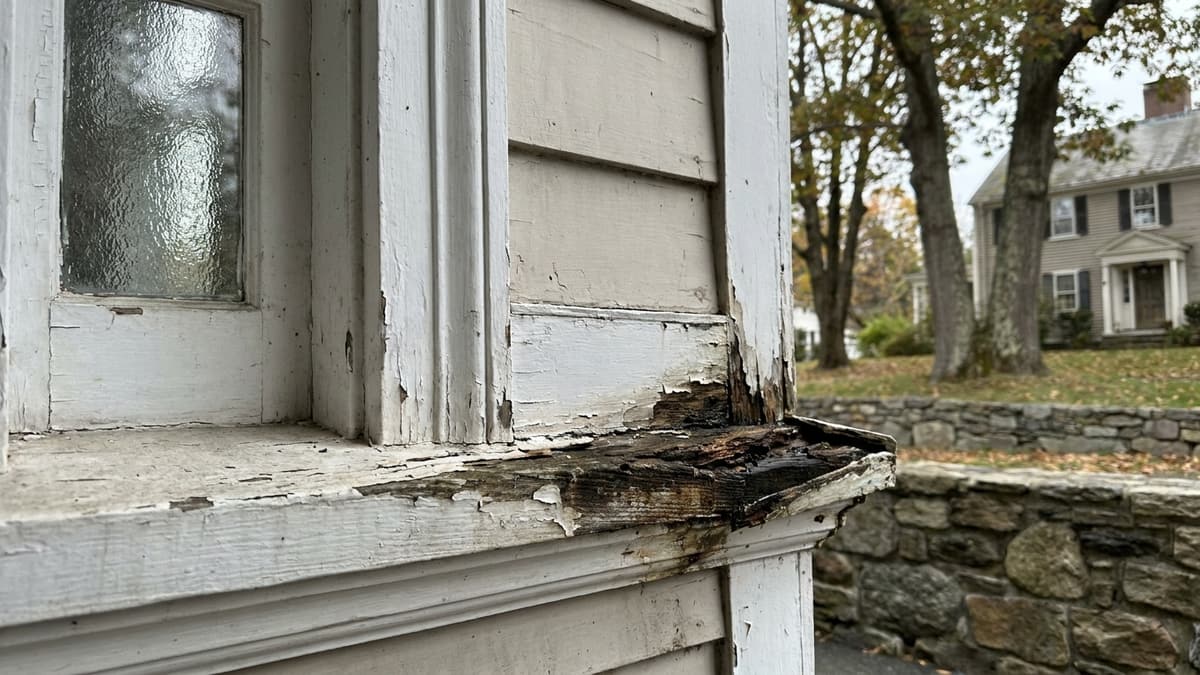
The rot line is the one people skip. Nobody knows what is under a thirty-year-old sill until the old unit comes out. A quote that carries a stated per-unit rate for sill or jamb repair is being honest about an unknown. A quote that is silent on it has simply moved the conversation to the middle of the job.
Permits, egress and historic review
Most Connecticut towns do not require a permit for a like-for-like window replacement where the opening size does not change. A permit is generally required if an opening is resized, a window is added, or a header is altered. If the scope includes any of that, the quote should name who pulls the permit and whether the fee is in the price.
Separately from permits, every bedroom needs at least one window meeting egress dimensions, and an insert replacement reduces the clear opening because the new unit sits inside the old frame. On a bedroom window already near the minimum, that reduction matters, and it is a measurement question to settle before the order goes in.
In a local historic district, Connecticut General Statutes Sec. 7-147f(a) does not require a Certificate of Appropriateness for replacement in similar materials. It does require one when the material type or the configuration changes, such as wood to vinyl. That is a calendar item, not a cost item, but it belongs in the project schedule.
What the numbers generally look like
These are broad Connecticut ranges that depend heavily on the house, the opening sizes and the installation method. They are not a quote.
| Category | General installed range |
|---|---|
| CategoryStandard vinyl windows | General installed range$300 to $700 per window |
| CategoryPremium wood or fiberglass | General installed range$800 to $1,500 or more per window |
| CategoryLarge or custom units | General installed range$1,000 to $2,500 or more per window |
| CategoryFull house, 10 to 15 windows | General installed range$5,000 to $20,000 or more |
Large and custom units are more common in Greenwich and Westport, where original openings tend to be bigger, and that alone can move a whole-house total well past the typical band.
The case for the shorter quote
An honest counterpoint: a long, itemized quote is not automatically the better deal. Some companies itemize because every line is an upsell waiting to happen, and the base number looks competitive only because the trim, the screens and the disposal were stripped out of it. A one-page quote from a contractor who writes "all openings finished inside and out, all debris removed, all screens included" is more useful than three pages of line items that each end in "additional."
What you want is not length. It is a document where every question above has an answer, and where nothing material is left to be decided after the deposit.
What the estimate appointment is
Someone comes to the house, measures each opening, looks at the existing frames and sills, discusses frame material, operation type, glass package, screens and hardware, and then produces a written price. It is a sales appointment, and treating it as one is fine. Bring the checklist above and ask for the specification in writing before you compare it to anything else.
If you want a quote built that way on your house, you can see what we install on the windows page, including double-hung units, and then request an estimate.