Short answer
Rotted decking is billed on top of the roof price, normally as a per-sheet unit rate agreed before the crew starts, because nobody can see the sheathing until the old roof is off. On most Connecticut homes only a few sheets are bad and the addition is modest, while a roof that leaked for years or carried two layers of shingles can need far more. Get the unit price written into the contract before the tear-off, not negotiated after.
On this page
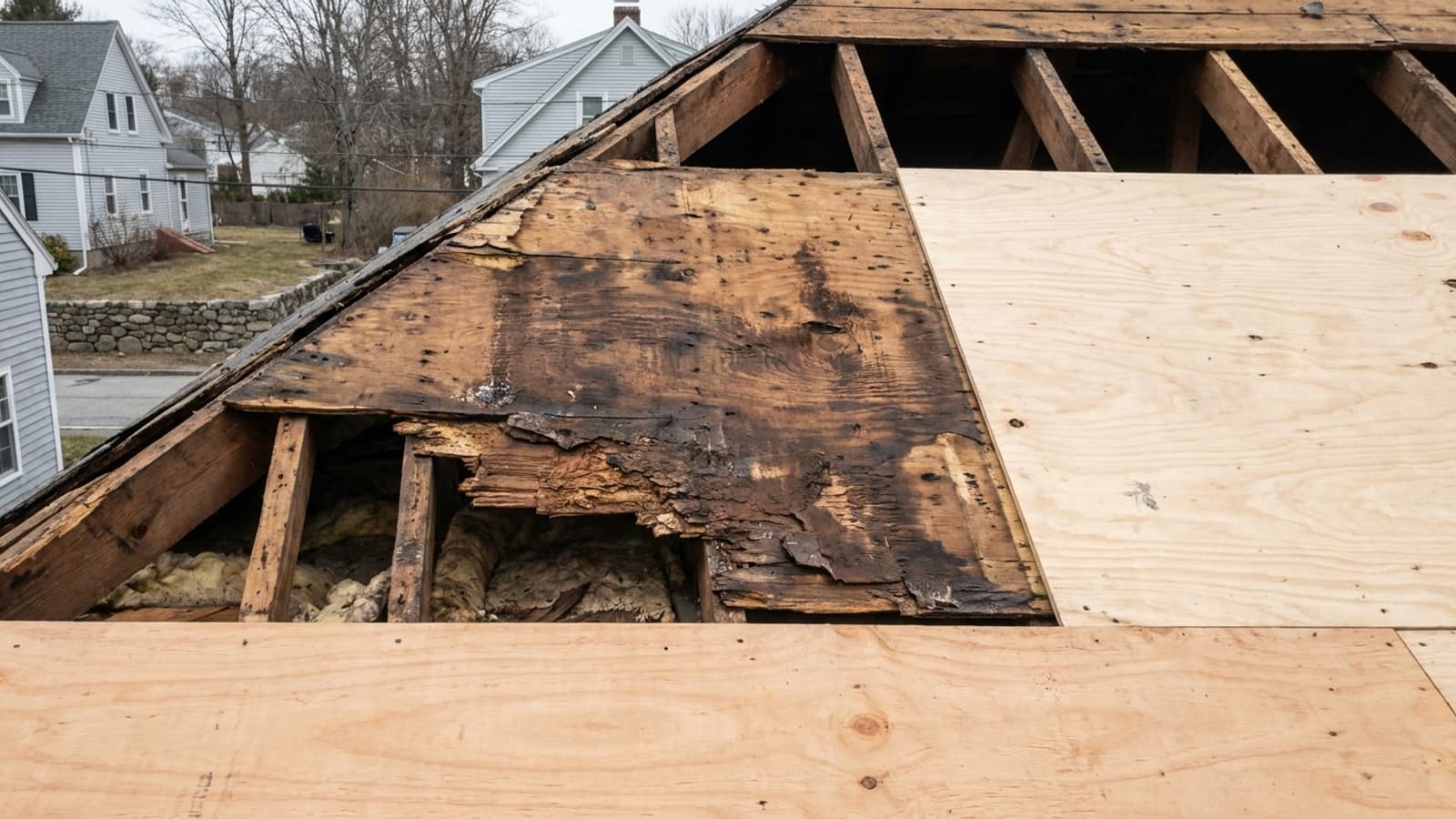
Rotted decking is the one line on a roofing project that no one can price in advance. The sheathing sits under the old shingles and the underlayment, and until both come off, nobody knows what condition it is in. That is why decking is handled as an extra rather than being folded into the base price, and why the way a contractor writes that extra tells you a lot about the contractor.
On most Connecticut homes the answer turns out to be a few sheets. On a roof that has been leaking quietly for a decade, or one that had a second layer of shingles laid over the first, it can be a large share of the deck. Both outcomes are normal. What should never be normal is finding out the price after the wood is already on the ground.
Why it cannot be quoted up front
A roofing estimate is built from measurable things: squares of roof area, linear feet of ridge, valley and drip edge, the number of penetrations, the pitch, the number of stories. Sheathing condition is not measurable from the driveway or from a drone photo. Some of it is visible from the attic — dark staining on the underside of the plywood, delamination, daylight where there should be none — but attic access rarely reaches the eaves, the valleys or the area behind a chimney, which is exactly where the problems concentrate.
So the estimate assumes the deck is sound and prices the replacement of what is not. Our full sequence for a tear-off, including the deck inspection step, is laid out on the roof replacement section of our roofing page.
How decking should appear on a quote
A unit price, not a vague allowance
The defensible way to write it is a stated dollar amount per 4-by-8 sheet of plywood or OSB of a named thickness, replaced and fastened, with the homeowner notified before any of it goes in. Some contractors include a small allowance — two or three sheets at no charge — and charge the unit rate beyond that. That is fine as long as the rate itself is on paper.
We do not publish a per-sheet number here, because sheathing pricing moves with the lumber market and with thickness, and a number in a blog post would be out of date before it helped anyone. Ask for the current rate in writing and ask what thickness it covers. If a quote says only "decking replaced as needed," it says nothing.
What counts as a sheet
A cut-out repair rarely lines up neatly with a full sheet. Good practice is to cut back to the center of the rafters on either side of the bad area so the new piece is supported on both edges, which usually means removing more material than is actually rotten. Ask whether you are billed for sheets installed or square footage of rot found. Sheets installed is the standard, and it is the honest one, because that is what the crew buys and handles.
Where rot actually shows up
Water damage on a roof deck is not random. It follows the same few paths on nearly every house.
The first few feet above the eaves
This is the ice dam zone. Meltwater backs up behind ice at the cold overhang, sits on the deck under the shingles and soaks in over multiple winters. It is the single most common location for soft sheathing in this state, and it is a symptom of an attic problem rather than a roof problem — which is the subject of our post on why Connecticut roofs leak in winter.
Valleys, chimneys, skylights and sidewalls
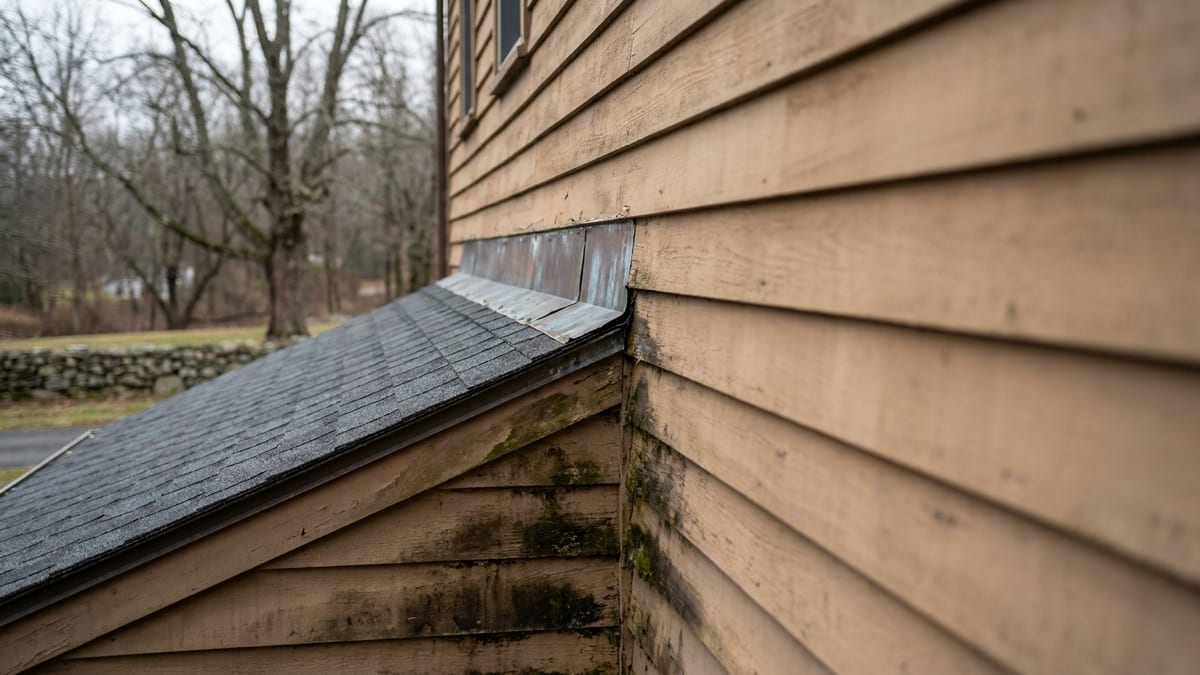
Anywhere two planes meet, or a roof meets a wall, the flashing is doing the work. Old step flashing that was reused, mortar-joint counterflashing that has failed, or a valley lined with nothing but rolled roofing will all move water into the deck slowly enough that no one notices a ceiling stain.
Around plumbing and exhaust vents
A pipe boot with a cracked rubber collar leaks a small amount of water in a small area for years. The result is often a neat, saturated circle around the penetration that is fully rotten while the sheathing three feet away is perfect.
Under a second layer of shingles
A roof-over traps whatever moisture was already in the assembly and hides the evidence. When both layers finally come off, the deck below can be in poor shape across large areas. We covered the wider trade-offs of that approach in our post on roofing over versus tearing off.
Why sound decking is not optional
It is tempting to treat sheathing replacement as an upsell. It is not, for one specific mechanical reason: a shingle's wind rating depends entirely on its fasteners holding.
Every town we serve is inside a designated hurricane-prone region, with an ultimate design wind speed of 120 mph, or 125 mph in Guilford, Madison and New Haven. Manufacturers earn their high-wind ratings on the condition that nails are driven flush, in the correct nail zone, and anchored in solid wood — commonly six nails per shingle rather than four for high-wind coverage. A nail driven into a delaminated or punky sheet has almost no withdrawal resistance. The shingle above it is rated on paper and unrated in practice.
Soft decking also telegraphs. Waves and dips in a finished roof are usually not the shingles. They are the substrate underneath, and they are permanent once the new roof is on.
What the extent usually looks like
| Situation | Typical extent of decking work | Why |
|---|---|---|
| SituationSingle-layer roof, 20 to 25 years old, ventilated attic | Typical extent of decking workA few isolated sheets, often none | WhyRot confined to vent boots or one valley |
| SituationHistory of ice damming at the eaves | Typical extent of decking workA continuous band along the lower edge | WhyRepeated winter saturation in the same zone |
| SituationTwo layers being removed | Typical extent of decking workAnywhere from a few sheets to most of a slope | WhyTrapped moisture and hidden prior leaks |
| SituationKnown interior stain never traced | Typical extent of decking workLocalized but often larger than expected | WhyWater travels along rafters before it drips |
| SituationPlank deck on a pre-war house | Typical extent of decking workSelective board replacement, sometimes overlay | WhyBoards fail individually rather than in sheets |
Those are patterns, not promises. The point of the table is that the extent is predictable in kind and unpredictable in amount.
Plank decking on older houses
Many Connecticut homes built before roughly 1950 have board sheathing rather than plywood — nominal one-inch planks running perpendicular to the rafters, sometimes with gaps between them. Around the Victorians and older housing stock common in places like Hartford, this is the norm rather than the exception.
Board decks are not a defect. Sound planks hold nails well. Two things do come up. First, wide gaps between boards mean some fasteners land in air, so the deck may need an overlay of thin plywood to give the shingles a continuous nailing surface. Second, individual rotten boards are replaced one at a time, which is slower work than swapping a sheet and is priced differently. Ask how your contractor bills board replacement, because a per-sheet rate does not translate cleanly.
Questions worth asking before the crew arrives
- What is the per-sheet price, and what thickness does it cover?
- Are any sheets included at no charge before the rate starts?
- Will I be notified and shown photos before replacement wood goes in?
- How is board sheathing handled if my house has it?
- Is the disposal of removed decking included in the tear-off?
The answers take five minutes and remove the single most common source of dispute on a roofing job.
Putting it in context
A typical Connecticut asphalt roof runs roughly $8,000 to $25,000, and $10,000 to $30,000 for architectural shingles, depending on the house. Those are general ranges rather than a quote, and the drivers behind them are broken down in our post on what a new roof costs in Connecticut. On most projects, decking is a modest adjustment inside that spread. On a small minority it is significant, and on those roofs it is also the work that matters most, because everything above it is fastened to it.
If you want a written price with the decking rate spelled out before anything is torn off, you can request an estimate. Someone comes out, inspects the roof and the attic, measures, and gives you an itemized price in writing.