Short answer
A full tear-off is the right default in Connecticut because it is the only version of the job that lets the crew see the deck and install an ice barrier at the eaves. A second layer over existing shingles is legal when the old roof is a single, sound layer of asphalt, and it saves the removal and disposal cost. On most houses that saving does not cover what you give up in information and roof life.
On this page
A layover, also called a roof recover, means new asphalt shingles installed directly over the existing ones. It is legal in Connecticut under defined conditions, and it is cheaper than tearing the old roof off. It is also the version of the job that tells you the least about your house, and it removes two details that matter more here than in most of the country: a look at the deck, and a proper ice barrier at the eaves.
That is the case in one paragraph. The rest of this post is the detail behind it, including the situations where a recover is a defensible choice rather than a shortcut.
What the code allows
The residential portion of the 2022 Connecticut State Building Code is the 2021 International Residential Code. Section R908.3 covers roof recover, and the list of situations where it is not permitted is short enough to read yourself before anyone quotes you.
A recover is not allowed when:
- The existing roof or roof covering is water-soaked or has deteriorated to the point that it is no longer adequate as a base for additional roofing.
- The existing roof covering is wood shake, slate, clay, cement or asbestos-cement tile.
- Two or more applications of any type of roof covering are already in place.
The practical translation is that a recover is only ever on the table for a house with exactly one layer of asphalt shingles that is still flat, sound and dry. If your roof already has two layers, the decision has been made for you. If it is cedar shake or slate, the same.
There is a second, less quoted requirement: the existing surface has to give the new shingles a reasonably even base. Old shingles that have curled, cupped or lost their bond telegraph through the new layer. That is not only cosmetic. A shingle that is not lying flat is not sealing the way its wind rating assumes.
The permit is the same either way
A recover is roofing work, and roofing work needs a building permit in every town we serve. The town issues it and inspects the result. Only a contractor registered as a Home Improvement Contractor may pull it for you. If a quote for a layover is priced as though it were maintenance rather than a permitted job, that is worth a question. The permit rules for Connecticut roof work do not relax because the old shingles are staying put.
The four things a tear-off buys
You get to see the deck
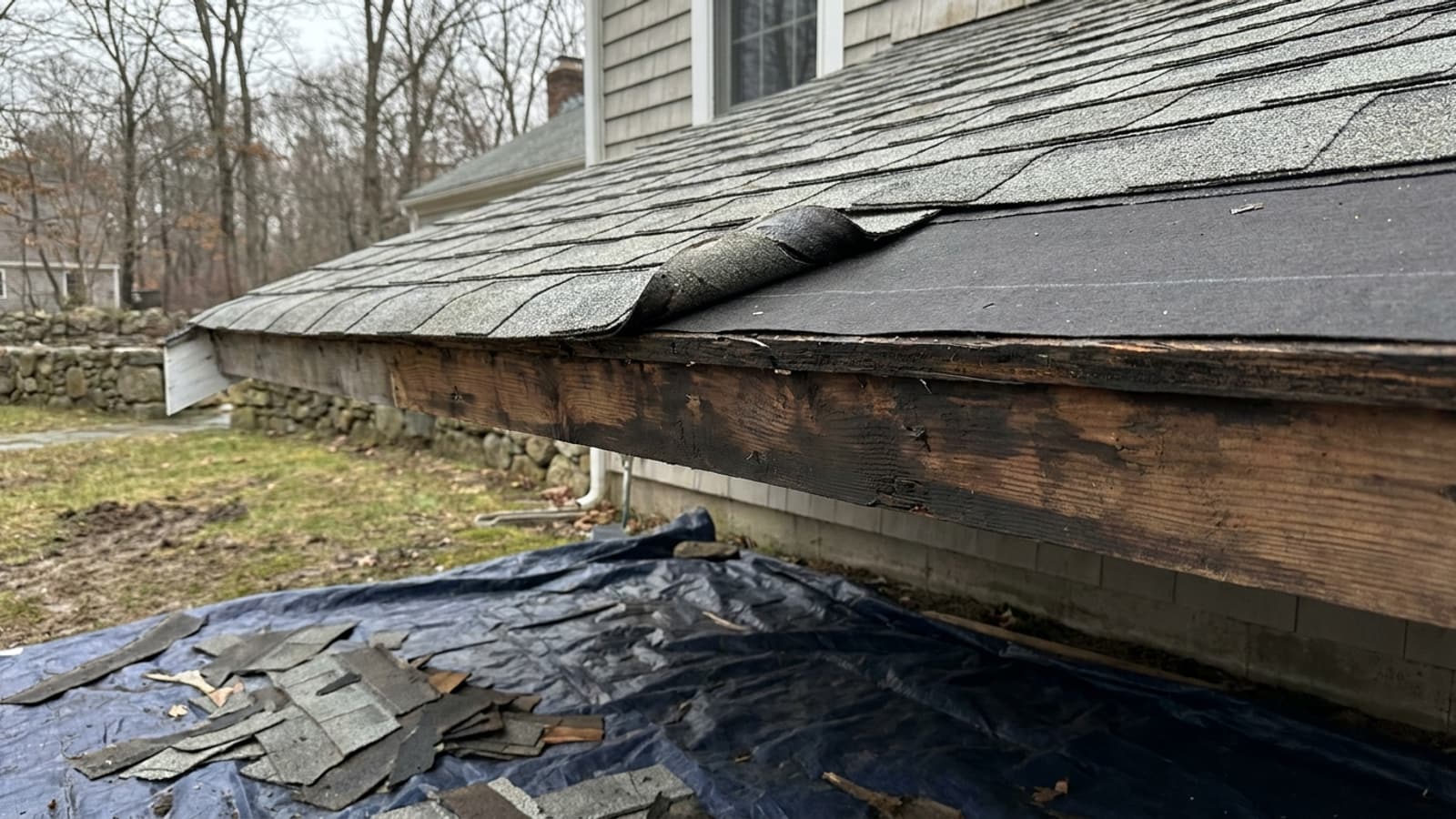
This is the largest item on the list. Once the shingles are off, the crew is standing on bare plywood or board sheathing and can find soft spots, delamination, old leak paths around chimneys and valleys, and nail pops. On a recover, none of that is visible. You are paying for a 25 to 30 year roof covering and placing it on a substrate nobody has looked at.
On post-war housing stock, where original or near-original roofs are common in towns like Manchester, the deck is usually where the surprises live. Deck repair adds cost, but the cost of finding it now is far lower than the cost of finding it in year six.
You can install an ice barrier at the eaves
The code requires an ice barrier in areas with a history of ice forming along the eaves, running from the lowest edge of the roof to a point at least 24 inches inside the exterior wall line. Connecticut qualifies. That barrier is a self-adhering membrane that has to bond to the deck. There is no way to install it in a recover, because the deck is under a layer of shingles you are not removing.
If your house has ever had an ice dam back water up under the shingles, a recover leaves the single most effective defense against a repeat out of the job.
The fastening can be done to specification
Roofing nails have to penetrate through the sheathing or at least three quarters of an inch into it. Adding a layer of shingles means the nail has more material to cross before it reaches wood, so the fastener length has to increase. Standard nails driven into a two-layer stack can hang up in old shingle mat and stop short of real holding power.
That matters here because of the wind figures. Appendix AY of the state code assigns 120 mph to most of the towns we serve and 125 mph to Guilford, Madison and New Haven, and every one of them sits in a designated hurricane-prone region. A shingle earns its wind rating only when it is fastened the way the manufacturer specifies to earn it, which for high-wind coverage usually means six nails per shingle in a defined nail zone. A recover does not make that impossible, but it makes it easier to get wrong and impossible to verify afterward.
The warranty is a full system
Enhanced manufacturer coverage is written around a set of components installed together on a clean deck: leak barrier, underlayment, starter, field shingles, hip and ridge, and ventilation. A recover cannot include several of them. Basic material coverage generally still applies over one existing layer, but the higher tiers usually do not. Ask which tier the quoted job qualifies for and get the answer in writing rather than in conversation.
Weight, and why it is a smaller issue than people think
A second layer of architectural shingles adds roughly 250 to 400 pounds per 100 square feet of roof area. Against a ground snow load of 30 psf in most of our towns, and 35 psf in Avon, Farmington and Simsbury, that added dead load is real but modest on framing built to code.
Where it becomes a live question is on older, lighter framing, on long rafter spans with no collar ties or purlins, or on a house that has already been modified. Weight is a reason to ask a question, not a reason on its own to reject a recover.
What you actually save
The savings from a recover is tear-off labor and disposal. It is not shingles, not underlayment where it is used, not flashing, not the permit, and not the crew days spent installing. That is why a layover rarely comes anywhere close to halving the price of a roof.
| Item | Full tear-off | Recover |
|---|---|---|
| ItemRemoval labor and dumpster | Full tear-offIncluded | RecoverNot incurred |
| ItemDeck inspection and repair | Full tear-offPossible | RecoverNot possible |
| ItemIce barrier at eaves | Full tear-offInstalled | RecoverCannot be installed |
| ItemFuture removal cost | Full tear-offOne layer | RecoverTwo layers to strip |
| ItemEnhanced warranty eligibility | Full tear-offTypically available | RecoverUsually not |
The last row is the one people forget. When the recovered roof reaches the end of its life, the next homeowner pays to remove two layers instead of one. Part of what a layover saves today is simply deferred to the next job.
For context on where the whole number lands, general Connecticut ranges run about $8,000 to $25,000 for a three-tab asphalt roof and $10,000 to $30,000 for architectural shingles, with cedar shake starting near $20,000. Those are ranges for the state, not a price for your house.
When a recover is a defensible choice
There are honest cases for it:
- A single sound layer of asphalt on a simple gable roof with no leak history and no interior stains.
- A garage, an addition or an outbuilding where the consequences of a hidden deck problem are small.
- A homeowner selling within a short window who needs a serviceable roof and is disclosing the layer count.
- A budget that genuinely does not reach a tear-off, where the alternative is leaving a failing roof in place through another winter.
What should push you the other way is any interior water stain, any sagging visible along the ridge or between rafters, curling or lifting shingles across the field, a valley that has leaked before, or a roof with skylights and multiple penetrations where flashing needs to be reset into a clean deck.
What to ask before you sign
Ask the contractor to write down the layer count they observed, the fastener length they will use, whether an ice barrier is included and where, and which warranty tier the job qualifies for. A quote that specifies those four things is a quote you can compare. Our roof replacement process and the full roofing service page lay out what a tear-off includes so you can hold any bid against it.
When you are ready, request an estimate. Someone comes out, gets on the roof, counts the layers, measures, and gives you a written price with the scope spelled out. If a recover is the sensible call on your house, that is what the estimate will say.