Short answer
A Low-E coating is a microscopically thin metallic layer on an inner glass surface that reflects heat back into the room, and argon is a denser-than-air gas that slows conduction across the gap between the panes. Together they are what take a double-pane window from roughly a 0.48 U-factor down to the 0.22 or lower that ENERGY STAR requires in Connecticut. The coating does most of that work; argon is a smaller incremental gain, and on almost every replacement window sold here both are already standard rather than paid upgrades.
On this page
Two windows can look identical on the showroom floor, carry the same frame material, and perform differently enough that one qualifies for ENERGY STAR in Connecticut and the other does not. The difference is almost never the frame. It is the glass package: what is coated onto the panes and what is sealed between them.
This post is about those two components specifically. We have covered the two numbers an NFRC label has to show in Connecticut separately. Here we are looking at what physically produces those numbers and what each part is actually worth to you.
What a Low-E coating is
Low emissivity coating is a metallic oxide layer, usually built around one or more microscopically thin layers of silver, deposited on a glass surface inside the sealed unit. It is measured in nanometers. You cannot feel it, and on good product you can barely see it except as a faint tint at a sharp angle.
What it does is reflect long-wave infrared. Heat radiating off your furniture, your floor and your body hits the inside pane and, instead of passing through and warming the outdoors, a large share of it is reflected back into the room. In summer the same principle works in reverse on heat radiating off a hot sidewalk.
Surfaces are numbered, and the number matters
In a double-pane unit the surfaces are counted from outside in. Surface one is the exterior face of the outer pane, surface two is the inside face of the outer pane, surface three is the inside face of the inner pane, and surface four is the room-side face.
In a heating-dominated climate like ours, a low-solar-gain coating normally goes on surface three, where it is best positioned to hold interior heat in. Southern-climate glass packages tend to put the primary coating on surface two to reject solar heat before it enters the cavity. Same product family, different placement, measurably different performance in a Connecticut winter.
Not all Low-E is the same strength
Coatings are often described by how many silver layers they contain. Single-silver coatings let more solar heat through. Double and triple-silver coatings block progressively more of it while continuing to improve the U-factor.
That is where Connecticut homeowners get sold the wrong thing. ENERGY STAR version 7.0, effective October 2023, requires a U-factor of 0.22 or lower and a solar heat gain coefficient of at least 0.17 in the Northern zone. The SHGC figure is a floor. A triple-silver package engineered for Phoenix can push SHGC so low that you give up useful winter sun on the south and west elevations in exchange for a cooling benefit you barely need in a Connecticut July.
What argon actually contributes
Argon is an inert gas, denser than air and slower to conduct heat. Filling the sealed cavity with it instead of air reduces conduction and convection across the gap. Krypton performs better still and is used where the cavity is too narrow for argon to work well, but it costs considerably more and shows up mainly in triple-pane units with tight gaps.
The honest framing is this. Going from a clear double-pane unit to a coated one is a large step. Adding argon on top of the coating is a smaller step. The coating does the heavy lifting; the gas fill trims the remaining conductive loss.
Gap width is part of the equation
Argon performs best in a cavity around half an inch. Narrower and conduction rises; much wider and the gas starts to circulate inside the cavity, which moves heat rather than blocking it. This is why a thicker window is not automatically a better one, and why the sash has to be built for the glass package rather than the glass squeezed into whatever sash exists.
Leakage, and what it does and does not mean
Sealed units lose a small fraction of their fill each year through the sealant and spacer. Industry test standards address this by setting a minimum retained concentration after accelerated weathering. The practical consequence of slow loss is a gradual uptick in U-factor, not a dramatic failure.
Actual seal failure is different and visible: persistent fog or mineral haze between the panes that you cannot wipe off. That is a failed unit, and we wrote about how to tell it apart from ordinary surface condensation in the post on window condensation.
The spacer is the quiet third component
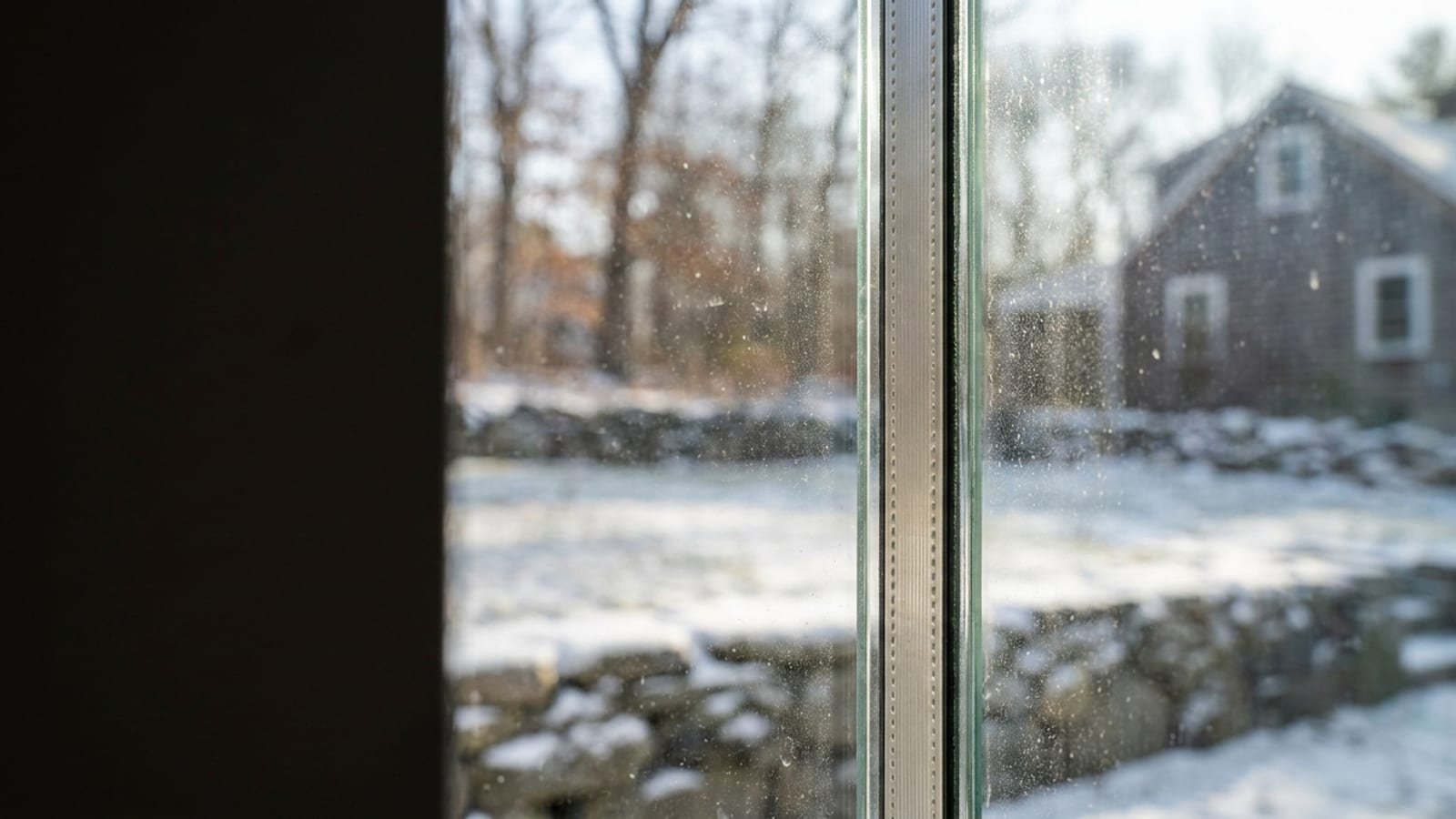
The bar separating the panes at the perimeter is where most of the remaining heat loss happens. A conventional aluminum spacer conducts well, which is exactly what you do not want; warm-edge spacers made of stainless steel, foam or structural polymer conduct far less. Edge temperature is what drives the condensation you see at the bottom of a sash on a cold morning. A quote that specifies the coating and the gas but says nothing about the spacer is describing two-thirds of the glass package.
What this costs on a real project
Here are the general Connecticut ranges. They depend on the house, the opening sizes and the access, and they are not a quote.
| Category | General Connecticut range |
|---|---|
| CategoryStandard vinyl replacement window, installed | General Connecticut range$300 - $700 per window |
| CategoryPremium wood or fiberglass, installed | General Connecticut range$800 - $1,500+ per window |
| CategoryFull house, 10 to 15 windows | General Connecticut range$5,000 - $20,000+ |
| CategoryLarge or custom units | General Connecticut range$1,000 - $2,500+ per window |
The part worth knowing: Low-E and argon are baked into those numbers. They are not an upgrade tier on most lines sold in the Northern zone, because a manufacturer cannot hit a 0.22 U-factor in a standard double-pane unit without them. A quote that itemizes argon as a several-hundred-dollar add-on is pricing something the base product almost certainly already includes.
There is no separate argon line on the NFRC label either. The gas fill is one of the inputs that produces the U-factor printed on the sticker. That makes the label the cleanest way to compare bids: the certified number already accounts for the coating, the gas, the spacer and the frame together.
The case against spending more here
If your existing windows are already double-pane with a Low-E coating and intact seals, upgrading the glass package alone is a weak investment. The published savings range for replacing windows, roughly 12 to 33 percent of heating and cooling cost or about $200 to $600 a year for a Connecticut home, comes overwhelmingly from replacing single-pane or old clear double-pane units. Replacing a sound 2010s Low-E window to gain two hundredths of a U-factor does not pay back in any reasonable period.
The better questions in that situation are whether the sashes still seal, whether the balances work, and whether air is moving around the frame rather than through the glass. Air leakage at the perimeter routinely costs more than the difference between two glass packages, and it is an installation problem, not a product problem. Our window service page describes how units are set, insulated and trimmed, and the installation process is where that perimeter detail is either handled or not.
What to ask before you sign
- What is the certified U-factor and SHGC of the exact unit being quoted, in the size being installed?
- Which Low-E coating is it, and on which surface?
- Is the cavity argon filled, and what is the gap width?
- What spacer is used at the perimeter?
- Does the glass warranty cover seal failure, and for how long, prorated or not?
Any competent supplier can answer all five from the specification sheet. A bid that cannot is a bid you cannot compare to anything.
If you want that comparison done on your own house, someone comes out, measures the openings, and gives you a written price with the glass specification on it. You can start that at get an estimate or by phone at (860) 703-7663.