Short answer
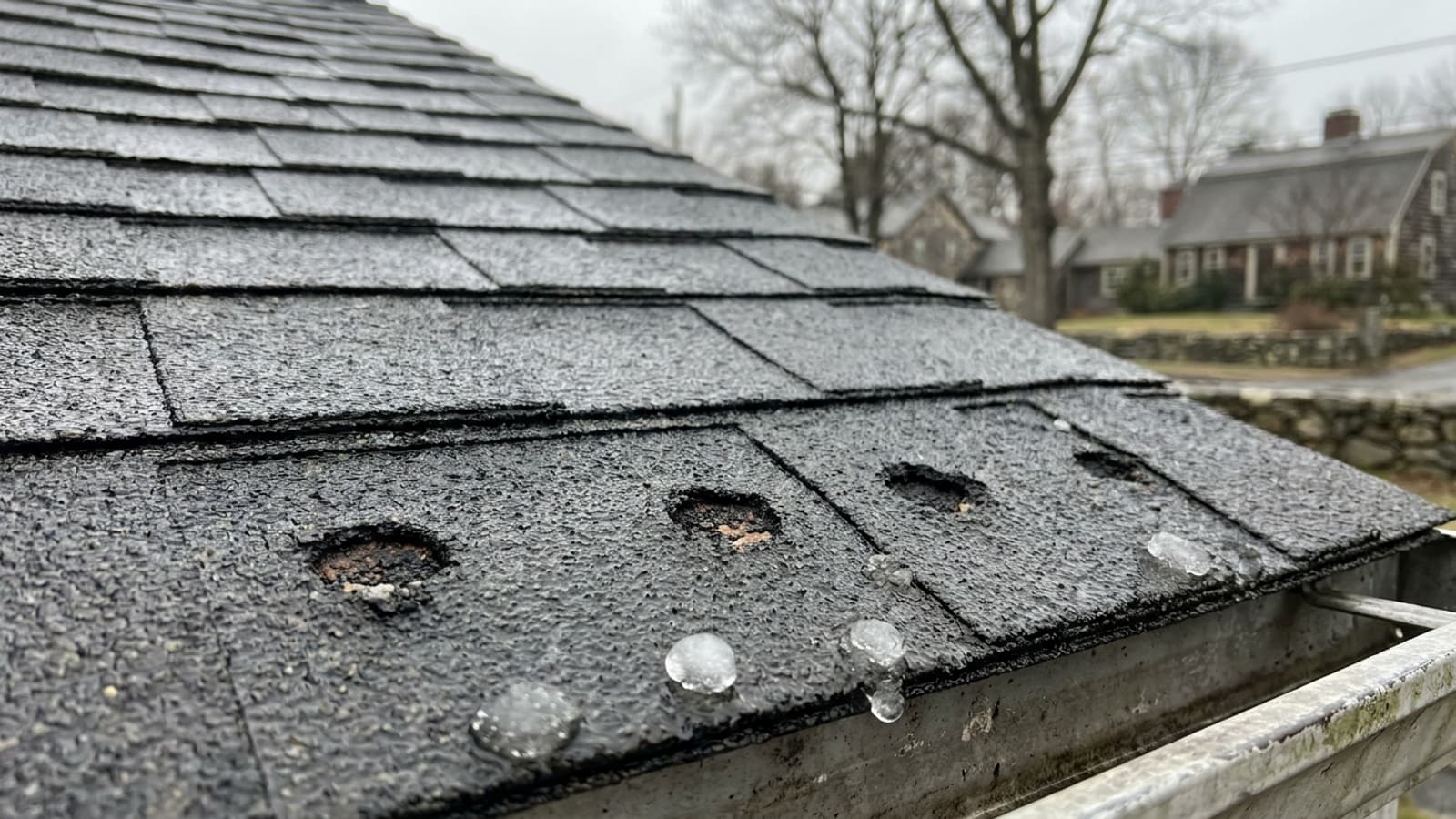
Hail damage on an asphalt shingle shows up as a random scatter of round marks where granules have been knocked off, exposing darker asphalt, and the spot often feels soft when pressed. It has no pattern, unlike the straight lines left by foot traffic or the uniform wear of an old roof. The fastest way to confirm it is to look at soft metal first, since dents in gutters, drip edge and vent caps prove hail hit the house before anyone climbs a ladder.
On this page
Hail damage on an asphalt roof looks like a random scatter of round marks where the granules have been knocked off, leaving a darker, smoother spot of exposed asphalt. Press one and it often gives slightly, the way a bruise on an apple does, because the fiberglass mat under the surface has been fractured by the impact even though nothing has torn.
That is the whole tell. Everything else in this post is about how to confirm it without climbing on a wet roof, and how to separate a real hail hit from the four or five things that get mistaken for one.
What hail actually does to a shingle
An asphalt shingle is a fiberglass mat saturated with asphalt and surfaced with ceramic-coated granules. The granules are not decoration. They are the ultraviolet shield that keeps the asphalt from drying out and losing its flexibility. When a hailstone lands hard enough, two things happen at once.
The granules come off
The impact knocks the granules loose in a rough circle, usually somewhere between the size of a dime and the size of a quarter. Those granules wash into the gutter. If you clean a gutter after a hailstorm and find a concentrated pile of granules well beyond the normal trickle, that is a signal worth following up, though granule loss on its own is not proof of anything since old shingles shed granules constantly.
The mat fractures underneath
This is the part that matters and the part you cannot see. A hard enough hit cracks the fiberglass mat beneath the surface without breaking through. The shingle is still watertight the day it happens. What has changed is its ability to survive the next several Connecticut winters, because a fractured mat with no granule cover over it weathers and opens far faster than the material around it.
Check the soft metal before you look at the roof
The most useful evidence on a house sits at eye level. Hail that is large enough to hurt a shingle is large enough to dent aluminum, and aluminum records the hit permanently.
Walk the perimeter and look at:
- Gutters and downspouts, especially the flat faces and the round elbows
- Drip edge and gutter apron along the eave
- Ridge vents, plumbing vent caps and any metal roof vents
- Window screens and vinyl or aluminum window wrap
- The top of the air conditioning condenser and the fins on its sides
- Deck rails, grill lids, mailboxes and any other soft metal on the property
If none of that soft metal shows fresh dents, the odds that the shingles took meaningful hail are low. If the downspouts are dimpled and the vent caps are pocked, you have confirmed that hail struck the house with enough force to do work, and the roof deserves a proper look. This is the same logic an insurance adjuster applies, and doing it yourself first tells you whether a claim is worth opening at all.
Where hail damage shows up first
Hail rarely falls straight down. It arrives at an angle, driven by the storm, so the damage concentrates on the slopes facing the direction the storm came from. On most Connecticut storms that is the south and west faces, but the reliable method is to read the soft metal and see which sides got hit.
The other places to look closely are the flat or low-slope areas, because a hailstone striking a steep slope glances off and a hailstone striking a shallow slope hits square. Porch roofs, dormer tops, low-slope additions and flat sections over a garage take the worst of it. On Hartford and New Haven multi-family buildings with flat membrane roofs, hail shows as bruising in the membrane rather than granule loss, and it is genuinely hard to see without kneeling on it.
What gets mistaken for hail
This is where most homeowners and more than a few contractors go wrong. Several completely unrelated conditions produce round marks on a shingle.
| What you see | Hail | Something else |
|---|---|---|
| What you seeRound bare spots, random placement, soft to the touch | HailHail impact | Something else— |
| What you seeRound bare spots in straight lines or clustered on a path | Hail— | Something elseFoot traffic from a prior repair or a service call |
| What you seeSmall raised bumps that have popped open | Hail— | Something elseBlistering, a manufacturing or ventilation issue |
| What you seeUniform thinning of granules across whole slopes | Hail— | Something elseNormal end-of-life weathering |
| What you seeShingles creased, lifted or missing along rakes and ridges | Hail— | Something elseWind uplift |
| What you seeScuffs and gouges with a direction to them | Hail— | Something elseBranch drag or ladder damage |
Blistering is the most common false positive. A blister is a bubble of gas that formed inside the shingle and later burst, and the resulting crater looks a lot like a hail bruise. The differences are that a blister crater has a raised, slightly ragged lip while a hail mark is depressed and clean, and blisters appear all over the roof rather than favoring the storm-facing slopes.
Wind is the other confusion, and it is a much bigger deal in this state than hail. If the shingles are creased at the seal line or torn loose along an edge, you are looking at uplift, and we cover how to read that in the post on wind damage versus normal shingle wear.
Does the size of the hail matter
It matters more than anything else, along with the wind speed carrying it. As a general rule, small hail that looks like sleet does not mark a sound asphalt roof. Hail around the size of a quarter starts to bruise older or thinner shingles. Hail at golf ball size and above will mark almost any asphalt roof, and the impacts get dense enough that whole slopes come into question.
Age changes the threshold. A twelve-year-old architectural shingle has lost some of the asphalt flexibility it had when new, so a hailstone that would have bounced off the roof in its first summer can fracture the mat now. The same storm can leave a new roof across the street untouched.
The Connecticut reality check
Here is the part a homeowner deserves to hear before spending money. Connecticut is not hail country. Roofs in the towns we serve fail far more often from wind uplift, ice damming at the eaves, aging seal strips and falling limbs than from hail. If someone knocks on your door after a storm and tells you the roof is hail damaged before they have looked at a single gutter, treat that as a sales pitch rather than a diagnosis.
The two numbers that actually govern roofs here are the ones in Appendix AY of the 2022 Connecticut State Building Code. Every town we serve carries an ultimate design wind speed of 120 mph, or 125 mph in Guilford, Madison and New Haven, and a ground snow load of 30 psf, or 35 psf in Avon, Farmington and Simsbury. Nothing in the code assigns a hail rating, because hail is not the governing load in this climate. Impact resistance is a separate voluntary test, UL 2218, where Class 4 is the top rating. It is a fine thing to have on a new roof and a poor reason by itself to replace a working one.
The post-war Capes and Ranches in towns like Manchester make the point. When we get called out for suspected hail on that housing stock, the actual finding is usually a roof at the end of a normal service life, and the honest recommendation is a planned roof replacement on your schedule rather than a claim that will not be paid.
What to do if the evidence points to hail
- Photograph the soft metal the same week, with something for scale next to each dent. Dents do not date themselves, and evidence collected months later is weaker.
- Write down the date of the storm. Insurers work from a specific event date.
- Photograph any hailstones still on the ground next to a coin or a ruler, if you can do it safely.
- Do not get on the roof in wet or freezing conditions. Nothing you learn up there is worth the fall.
- Have the roof looked at properly, and get the findings in writing with photographs of the actual slopes rather than stock images.
Our storm damage work starts with that documentation step, and a roof inspection after a storm tells you which of the three answers you are dealing with: nothing meaningful, a localized repair, or a roof that has genuinely lost enough life to justify replacement.
Getting a straight answer
The useful outcome of a hail inspection is often that there is no hail damage. That is a real result, and it saves you from opening a claim that gets denied and sits on your record. When there is damage, you want it counted, mapped by slope and photographed, so that the conversation with your insurer is about evidence rather than opinion.
If you want the roof looked at after a storm, request an estimate and we will come out, inspect the soft metal and the slopes, photograph what we find, and give you a written price if work is warranted. It is a sales appointment, and you should expect a number at the end of it. What you should also expect is an honest answer about whether the damage is real.