Short answer
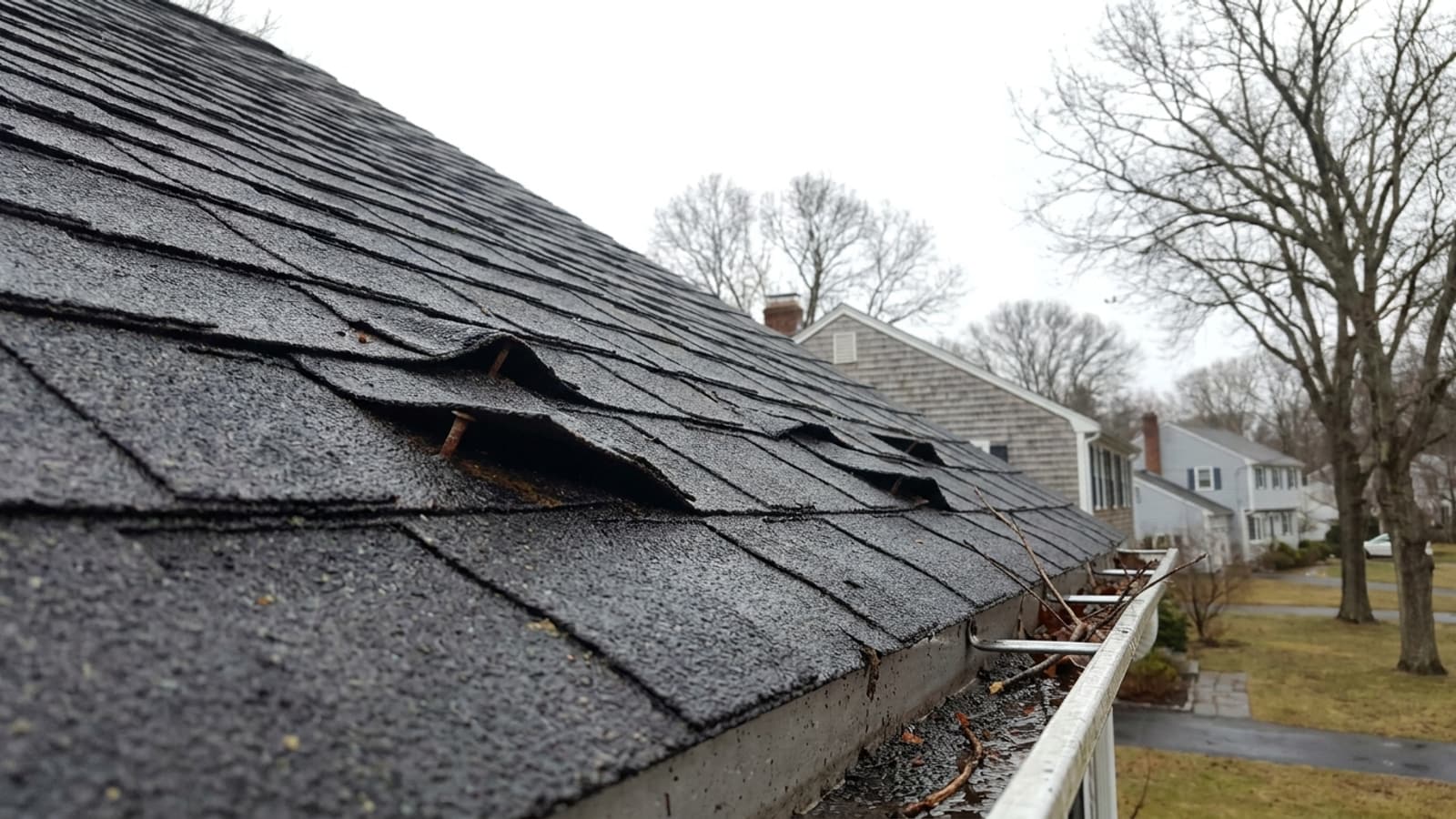
Wind damage is mechanical and appears in patterns: creased tabs, shingles broken loose from the seal strip, exposed or backed-out nails, and missing tabs concentrated along rakes, ridges and the windward slope. Normal wear is gradual and even, showing as uniform granule loss, curling edges and brittleness across the entire roof at the same time. If the problem is concentrated in specific locations while the rest of the roof simply looks its age, you are dealing with a storm event rather than the end of the roof's service life.
On this page
Wind damage and age are two different failure mechanisms, and they leave different evidence. Wind is mechanical and sudden, so it shows up in patterns tied to where the wind hit hardest. Age is chemical and gradual, so it shows up evenly across every slope at roughly the same rate. Once you know which signals belong to which cause, most roofs sort themselves out in a ten-minute look.
This matters because the two lead to completely different decisions. Storm damage on an otherwise healthy roof is usually a repair, and sometimes an insurance conversation. A worn-out roof is a replacement conversation regardless of what the weather did last week.
What wind physically does to an asphalt shingle
An asphalt shingle roof is not fastened down at its bottom edge. Each course is nailed near the top and held at the exposed edge by a strip of factory-applied adhesive that softens in the sun and bonds the shingle above to the shingle below. That seal strip is the entire wind resistance system.
Wind does not usually push a roof. It creates negative pressure, or lift, along edges and corners. When lift exceeds the strength of the seal, the tab peels up. Three things happen from there:
- The seal breaks and does not re-bond. Dust and debris contaminate the adhesive within hours. The shingle lies back down looking normal but is no longer attached at its lower edge.
- The shingle creases. A tab folded back past its bending point fractures the fiberglass mat. The crease reads as a straight horizontal line across the tab, often lighter in color because granules were shed along it.
- The fastener pulls through or backs out. You see nail heads sitting proud of the shingle, or small round holes where the nail tore through the mat.
All three are damage. Only the third is obvious from a distance.
Where it shows up first
Uplift is highest at the perimeter, so look at rake edges, the ridge, the first two or three courses above the eave, and around anything that interrupts the plane, such as chimneys, dormers and sidewall transitions. Damage concentrated on one slope, usually the one facing the storm, is a strong indication that wind caused it. Damage evenly distributed on every slope, including the sheltered ones, points at age.
What age does instead
Asphalt shingles fail from the top down and from the whole surface at once. The signals are:
- Even granule loss. The ceramic granules protect the asphalt from ultraviolet light. As they wear off, the surface looks darker and shinier and the roof sheds granules into the gutters steadily rather than all at once.
- Curling and clawing. Edges lift because the asphalt is drying out and shrinking. This looks superficially like an unsealed tab, but a curled shingle is stiff and turned up along its whole edge, while a wind-unsealed shingle is still flat and flexible and simply lifts when you touch it.
- Cracking and crazing. Fine random cracks across the face, unlike the single straight crease left by a fold.
- Blistering. Small round pockmarks from moisture trapped in the asphalt during manufacture, often mistaken for hail.
Connecticut freeze-thaw cycling accelerates all of this, and so does a hot, poorly ventilated attic. Age damage tends to be worst on the slope with the most sun exposure, not the slope facing the prevailing wind.
A side-by-side read
| Sign | Wind damage | Normal wear |
|---|---|---|
| SignDistribution | Wind damageConcentrated at rakes, ridge, eaves, one slope | Normal wearEven across every slope |
| SignShingle edges | Wind damageFlat but unsealed, lifts when touched | Normal wearCurled, stiff, will not lie flat |
| SignCracking | Wind damageSingle straight crease across a tab | Normal wearRandom fine cracks over the whole face |
| SignGranules | Wind damageSudden heavy load in gutters after a storm | Normal wearSteady accumulation over years |
| SignFasteners | Wind damageExposed heads, torn nail holes | Normal wearIntact |
| SignTiming | Wind damageAppears after a dated weather event | Normal wearAppears gradually |
The town wind numbers, and what they do not promise
Appendix AY of the 2022 Connecticut State Building Code assigns each municipality an ultimate design wind speed. In the towns we serve that figure is 120 mph, except Guilford, Madison and New Haven, which are 125 mph. Every one of these towns sits inside a designated hurricane-prone region.
Two clarifications homeowners deserve. First, that figure is a structural design value, not a guarantee that a specific shingle will survive that wind. Second, the high-wind underlayment provisions that get quoted at homeowners are keyed to Vasd, the allowable stress design wind speed, above 110 mph. Converted from the Vult numbers above, Vasd here lands around 93 to 97 mph, so that trigger does not apply in these towns.
What does apply is the manufacturer's own fastening requirement. Most laminated shingles earn their top wind rating only when fastened with six nails per shingle inside a defined nail zone rather than four. A roof nailed four times on the shoreline in Madison carries the rating printed on the wrapper and very little of the performance behind it. If your roof lost tabs in a storm that was well below its stated rating, the nail count is the first thing worth asking about.
What gets misdiagnosed
A few things are routinely sold as storm damage and usually are not:
- Blistering called hail. Blisters are round and uniform, sit where the shingle bulged, and have soft edges. Hail bruises are irregular, expose black asphalt, and appear alongside dents on soft metals like gutters, vents and flashing.
- Scuffed granules from foot traffic. Someone walked the roof. Cosmetic, unless the mat is exposed.
- Nail pops from deck movement. These reflect a fastening or deck problem, not weather.
- Algae streaking. Dark vertical stains are a plant, not deterioration.
Getting this right protects you. A claim built on the wrong evidence wastes a claim, and a replacement sold on the wrong evidence wastes money.
What to do after a storm
Walk the perimeter first and pick up any shingle fragments in the yard; they are the fastest confirmation that tabs came off. Photograph the yard, the gutters and each elevation of the house from the ground, and write down the date of the storm. Check ceilings and the attic for staining before assuming the roof held.
Then have the roof looked at properly. A useful storm damage inspection includes walking the slopes, lifting tabs by hand to test which ones are still sealed, and documenting locations with photographs rather than a verbal summary. The same is true of a routine roof inspection: what you want in your hands afterward is a description of what was found and where, not a conclusion.
Be skeptical of anyone who arrives uninvited after a windstorm and reaches a total-replacement conclusion before showing you a single photograph. Be equally skeptical of a report that finds nothing without anyone getting on the roof.
When repair is the right answer
Most wind damage on a roof with life left in it is a repair. Replacing a run of creased shingles along a rake, re-sealing lifted tabs and reinstalling ridge cap is a modest job compared with a full replacement, and it is what we recommend when it will actually solve the problem.
The honest case for replacement is narrower than the industry implies. It applies when the shingles are already past roughly 20 years, when the same slopes keep failing, when there are already two layers, or when the damage is spread widely enough that a repair becomes a patchwork with visible color mismatch. Color matching is a genuine constraint: shingle lines are discontinued and installed shingles weather, so a repair on a visible front slope will rarely be invisible.
If you want a second opinion on what a storm actually did, we will come out, get on the roof, photograph what we find and give you a written price. You can start that at get an estimate, and the full scope of what we do on roofing is laid out on the service page.