Short answer
Sometimes. A good guard reliably cuts how often gutters need cleaning, which matters most on a tall house under oaks or white pines, but no guard makes a gutter maintenance-free and none prevents ice dams. Whether it pays off comes down to your tree cover, the height of the house, and what you currently spend to have the gutters cleared.
On this page
Sometimes. The honest version of the answer is that gutter guards are a labor-saving product, not a performance upgrade to the roof. They reduce how often somebody has to get on a ladder. They do not keep ice out of the gutter, they do not stop water from getting behind a gutter that is pitched wrong, and they do not eliminate maintenance. On a two-story house surrounded by oaks, that labor savings is worth real money. On a ranch with one maple in the front yard, it usually is not.
Here is how to decide without relying on a brochure.
What a guard is actually being asked to do
A Connecticut gutter fills with four different things, and no single product handles all four equally well.
- Broad leaves. Maple, oak and sycamore. These sit on top of any guard and mostly blow off once they dry.
- Needles and tassels. White pine needles and oak flower tassels in late spring. These are the real test. Anything with an opening wider than a needle passes them straight through into the gutter.
- Shingle granules. Every asphalt roof sheds mineral granules, heavily in the first year and steadily after that. Granules are sand. They pass through screens and settle into a hard layer in the bottom of the trough.
- Seeds and organic silt. Maple samaras, bud casings, and the dark mulch that forms when leaf litter breaks down. This is what actually blocks a downspout.
A guard that solves the first category and ignores the other three is the reason so many homeowners say guards did not work for them.
The four common types and how each one fails
| Type | How it works | Handles needles and grit | Typical failure |
|---|---|---|---|
| TypePerforated aluminum screen | How it worksPunched holes over the trough | Handles needles and gritPoorly | Typical failureNeedles wedge in the holes, debris mats on top |
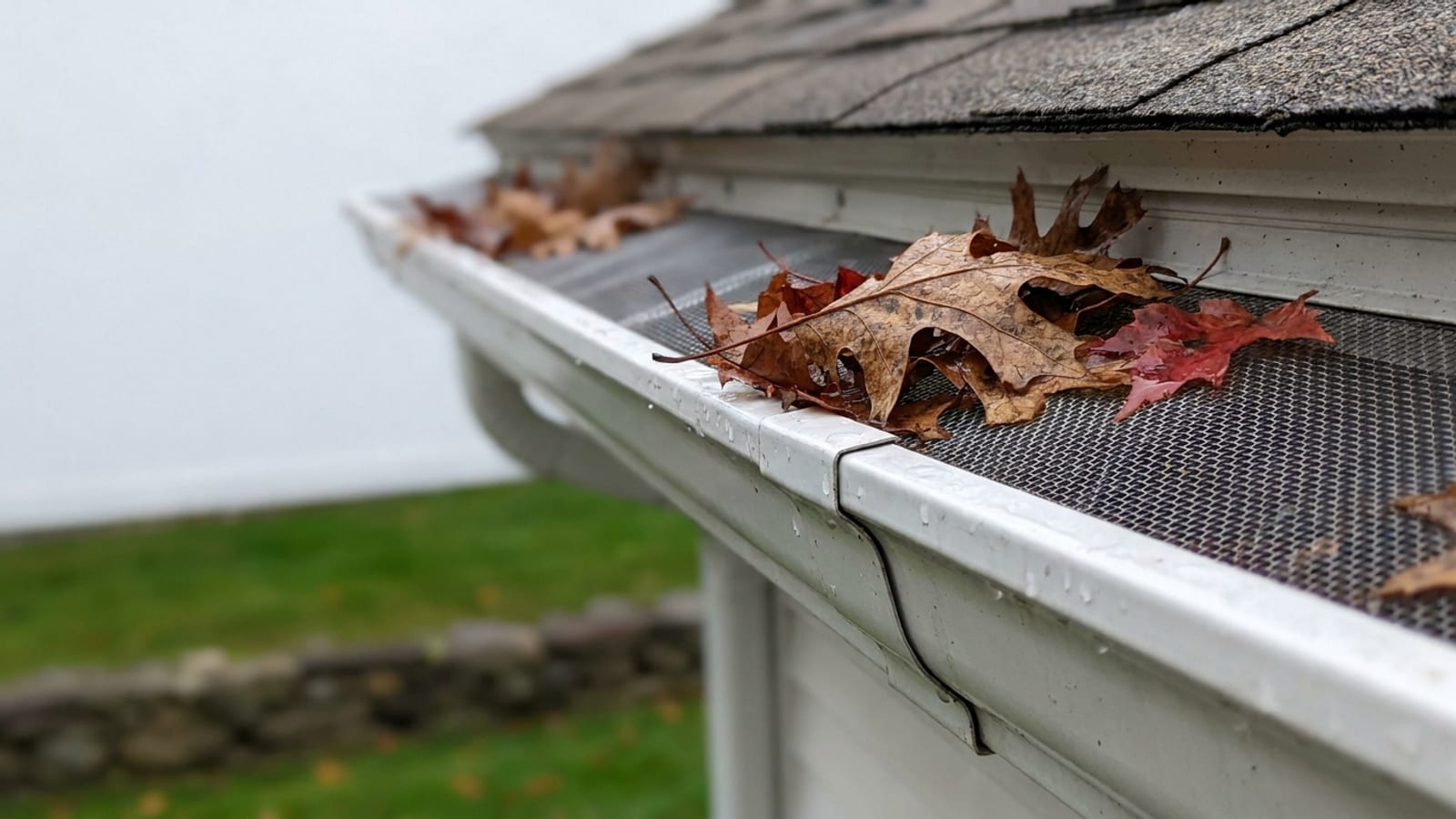
| TypeMicro-mesh over a frame | How it worksStainless mesh finer than a needle | Handles needles and gritWell | Typical failureSurface films over with pollen and granules, needs rinsing |
| TypeReverse-curve or helmet | How it worksSolid nose, water clings around the lip | Handles needles and gritModerately | Typical failureOvershoots in heavy rain, gives ice a ledge to build on |
| TypeFoam or brush insert | How it worksFills the trough so debris sits on top | Handles needles and gritPoorly | Typical failureHolds moisture and seed, becomes a planter within a few seasons |
If you take one thing from that table, it is that fine stainless micro-mesh in a rigid frame is the only category that deals with pine needles and shingle granules at the same time. It is also the most expensive category. The cheaper products are cheap because they solve the easy part of the problem.
Running the cost math yourself
Guards are quoted by the linear foot, installed, and the range across types is wide enough that a single average number would mislead you. Ask for three things in writing: the price per linear foot, the total linear feet being covered, and whether the price includes cleaning and re-hanging the existing gutters first. A guard installed over a sagging or debris-packed gutter is money spent on a problem that is still there.
Then do this division. Take the installed total and divide it by what you currently pay to have the gutters cleared twice a year. That gives you the payback period in years. Compare it against how long the gutters themselves have left, because aluminum gutters do not last forever and a guard system does not transfer to new ones without cost.
Two things push that math toward yes:
- Height and access. A three-story Victorian, a steep roof over a deck, or a gutter you cannot reach without staging costs far more per cleaning than a single-story eave over a lawn.
- Tree load. Mature oaks or white pines directly overhanging the roof mean three or four cleanings a year, not two.
And one thing pushes it toward no: if the gutters are near the end of their life, replace them first and decide about guards afterward. We covered the timing question in more depth in our post on whether to replace gutters with a new roof.
The ice dam claim, which is the one to push back on
Some guard marketing implies that keeping the gutter clear prevents ice dams. It does not. An ice dam forms when heat escaping from the living space melts snow on the roof field, the meltwater runs down to the cold overhang, and it refreezes there. The gutter is where you see the ice, not where the problem starts. We walked through the mechanism and the actual fix in why Connecticut roofs leak in winter and not in storms, and the short version is that the repair is almost always air sealing, insulation and balanced ventilation in the attic.
A solid reverse-curve cover can make winter slightly worse by giving ice a continuous surface to bond to at the eave. Micro-mesh is more forgiving because ice tends to lift off the frame rather than grip it, but it still does nothing preventive.
Installation details that matter on a Connecticut roof
How the guard attaches
The cheapest installation method is to slide a flange up under the first course of shingles. Avoid it. Shingles at the eave are sealed down, and prying them up to insert metal breaks that seal and disturbs the nailing the manufacturer requires. A shingle earns its wind rating only when it is fastened the way the manufacturer specifies, which for high-wind coverage usually means six nails in a defined nail zone rather than four. Every town we serve sits inside a designated hurricane-prone region, with ultimate design wind speeds of 120 mph across Hartford and Fairfield counties and 125 mph in Guilford, Madison and New Haven. That is not a detail to compromise for the sake of a gutter accessory. Choose a system that fastens to the front lip of the gutter or to the fascia.
Snow and ice load
The 2022 Connecticut State Building Code assigns a ground snow load of 30 psf to most of the towns we serve and 35 psf in Avon, Farmington and Simsbury. Those figures are about structure, not gutters, but they tell you something about what lands at the eave. Snow sliding off a steep roof will bend an under-supported guard and can pull hangers out of soft fascia. If guards are going on, the hanger spacing and the condition of the fascia board matter as much as the guard itself.
What should be checked before anything is installed
Have someone look at the gutter pitch, the outlet size, the drip edge, and whether the fascia behind the gutter is still solid. Those four items cause most of the water problems homeowners blame on clogging. A roof inspection is a reasonable time to get an honest read on them, because all four are visible from the same ladder.
When the answer is clearly no
- Single-story house with light tree cover, where a cleaning is a short job.
- Gutters that already overflow in heavy rain, which usually means undersized outlets or wrong pitch, not debris.
- A roof that will be replaced within a year or two. Wait, and handle the eave as one job.
- Any quote that presents guards as a cure for ice dams or interior water stains.
When it is clearly yes
- Tall or steep houses where each cleaning requires real setup.
- White pines or mature oaks directly over the roof.
- Anyone who has been climbing ladders and would rather not, which is a legitimate reason on its own and does not need a payback calculation to justify it.
If you are weighing this alongside a roof decision, the eave is the place where the roof covering, the drip edge, the ice barrier and the gutter all meet, and it is worth getting all of it right at once. Request a written estimate at /get-estimate or call the office. Someone comes out, measures the roof, looks at the eave condition, and gives you a written price you can compare against anyone else's.