Short answer
Most winter drafts come from gaps around the window rather than from the window itself, and weatherstripping, sash hardware and air sealing behind the interior casing fix those for a small fraction of replacement cost. Replacement becomes the honest answer when the sash or frame has rotted, when the sealed glass unit has failed, or when a whole house of single-pane windows means you are buying comfort and quiet as much as efficiency. The test is whether the wood and the glass are sound, not whether the window feels cold.
On this page
A drafty window is usually not a broken window. In most Connecticut houses the cold air is coming through the gap between the window frame and the rough opening, hidden behind the interior casing, or past worn weatherstripping at the meeting rail. Those are repairs. Replacement earns its place when the wood has rotted, the sealed glass unit has failed, or the whole house is single-pane and you are buying comfort across every room rather than fixing one bad window.
This post is about how to tell those two situations apart before you spend money.
Find the leak before you price anything
The words "drafty window" cover at least four different physical problems, and they have different fixes.
Air leaking around the frame
When a window was installed, the frame was set into a rough opening slightly larger than the unit, and the space between them was shimmed and, ideally, insulated and sealed. On older houses that cavity was often stuffed loosely with fiberglass, which stops nothing. The interior casing covers it, so nobody sees it. Air moves through that path all winter.
This is the single most common source of window draft in Connecticut, and it has nothing to do with the window's condition.
Air leaking through the window
Double-hung sash slide, so they need clearance, and clearance means the weatherstripping is doing the sealing. When the weatherstrip at the meeting rail flattens or the sash lock no longer pulls the two rails together, air moves straight through. A sash lock is not a security device; on a double-hung it is a compression device.
Cold glass that feels like a draft
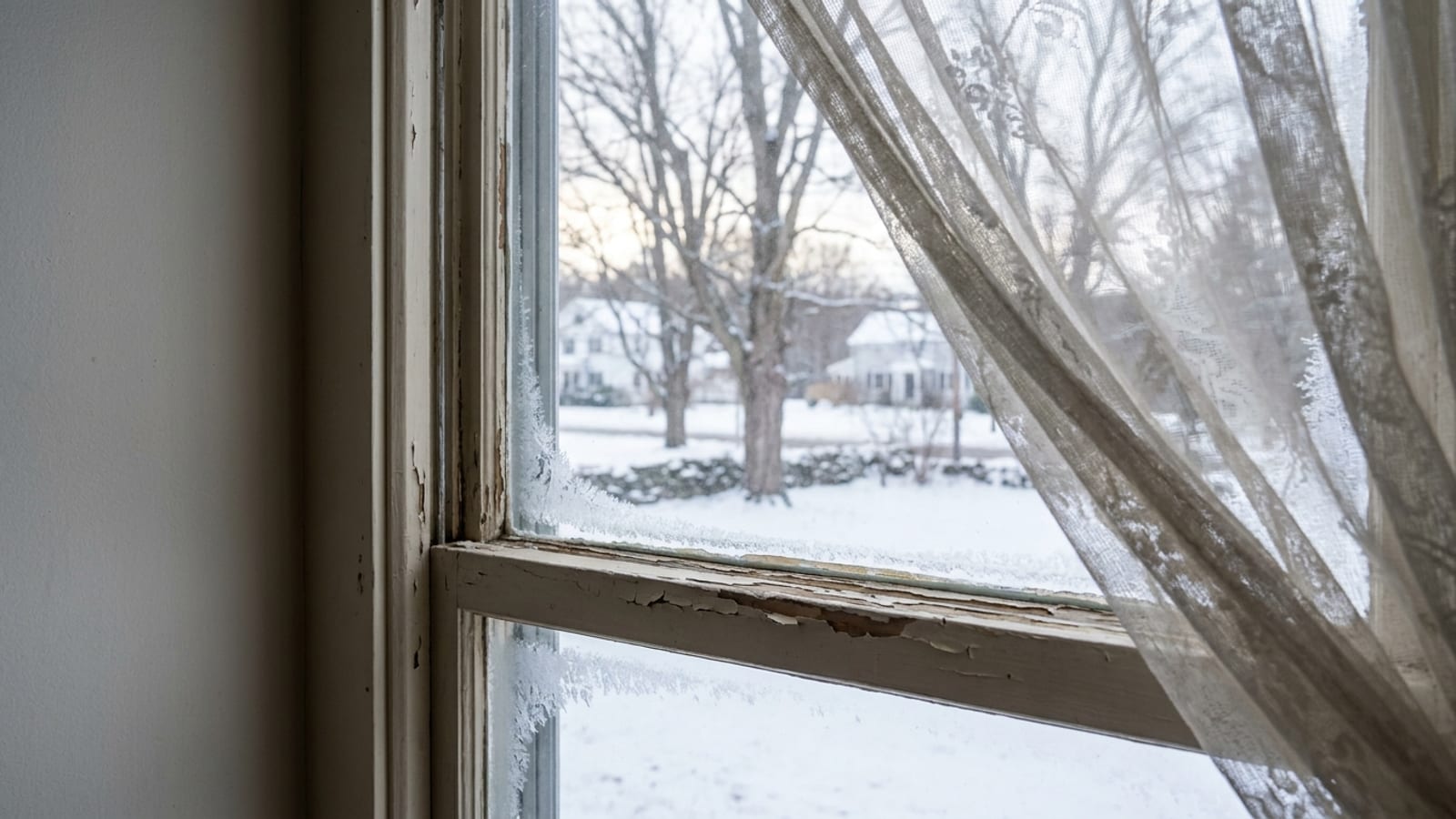
Single-pane glass in January sits close to outdoor temperature. Air touching it cools, gets denser and falls, and you feel a cold current at the floor near the window even if the assembly is airtight. No amount of caulk fixes this. Only better glazing or a storm window does.
A failed sealed unit
If there is fog or a haze between the panes, the seal has gone and the insulating gas with it. That window is not repairable in place. We covered the diagnosis in detail in the post on window condensation and failed seals.
Repairs that genuinely work
On a sound window, these are the fixes in the order that usually pays best.
- Air seal behind the interior casing. Pull the casing, remove any loose fiberglass, fill the gap with low-expansion foam rated for windows, and reinstall the trim. This is disruptive to paint but very effective.
- Replace the weatherstripping. Kits exist for most double-hung and casement profiles. On casements the compression gasket is a wear item and does not last the life of the window.
- Fix the sash lock and keepers. A lock that no longer draws the rails tight is an air leak with a handle on it.
- Repair sash balances or cords. A sash that will not stay closed against its stops is not sealing.
- Reglaze and repaint. On old wood sash, failed glazing putty lets air past the glass edge. Reglazing plus a good paint line onto the glass restores the seal and protects the wood.
- Add or repair storm windows. A tight storm adds a dead air space and blocks infiltration. On antique houses with original sash, this is often the right answer rather than a compromise.
Repairs make the most sense when the frames and sash are sound wood, when only a few windows are bad, and when the units are original to a house whose character depends on them. Farmington Village, the Guilford Green area and Hartford's Victorian neighborhoods are full of sash worth keeping.
When repair stops making sense
Repair has a ceiling. Once you cross one of these lines, the money stops working:
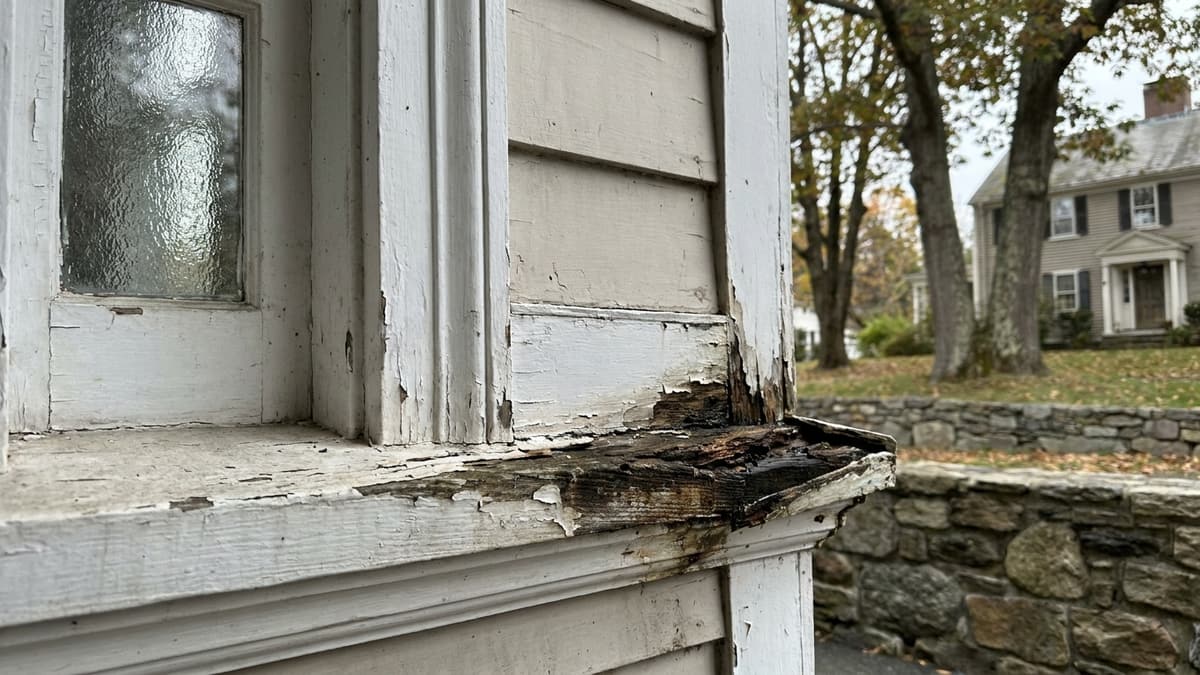
- Rot in the sill, jamb or sash bottom rail. Probe with an awl. If it sinks, you are past weatherstripping.
- A failed sealed glass unit. Fog between panes means the unit is done.
- Aluminum frames with no thermal break. The metal conducts cold straight through. Sealing the perimeter helps a little, and that is all.
- Obsolete hardware. If the balances and locks are no longer manufactured and no replacement fits, every future repair is improvisation.
- Painted-shut windows in bedrooms. A bedroom window that will not open is a life safety problem, not a comfort problem.
- Whole-house single pane. When eleven of twelve windows are bad, repairing them one at a time costs more in total labor than a coordinated replacement.
What replacement costs in Connecticut
These are general Connecticut ranges that depend on the specific house. They are not a quote.
| Scope | General Connecticut range |
|---|---|
| ScopeStandard vinyl window, installed | General Connecticut range$300 to $700 per window |
| ScopePremium wood or fiberglass window | General Connecticut range$800 to $1,500 or more per window |
| ScopeWhole house, 10 to 15 windows | General Connecticut range$5,000 to $20,000 or more |
| ScopeLarge or custom units, common in Greenwich and Westport | General Connecticut range$1,000 to $2,500 or more per window |
The spread inside those ranges comes from unit size, frame material, whether the install is an insert or a full-frame tear-out, and what condition the sill and framing are in once the old unit comes out. The difference between the two install methods is a real decision with real tradeoffs, and we walk through it in insert versus full-frame replacement. Double-hung is still the most common configuration in Connecticut, and the double-hung section of our windows page covers what changes between styles.
The numbers to hold a replacement quote to
All of Connecticut is in the ENERGY STAR Northern climate zone. Under version 7.0, effective October 2023, a qualifying window needs a U-factor of 0.22 or lower and a solar heat gain coefficient of at least 0.17. Both figures are printed on the NFRC label.
The SHGC number is the one people get backward. It is a minimum, not a maximum. In a heating-dominated climate, a window that blocks too much solar gain is throwing away free winter heat. A salesperson pushing the lowest SHGC on the shelf is selling you a Southern-zone window.
Two rules worth knowing before the work starts
Permits. Most Connecticut towns do not require a permit for a like-for-like window replacement where the opening size does not change. A permit is generally required if the opening is resized, a window is added, or a header is altered. That is different from roofing, which requires a permit in every town we serve.
Egress. Regardless of permits, every bedroom needs at least one window meeting egress dimensions. An insert replacement sits inside the existing frame and gives up clear opening in the process. On a window already close to the minimum, that reduction can take a compliant bedroom out of compliance, and the fix afterward is expensive. Have the clear opening measured before the order goes in.
Historic districts. Under Connecticut General Statutes Sec. 7-147f(a), replacing windows with similar materials in a local historic district does not require a Certificate of Appropriateness. Changing the material type or the configuration does.
A short decision path
- Do the paper test and the smoke test. Locate the leak.
- If the leak is at the casing, air seal there first and retest. This is cheap and frequently ends the conversation.
- Probe the sill and lower rails for rot. Soft wood ends the repair option.
- Look for fog between the panes. Fog means the unit is spent.
- Count how many windows are bad. One or two is a repair project. Ten is a replacement project.
- If you replace, check the NFRC label and the bedroom egress dimensions before signing.
Older housing stock changes the odds. In the 1920s to 1960s Colonials and Tudors common in West Hartford, original wood sash is often worth restoring, while 1980s aluminum and early vinyl replacements usually are not.
If you want a second opinion on which windows in your house are worth saving, request an estimate. Someone comes out, measures the openings, checks the sash and sills, and leaves you with a written price. If the honest answer is weatherstripping and a caulk gun on eight of your windows and new units on two, that is what the number will say.