Short answer
Yes, dark vinyl siding fades more visibly than light vinyl, but modern colorfast dark lines fade far less than the dark vinyl sold a generation ago. The bigger issue is heat, because dark panels absorb more solar energy, expand further and buckle if they were nailed tight or cut long. Fading and warping are mostly questions of product grade and installation technique rather than the color itself.
On this page
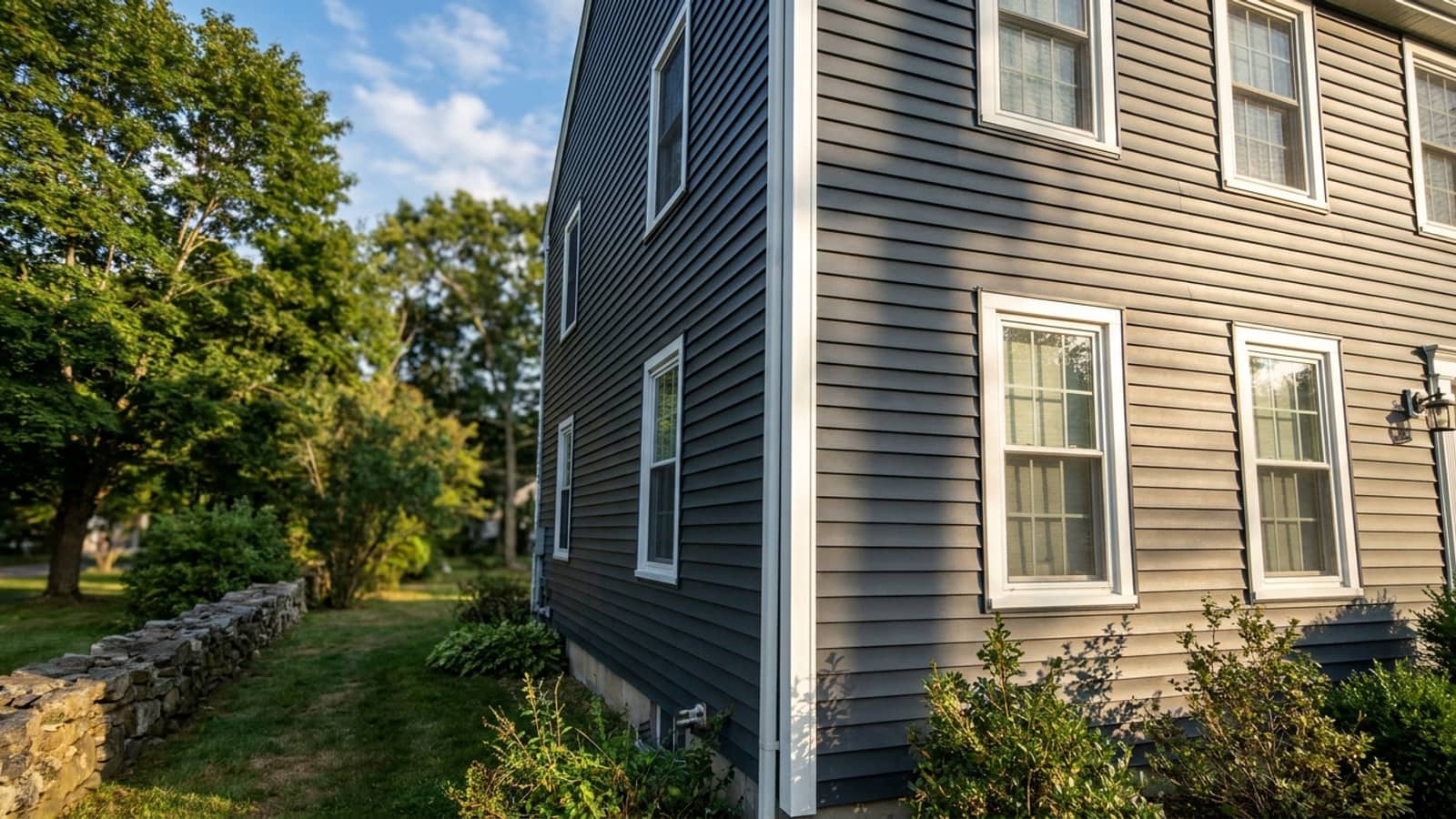
Dark vinyl siding fades. So does light vinyl siding, but on a charcoal, deep blue or near black wall you can see it, because the change in pigment has more color to subtract from. The question worth asking is not whether it fades but how much, how fast, and what the manufacturer will actually do about it.
Heat is the part most homeowners do not plan for. A dark wall in full sun absorbs more solar energy than a light one, and vinyl is a thermoplastic that grows and shrinks with temperature. Everything that goes wrong with dark siding, from wavy courses to gaps at corner posts, traces back to that movement being ignored during installation.
What fades, and what the standard requires
A vinyl panel is not one material. Premium panels are coextruded, meaning a thin outer layer called the capstock is bonded to a thicker substrate underneath. The capstock carries the pigment, the ultraviolet stabilizers and the weathering package. The substrate carries the strength.
Dark colors live or die on the capstock
Standard organic pigments in dark shades absorb ultraviolet light and break down under it. Manufacturers producing colorfast dark lines use engineered pigment systems, often ceramic or complex inorganic pigments, that are more stable under ultraviolet exposure and reflect more infrared energy than conventional pigments of the same shade. That technology costs money, which is why dark colors usually appear only in a manufacturer's upper series and sometimes carry a price premium over the same profile in beige.
That also means two charcoal panels from two different product lines are not comparable just because the color chips look alike. If you are shopping dark colors, the product series matters more than the color name, and the heavier premium profiles are where the better capstocks live. We covered what separates one grade from another in our breakdown of vinyl siding thickness grades.
The ASTM benchmark
Rigid PVC siding sold in the United States is generally made to ASTM D3679, the standard specification for the product. That specification includes a weathering requirement with a numeric ceiling on color change, expressed in Delta E units of color difference. A manufacturer stating that a product meets D3679 is making a checkable claim, and it is reasonable to ask a salesperson which test exposure the dark colors were run under. Good answers exist. Vague ones tell you something too.
Why heat is the real mechanical risk
Air temperature is not the number that matters. A dark cladding surface in direct summer sun on a south or west wall runs far above the air temperature around it. Vinyl responds to that by getting longer.
Expansion is predictable, so it gets designed for
A twelve foot panel can change roughly half an inch in overall length between a January morning and a July afternoon. Manufacturer installation instructions handle this with a short list of non negotiable details:
- Nail into the center of the nailing slot, never at the end of it.
- Leave roughly one thirty second of an inch between the nail head and the nailing hem so the panel can slide. A panel pinned flat cannot move.
- Leave about a quarter inch of clearance where panel ends meet trim, corner posts and channels, and roughly three eighths of an inch when installing in cold weather.
- Hang panels, do not stretch them. Lock the panel into the course below and let it rest.
When those steps are followed, movement disappears into the joints and nobody ever sees it. When they are not, the panel has to go somewhere, and on a hot dark wall it goes outward as a visible wave. Light siding hides sloppy work of this kind for years. Dark siding does not.
Reflected sunlight is a separate failure
There is a second heat problem that has nothing to do with workmanship. Insulated glass units can bow slightly under pressure differences, and a slightly concave low-E window acts like a weak mirror, concentrating reflected sunlight into a narrow intense band. Where that band lands on vinyl, it can distort the panel in a shape that follows the sun across the day. It happens on neighboring walls and between close houses, and it is more common in dense neighborhoods. The fix lives at the reflecting window, with screens, awnings or planting, not at the siding.
What a dark color costs you in practice
| Consideration | Light or mid tone vinyl | Dark vinyl |
|---|---|---|
| ConsiderationVisible fade over time | Light or mid tone vinylMinimal and gradual | Dark vinylMore visible, varies sharply by product series |
| ConsiderationSurface temperature in sun | Light or mid tone vinylModerate | Dark vinylSubstantially higher on south and west walls |
| ConsiderationTolerance for careless nailing | Light or mid tone vinylForgiving | Dark vinylUnforgiving, movement shows |
| ConsiderationColor options later | Light or mid tone vinylNone, vinyl is not meant to be painted | Dark vinylNone, same limitation |
| ConsiderationTypical product tier | Light or mid tone vinylAvailable across all grades | Dark vinylUsually premium series only |
Price follows the tier more than the shade. Vinyl siding in Connecticut generally runs $8,000 to $35,000 depending on wall area, trim complexity and what the crew finds behind the old siding, and a dark premium series sits in the upper half of that band for a given house. Those are general state ranges, not a quote for your address.
Read the fade warranty, not the brochure
Most vinyl warranties separate the product coverage from the fade coverage. The fade section typically defines a permitted amount of color change, applies only to uniform fade rather than staining or reflected heat damage, prorates after a stated number of years, and frequently covers material only. Transfer rules to a second owner are usually tighter as well.
None of that is improper. It is simply narrower than the headline on the sample folder suggests, and it is the difference between a replacement wall and a box of panels on the driveway in year eighteen.
The honest case for a different material
If a deep color is central to the look you want and you plan to stay in the house a long time, factory finished fiber cement deserves a real comparison. It holds dark color well, it does not move the way vinyl does, and it can be repainted when tastes change, which vinyl cannot. It also costs meaningfully more to install. Our side by side on James Hardie versus vinyl in Connecticut lays out where each one wins.
The case for dark vinyl is still strong: no painting, no rot, a lower installed price, and modern colorfast lines that look nothing like the chalky dark vinyl of twenty years ago. Just buy it from the right series and insist the crew install it loose. Details on both products are on our siding page, and the vinyl options are listed there as well.
One practical note for Connecticut: a straightforward like-for-like siding replacement usually does not require a building permit, though a permit is generally needed once the scope grows to include exterior insulation, sheathing replacement or altered openings. Changing color does not change that. Changing material type inside a local historic district does trigger review.
When you are ready for real numbers on your house, request an estimate. Someone comes out, measures the walls and trim, looks at what is behind the existing siding where possible, and gives you a written price with the product series named on it.