Short answer
Capping is the step where an installer bends painted aluminum coil stock around the existing wood trim at windows and doors so the wood is covered and the repainting cycle ends. It is normally quoted per opening as part of a siding job, and the price swings with the number of openings, the complexity of the trim profile and whether any wood has to be repaired first. It is the right call on most houses, but only after the wood underneath has been checked, because aluminum hides rot as well as it hides weathered paint.
On this page
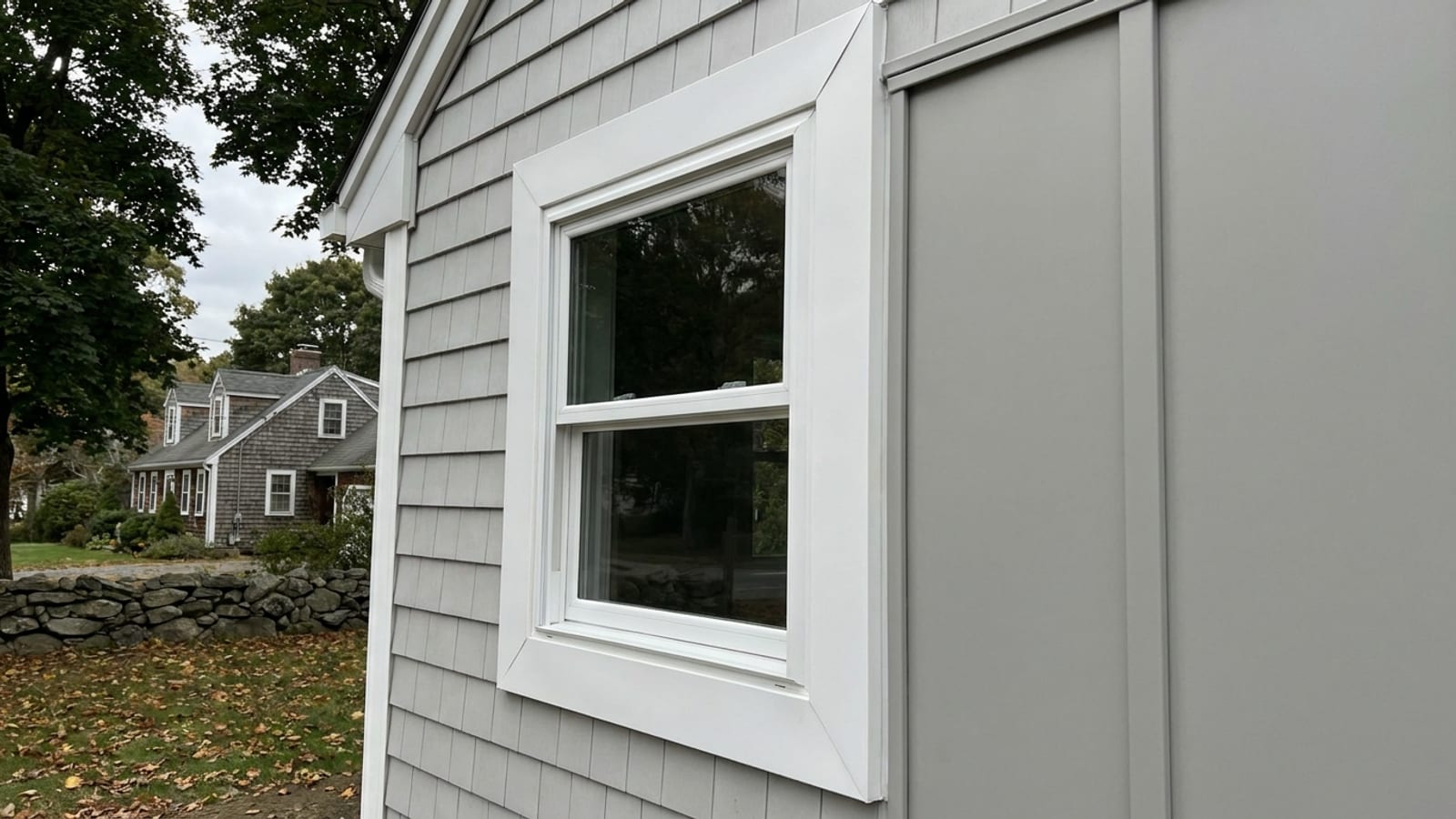
Capping, also called trim coil wrap or aluminum cladding, is the step in a siding job where the installer bends flat painted aluminum around the wood casing, sills and brickmold at your windows and doors. The wood stays in place. The aluminum covers it. From that point the trim does not get scraped and painted again, which is the whole point of doing it.
It is also one of the easiest line items to quietly leave out of a bid so the bottom line reads lower than a competitor's. If you are comparing two siding quotes and one is noticeably cheaper, capping is among the first places to look.
What capping actually is
The material is aluminum coil stock, typically 0.019 inch thick for residential work, with a baked finish on the exterior face. It comes in rolls, usually 24 inches wide, in colors meant to match common siding and trim palettes. White and almond are the most requested in Connecticut, but dark bronze and black have become common on newer builds.
The installer cuts a piece to length, then runs it through a sheet metal brake on site to fold it into the exact shape of the trim. Good capping is a series of deliberate folds: a return at the edge so no raw cut aluminum shows, a hem where two pieces meet, and a sill piece with a drip formed into it. Nothing about it is a stock part. Every opening is measured and bent on the sidewalk.
Why it exists
On a typical Connecticut Colonial or Cape, the siding itself is the easy part of exterior maintenance. Vinyl does not need painting and fiber cement with a factory finish goes many years between coats. The trim is what fails. South and west facing window casings take the most sun, the paint film opens up, water gets into the end grain at the sill, and within a few seasons you are back on a ladder. Capping ends that cycle without replacing the wood.
The case for capping
- It eliminates the repainting cycle on the part of the house that needs it most.
- It is faster and less expensive than tearing out and replacing trim.
- Done well, it gives crisp uniform lines at every opening, which is most of what people notice when they look at finished siding work.
- The finish on quality coil carries a long manufacturer warranty and the metal does not rot, warp or feed insects.
The case against capping
An honest comparison has to include the ways this goes wrong, because it goes wrong often enough to matter.
Rot gets hidden rather than fixed
The fastest way to finish a siding job is to wrap whatever is there. A crew working on price has every incentive to cap a sill that should have been replaced. The homeowner sees clean white metal and assumes the problem went away. Water does not care what the exterior looks like. If a sill is already soft, the right sequence is to cut out and replace the bad wood first, and our post on rotted window sill and trim repair walks through how that decision is made.
Water needs a way out
Aluminum is not a water barrier. Water gets behind capping at the top edge, through failed sealant, and from wind driven rain. A correctly wrapped opening is detailed so that whatever gets in can drain back out at the sill. A sealed box traps it. The most common bad habit is running a heavy bead of caulk along the bottom edge of the sill cap, which seals the one place the water was supposed to escape.
Dents and repairs
Thin aluminum dents. A ladder leaned against a capped corner leaves a mark that cannot be pushed back out. Repairing a damaged piece means peeling it off and bending a new one, which is not difficult but is not a touch up either.
It can flatten the look of a period house
On an antique Colonial or a detailed Victorian, the trim profile is the architecture. Capping smooths shadow lines and softens the crispness of the original moldings. Some owners do not mind. Some would rather keep the wood and keep painting it.
What drives the cost
Capping is quoted per opening, and that number varies enough between houses that any figure published online is close to meaningless. These are the real drivers.
| Factor | Effect on price |
|---|---|
| FactorNumber of openings | Effect on priceThe single biggest driver. Eighteen windows cost roughly twice what nine do. |
| FactorTrim profile | Effect on priceFlat 1x4 casing is quick. Crown, built up heads, curved tops and decorative sills take far more bends per opening. |
| FactorHeight and access | Effect on priceSecond and third story openings need staging or a lift and carry more labor. |
| FactorWood repairs found first | Effect on pricePriced separately, and the honest ones price it per linear foot before work starts. |
| FactorColor | Effect on priceStandard colors are stocked. Custom colors mean ordering coil and waiting for it. |
| FactorDoor units | Effect on priceEntry and patio door surrounds are usually priced higher than a standard window. |
For context, siding projects in Connecticut generally run $8,000 to $35,000 for vinyl, $18,000 to $80,000 or more for James Hardie fiber cement and $25,000 to $60,000 or more for cedar, depending heavily on the house. Those are statewide ranges rather than a quote, and capping is a component inside them, not an add on charged later. Ask to see it as its own line with a count of openings. A quote that says "wrap trim" with no number of openings next to it is not a price you can compare.
Capping compared with the alternatives
| Approach | Up front cost | Maintenance | Best when |
|---|---|---|---|
| ApproachCap existing wood in aluminum | Up front costLowest | MaintenanceNone beyond occasional sealant | Best whenExisting trim is sound and the profile is simple |
| ApproachReplace trim with cellular PVC | Up front costHighest | MaintenanceNone, paint optional | Best whenWood is already failing or you want a crisp profile that will not rot |
| ApproachLeave wood and keep painting | Up front costLowest now | MaintenanceScrape and repaint every several years | Best whenHistoric detail is worth preserving or a historic district requires it |
If you are weighing the second row, our comparison of PVC and wood exterior trim covers where the extra money actually buys something.
Permits and historic districts
Most Connecticut towns do not require a building permit for a straightforward like for like siding replacement, and capping by itself is not generally a separate trigger. A permit does become likely once the scope grows into sheathing replacement, exterior insulation or altered openings.
Historic districts work differently, and this is the detail that catches people. Under Connecticut General Statutes Sec. 7-147f(a), replacing exterior materials with similar materials does not require a Certificate of Appropriateness. Changing the material type does. Covering painted wood trim with aluminum is a change in material type on a visible surface, so in a local historic district, including the areas around the Guilford Green, historic Farmington Village and the Glastonbury Town Green, assume the capping has to be reviewed before it goes on.
Shoreline details worth specifying
In Guilford, Madison, Fairfield and the Westport beach neighborhoods, salt air changes the fastener conversation. Aluminum in contact with the wrong fastener corrodes at the contact point, which shows up as staining and then as loose capping. Specify stainless or coated fasteners compatible with aluminum, and expect sealant joints to be inspected more often than they would be inland. The same houses are inside a designated hurricane prone region under the state building code, so edge laps that are hemmed rather than left as raw cuts matter for wind as well as appearance.
How to inspect the finished work
Walk the house before the final payment and look at these things specifically.
- Corners. Folds should be square and tight, not cut and butted with a caulk bead filling the gap.
- Raw edges. Every exposed cut edge should be hemmed back on itself. A visible raw cut is both sharp and a sign of rushed work.
- Sill drip. Sill caps should slope out and end in a formed drip edge, with the bottom lip left open so water can escape.
- Fastener count. Capping should be mechanically fastened in the right places, not held on by sealant alone.
- Dents and oil canning. Some waviness on wide flat runs is normal in sheet metal. Dents are not.
- Color match. Check it in daylight against the siding and the soffit, not under a garage light.
The installation sequence for the rest of the job is laid out on our siding process page, and the full range of materials we install is on the siding services page.
Getting a real number for your house
Capping is not a candidate for a phone estimate, because the price depends on how many openings you have and what the trim looks like at each one. Someone comes out, counts the openings, checks the wood with a probe where it matters, measures the profiles and gives you a written price with the capping shown as its own line. If rot is found, you should get a per foot repair number in writing before anyone starts bending metal.
When you are ready for that, request an estimate and ask specifically for the opening count and the sill detail to be spelled out on the proposal.