Short answer
PVC trim costs more per linear foot than wood and never rots, splits or depends on paint to survive. Wood costs less up front, takes paint and profiles better, and can be worked on site, but its service life is tied to a maintained paint film. On most Connecticut houses the honest answer is a mix: PVC in the wet, exposed, hard-to-reach locations and wood where the detail, the budget or a historic district calls for it.
On this page
- What the two materials actually are
- Where the cost difference actually sits
- The upkeep comparison
- Where PVC earns its price
- Where wood is still the better choice
- Installation details that decide whether PVC performs
- Fiber cement trim, the third option
- How to read the trim line on a quote
- Getting a number for your house
PVC trim costs more per linear foot than wood and does not rot, split, or rely on a paint film to stay intact. Wood costs less to buy, holds paint better, takes a custom profile, and can be cut and fitted on site by any competent carpenter. Both are legitimate choices on a Connecticut house. The decision is usually location by location rather than whole-house.
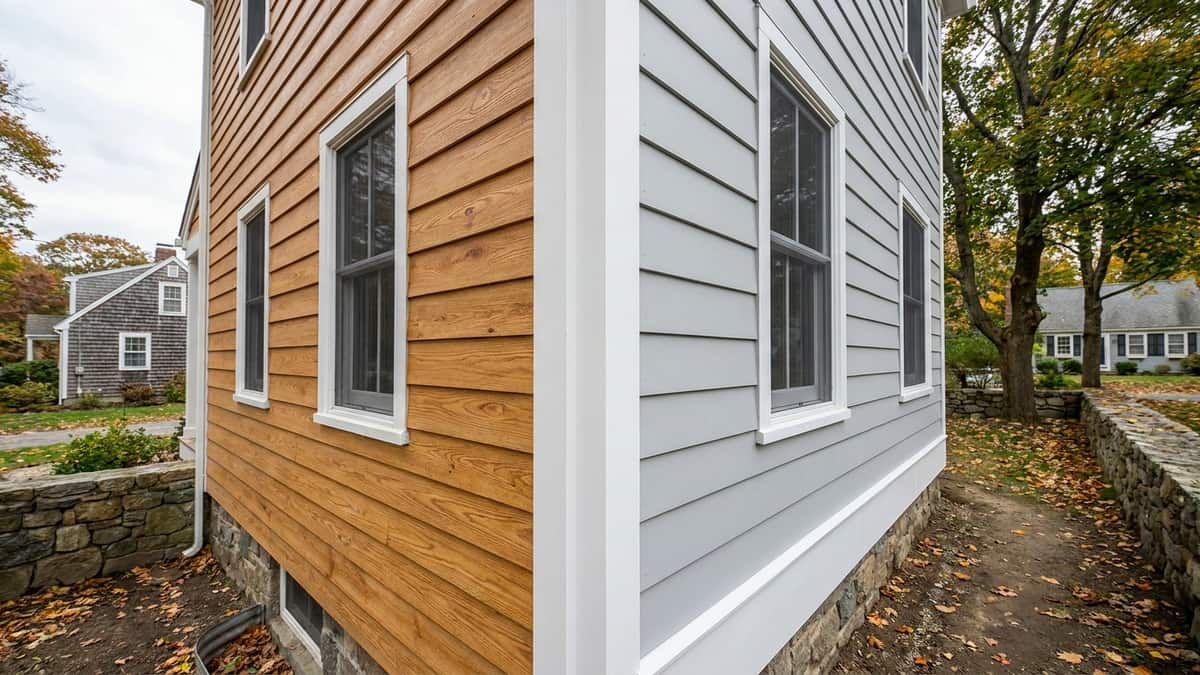
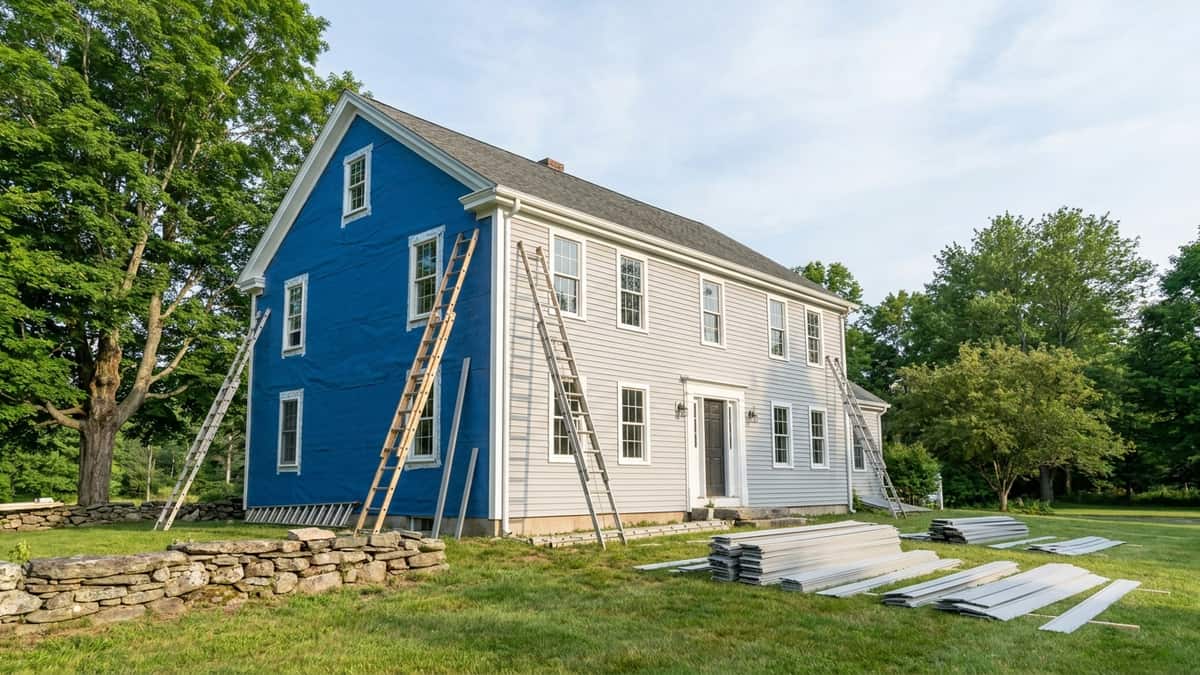
This post is about the trim specifically, meaning corner boards, window and door casing, rake and frieze boards, water tables, sills, and column wraps. It is a different question from the siding behind it, which we cover in what new siding costs on a Connecticut home.
What the two materials actually are
Cellular PVC
Cellular PVC is an expanded polyvinyl chloride board, white through its thickness, sold in the same nominal dimensions as lumber. It does not absorb water, so it cannot rot, and insects have no interest in it. It is stable in sunlight without a coating. It is also not wood in three ways that matter on a job site: it is not structural, it moves noticeably with temperature, and its joints are chemically welded rather than simply caulked.
Wood
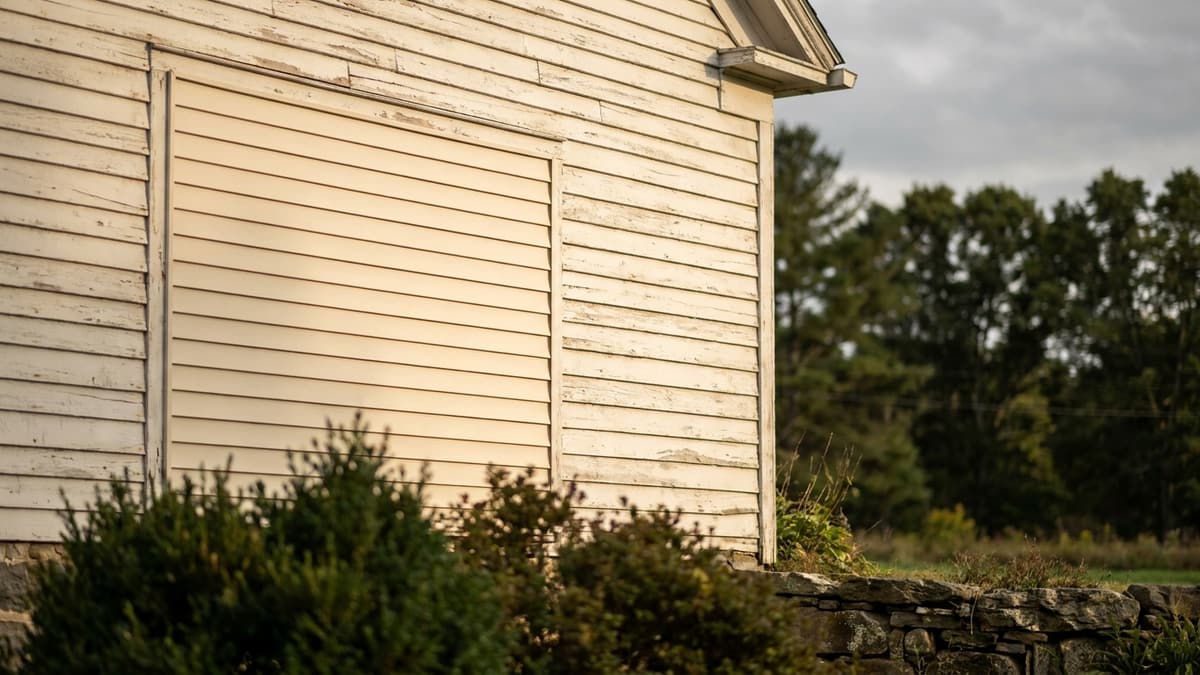
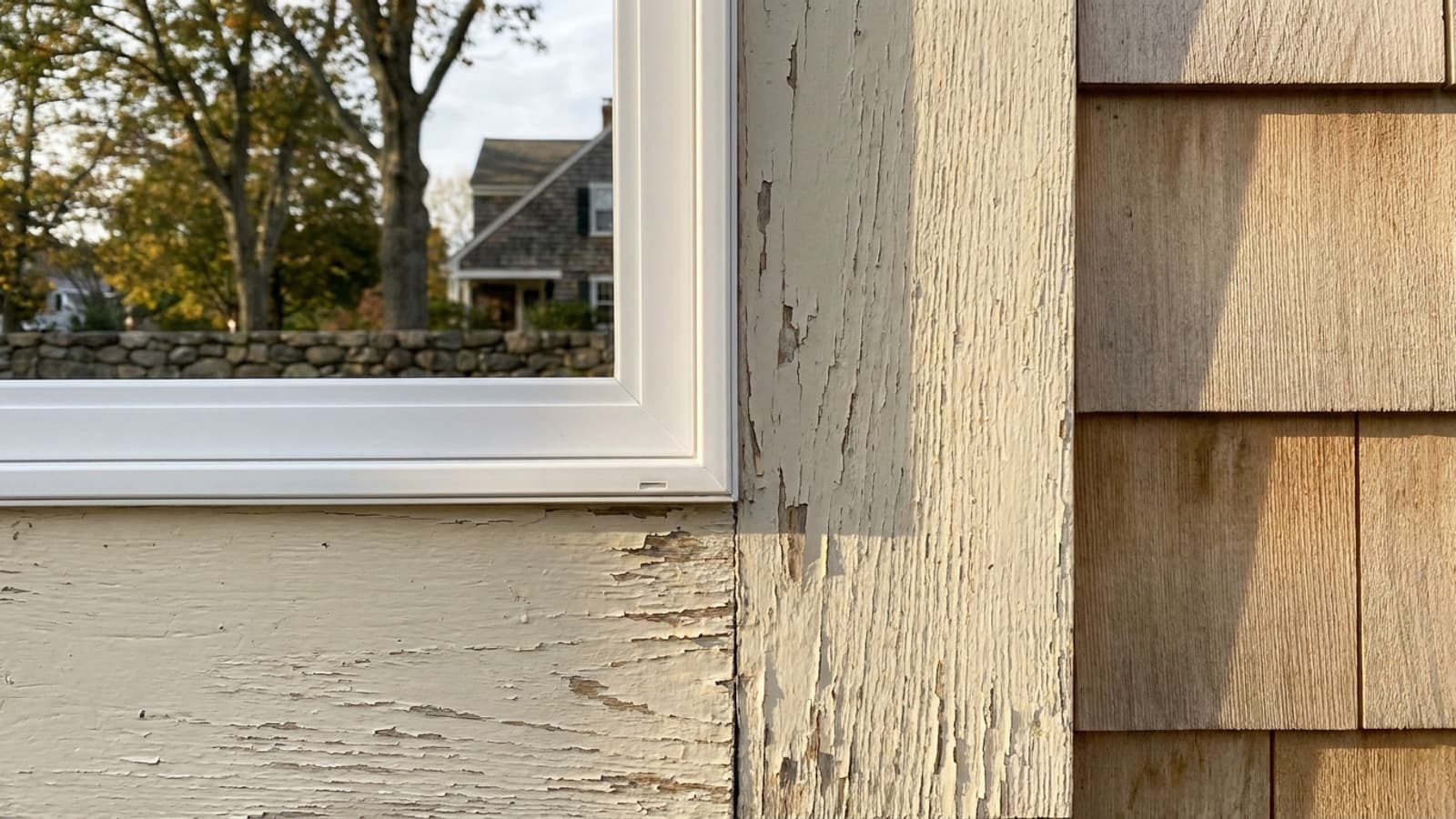
Exterior wood trim in Connecticut is usually finger-jointed primed pine, solid pine, or cedar. Cedar is the durable option and the one that pairs naturally with cedar siding. All of them are protected by a paint or stain film. When that film fails, water gets into end grain and joints, and the board starts to go. The rate at which that happens is a function of exposure, drainage and how carefully the board was primed on all six sides before it went up.
Where the cost difference actually sits
Homeowners tend to compare the price of a board. That is the smaller half of the comparison.
On any trim job, labor is the larger line, and labor is nearly identical for the two materials. The crew is on the same ladders, cutting the same lengths, flashing the same heads. PVC carries a material premium per foot over primed pine, and it closes some of that gap against clear cedar. Trim is also a modest share of a full re-side, so moving from wood to PVC on corner boards and casings shifts the total by a smaller percentage than most people expect.
The real cost divergence appears later, in painting. A painted wood trim package needs a maintenance repaint on a cycle, and the second and third repaints are usually more expensive than the first because they include scraping, spot priming and carpentry replacement of the worst boards. PVC, left white or painted once for color, drops out of that cycle entirely.
The upkeep comparison
| Factor | Cellular PVC | Painted wood |
|---|---|---|
| FactorRot risk | Cellular PVCNone, the material does not absorb water | Painted woodReal wherever the paint film fails |
| FactorInsect damage | Cellular PVCNone | Painted woodPossible in damp, unpainted areas |
| FactorPaint required | Cellular PVCOptional, for color only | Painted woodRequired, and it is the protection |
| FactorRepaint cycle | Cellular PVCOnly when you want a new color | Painted woodRecurring, and scraping grows over time |
| FactorThermal movement | Cellular PVCSignificant, must be detailed for | Painted woodMinor by comparison |
| FactorCustom profiles | Cellular PVCLimited to stock shapes and milled sheet | Painted woodAnything a shaper can cut |
| FactorStructural capacity | Cellular PVCNone | Painted woodLimited, but real |
| FactorFire behavior | Cellular PVCCombustible, softens with heat | Painted woodCombustible |
| FactorHistoric district | Cellular PVCMaterial change, needs review | Painted woodLike-for-like, no review |
Where PVC earns its price
The places where wood trim fails first are predictable, and those are exactly where PVC is worth the premium:
- Water tables and skirt boards near grade, where splash-back keeps the bottom edge wet.
- Garage door jambs, which take snow, salt and plow spray every winter.
- Window sills and sill horns, which hold standing water at their ends.
- Rake and frieze boards on gable ends with no overhang above them.
- Column bases and porch trim within reach of runoff.
- Anything three stories up that nobody will realistically repaint on schedule.
Along the shoreline the case is stronger still. Salt air wears paint faster and corrodes fasteners, which is why work in towns like Guilford and Madison gets specified with corrosion-resistant fasteners regardless of the trim material. If you are planning siding work in Guilford or anywhere else on the central shoreline, the trim package deserves the same scrutiny as the siding.
Where wood is still the better choice
The case against PVC is not sentimental.
Profiles are the first issue. A house with period casing, a molded water table or a built-up crown will not find those shapes in stock PVC. They can be built up from sheet stock, but that is carpentry time, and at some point the labor cost erases the material argument.
Second, PVC is not structural. It wraps a post, it is not a post. Anywhere the trim carries or braces something, wood or steel is doing the work and the PVC is cosmetic.
Third, deep, protected locations simply do not stress wood much. Trim under a four-foot overhang on a north wall that has held paint for twenty years is not a problem looking for a solution.
Fourth, if the house sits in a local historic district, the statute settles it. Under Connecticut General Statutes Sec. 7-147f(a), replacing trim with similar materials needs no Certificate of Appropriateness, while changing the material type does. Choosing wood keeps the project on its own schedule rather than a commission's meeting calendar.
Installation details that decide whether PVC performs
PVC fails almost exclusively from installation, not from the material.
Movement
Cellular PVC expands and contracts with temperature more than wood does. On a long run, that movement is visible across a Connecticut year. It is handled by leaving the manufacturer's specified gap at butt joints and terminations, fastening at the required spacing rather than at the ends only, and never trapping a long board tight between two fixed points.
Fastening and joints
Fasteners should be stainless steel where salt air is a factor, driven into solid framing rather than sheathing alone. Butt joints are bonded with PVC cement, which welds the two boards into one piece, rather than filled with caulk that will open. A caulked PVC joint that keeps reopening is an installation defect and nothing else.
Paint color limits
PVC can be painted, but most manufacturers set a minimum light reflectance value for the coating unless it is a product specifically formulated for vinyl and PVC substrates. Dark paint on PVC absorbs heat and increases movement, and installing a dark color outside the manufacturer's stated limit is a reliable way to lose warranty coverage. That specification is on the manufacturer's literature and worth reading before picking a color.
Fiber cement trim, the third option
Fiber cement trim sits between the two. It does not rot, holds paint well, is not combustible, and moves very little. It is heavier, harder to cut, and cannot be milled into fine profiles. On a house already getting fiber cement siding it is often the coherent choice, and it is worth asking about alongside the siding options we install.
How to read the trim line on a quote
A quote that says "trim as needed" is not a price. Ask for:
- Which material is going where, by location, not as a single blanket line.
- Linear footage for each trim type.
- Fastener type and whether joints are cemented or caulked.
- Who paints, how many coats, and on how many sides of a wood board.
- What happens if rot is found behind the old trim, priced in advance per board or per sheet.
That last one matters. Rotten trim frequently means wet sheathing behind it, and sheathing replacement is one of the scope changes that can pull a permit into a job that otherwise would not need one.
Getting a number for your house
Trim quantities depend on the number of corners, the window count and the way the gables are detailed, which is why a per-foot figure from the internet will not tell you much. If you want a real comparison, request an estimate: someone comes out, measures the trim runs along with the siding, and gives you a written price you can read line by line. Ask for the wood and PVC versions side by side if you want to see the difference for yourself.