Short answer
Patch when the holes are few, the surrounding boards are sound, and the damage stops at the siding. Replace boards or whole courses when the bird has drilled through to the sheathing, when several boards on one wall are perforated, or when the siding was already near the end of its life. Either way the repair only holds if you deal with the reason the bird picked that wall.
On this page
- Read the holes before you read a quote
- The bird is protected, which changes your options
- Materials differ a lot in how they take the hit
- When patching is the right call
- When replacement is the cheaper decision
- The part nobody warns you about: matching
- Permits and historic districts in Connecticut
- What this costs
A woodpecker hole is a siding problem, an insect problem and a wildlife problem at the same time, and the three get solved in different ways. The patch decision is the easy part. The harder question is why that bird chose your wall, because a filled hole on an untreated wall tends to reopen the following spring.
This post covers how to read the damage, when a localized repair is honest, and when replacing boards or a full elevation is the cheaper answer over ten years.
Read the holes before you read a quote
Woodpeckers hit houses for three reasons, and the hole pattern tells you which one you have.
Drumming
Drumming is territorial noise, not feeding. The bird wants a surface that resonates, which is why it targets corner boards, fascia returns, gutter ends, metal flashing, chimney caps and hollow trim. Damage is usually a cluster of shallow dents or a row of small punctures in one spot, repeated at the same time each morning during spring breeding season. Drumming rarely goes through a board, and the fix is usually deterrence plus cosmetic filling.
Foraging
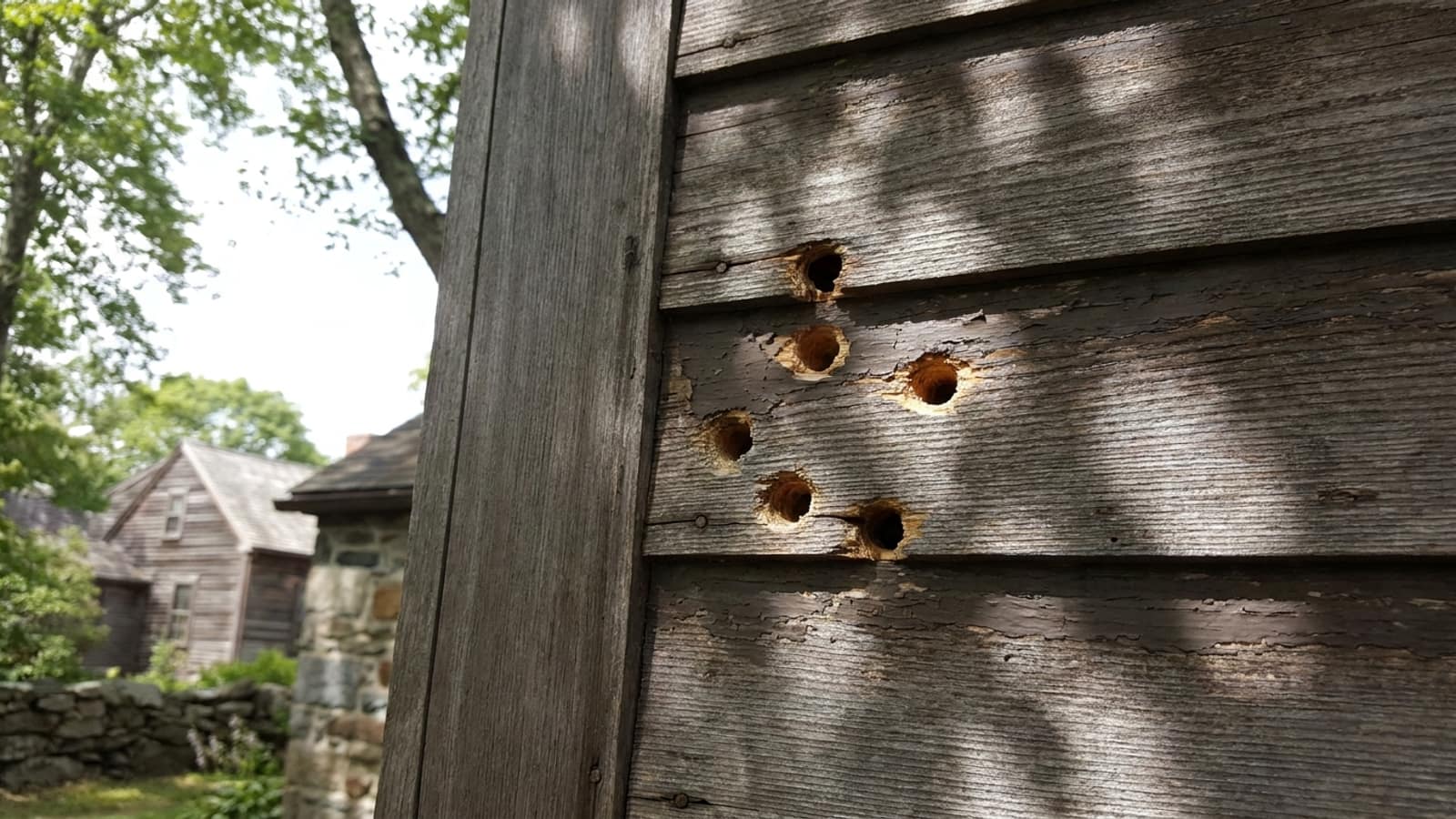
Foraging holes are irregular, often clustered tightly in a small area, and they go deeper. The bird heard or smelled something in the wood. In Connecticut the common culprits are carpenter bees, leafcutter bees, carpenter ants in damp wood, and larvae in older cedar or in engineered wood that has taken on moisture. Foraging damage is a symptom. Fill it without dealing with the insects and the bird comes back to the same four square feet.
Nesting
Nesting cavities are the serious version. They are round, close to two inches across, and they are meant to go through the siding and into a cavity the bird can occupy. On a house that means through the sheathing and into the stud bay, where there is insulation to pull out and an open path for water, wasps, mice and bats. A nesting hole is not a cosmetic repair.
The bird is protected, which changes your options
Woodpeckers are protected under the federal Migratory Bird Treaty Act. They cannot be trapped, harmed or killed without a permit, and that is true regardless of how much damage they have done. What is permitted is exclusion and deterrence: netting standing off the wall, reflective tape or streamers, removing the food source, and sealing holes once the birds are gone. Sealing an active nest cavity with a bird inside is both inhumane and a legal problem, so timing matters.
Materials differ a lot in how they take the hit
| Siding | How it typically fails | Usual answer |
|---|---|---|
| SidingCedar clapboard or shingle | How it typically failsDeep foraging holes, nesting cavities, splitting along grain | Usual answerEpoxy fill for small holes, board or shingle replacement for anything deeper |
| SidingEngineered wood | How it typically failsHoles that wick moisture and swell at the edges | Usual answerReplace the affected plank rather than filling |
| SidingHollow vinyl | How it typically failsPunched holes, cracked panels, especially in cold weather | Usual answerSwap individual panels with a zip tool |
| SidingInsulated vinyl | How it typically failsHoles through the face into the foam backer | Usual answerPanel replacement, since the foam holds water |
| SidingFiber cement | How it typically failsRarely targeted, no insects and little resonance | Usual answerSpot repair is unusual |
Cedar is the most frequently hit material we see, which is one reason shoreline homeowners with cedar siding deal with this more than their neighbors with fiber cement. Antique and cottage housing stock in towns like Guilford and Madison is heavily cedar, and the same salt air that weathers the finish also opens the grain that bees use. If you are already weighing a material change on that kind of house, our Guilford siding page lays out the options for coastal walls.
When patching is the right call
A localized repair is honest when all of the following are true.
- The holes are confined to one or two boards on one elevation.
- Nothing penetrates the sheathing, and the house wrap behind the siding is intact.
- The rest of the wall is sound, with no soft spots, no open joints at trim, and no interior stains.
- The siding has meaningful service life left, which for quality vinyl means it is well inside its 20 to 30 year range and for cedar means it is still holding stain.
On cedar, that repair means cleaning out the hole, treating any active insect activity, filling with a two part exterior epoxy rather than a paintable latex filler, sanding flush and then staining. Latex fillers shrink and telegraph through the finish after one Connecticut freeze and thaw cycle. On vinyl, it means unzipping the course and sliding in a replacement panel, not caulking a hole shut.
When replacement is the cheaper decision
Replacement of boards, a full wall or the whole house starts to win when any of these apply.
- A nesting cavity has gone through the sheathing, which means opening the wall anyway to inspect insulation and framing.
- Damage is spread across several boards and multiple courses, so patch count climbs and every patch is a visible repair.
- The siding is at the end of its life and the woodpecker damage is simply the most visible symptom of wood that has gone soft.
- The pattern repeats year after year because the wall itself is the attraction.
That last case is worth being blunt about. If a wall has been drummed every spring for five years, you are paying for the same repair repeatedly. Changing what is on that wall ends the cycle in a way that filler does not. Our siding repair work covers both paths, and we will say which one we think the house needs.
The part nobody warns you about: matching
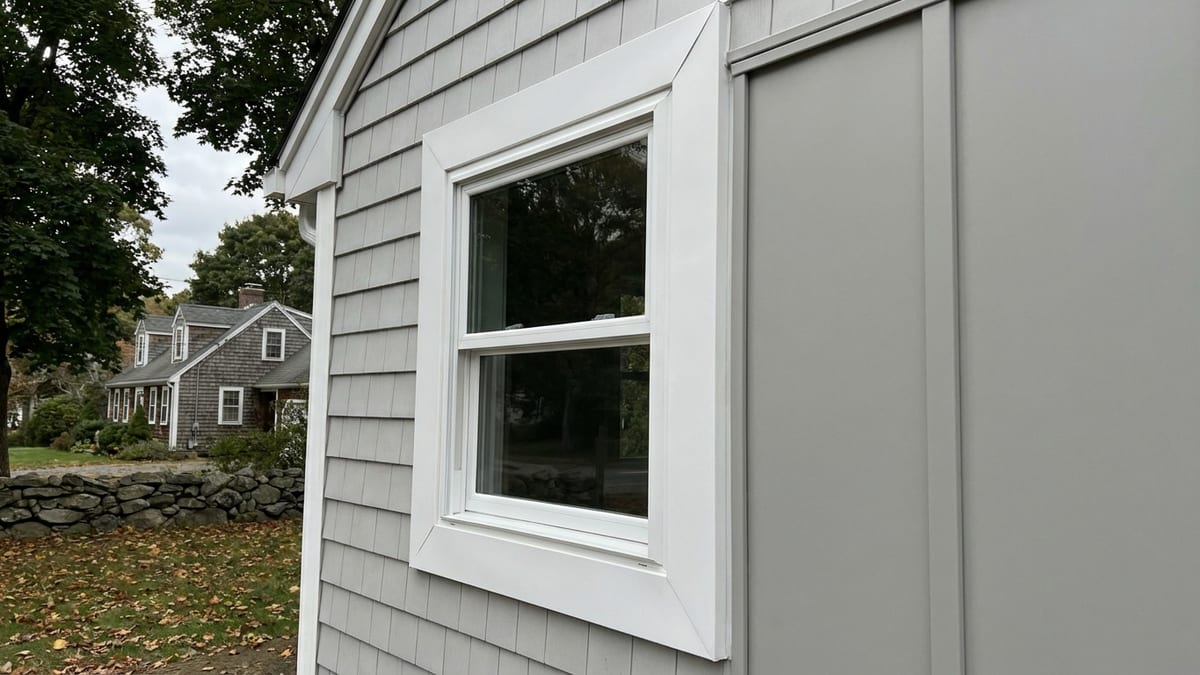
A technically perfect patch that does not match is still a visible scar. New cedar next to fifteen year old cedar is a different color even with the same stain, and vinyl profiles and colors get discontinued regularly, so an exact panel match on an older wall is often not available. The usual trade workaround is to harvest matching boards or panels from a hidden elevation, such as the back of a garage wall, and put the new material there instead. We go through that in more detail in our post on matching existing siding during a repair.
Permits and historic districts in Connecticut
Most Connecticut towns do not require a permit for a like-for-like siding repair or replacement. A permit is generally required once the scope grows: sheathing replacement, structural repair discovered after demolition, altered openings or added exterior insulation. A nesting cavity repair can easily cross that line, since you may be replacing sheathing.
In a local historic district, Connecticut General Statutes Sec. 7-147f(a) means replacing damaged cedar with cedar needs no Certificate of Appropriateness. Switching that wall from cedar to vinyl or fiber cement changes the material type and does require review, which means a commission meeting in your schedule.
What this costs
Repair pricing depends entirely on access, board count and what is found behind the siding, so no honest number exists before someone looks at the wall. For context on the other end of the scale, full siding projects in Connecticut generally run $8,000 to $35,000 for vinyl, $18,000 to $80,000 or more for James Hardie fiber cement, and $25,000 to $60,000 or more for cedar, depending heavily on wall area and trim complexity. Those are general state ranges, not a quote.
If you want it priced, request a free estimate. Someone comes out, looks at the damage, checks whether it has gone past the siding into the wall, and gives you a written price for the repair and, where it is the better value, for replacing the affected wall instead.