Short answer
Architectural shingles are the right default on most Connecticut homes because they last 25 to 30 years against 15 to 20 for three-tab and carry much higher wind ratings, which matters in towns assigned 120 or 125 mph. Three-tab is still a defensible choice on a rental, a detached garage, or a house you intend to sell within a few years. The gap in installed price is narrower than most homeowners expect, because tear-off, disposal, labor and flashing cost the same either way.
On this page
Architectural shingles are the default on most Connecticut homes for a reason: they last roughly 25 to 30 years against 15 to 20 for three-tab, and they are rated for far more wind. The honest counterpoint is that the difference in installed price is smaller than the marketing suggests, and there are still houses where a three-tab roof is the correct financial decision.
This post is about how the two products actually differ, what the difference is worth in a Connecticut climate, and how to tell which one you are being quoted.
What physically differs
Both products are asphalt shingles. Both use a fiberglass mat saturated with asphalt and surfaced with ceramic-coated granules. The difference is how many layers there are.
Three-tab
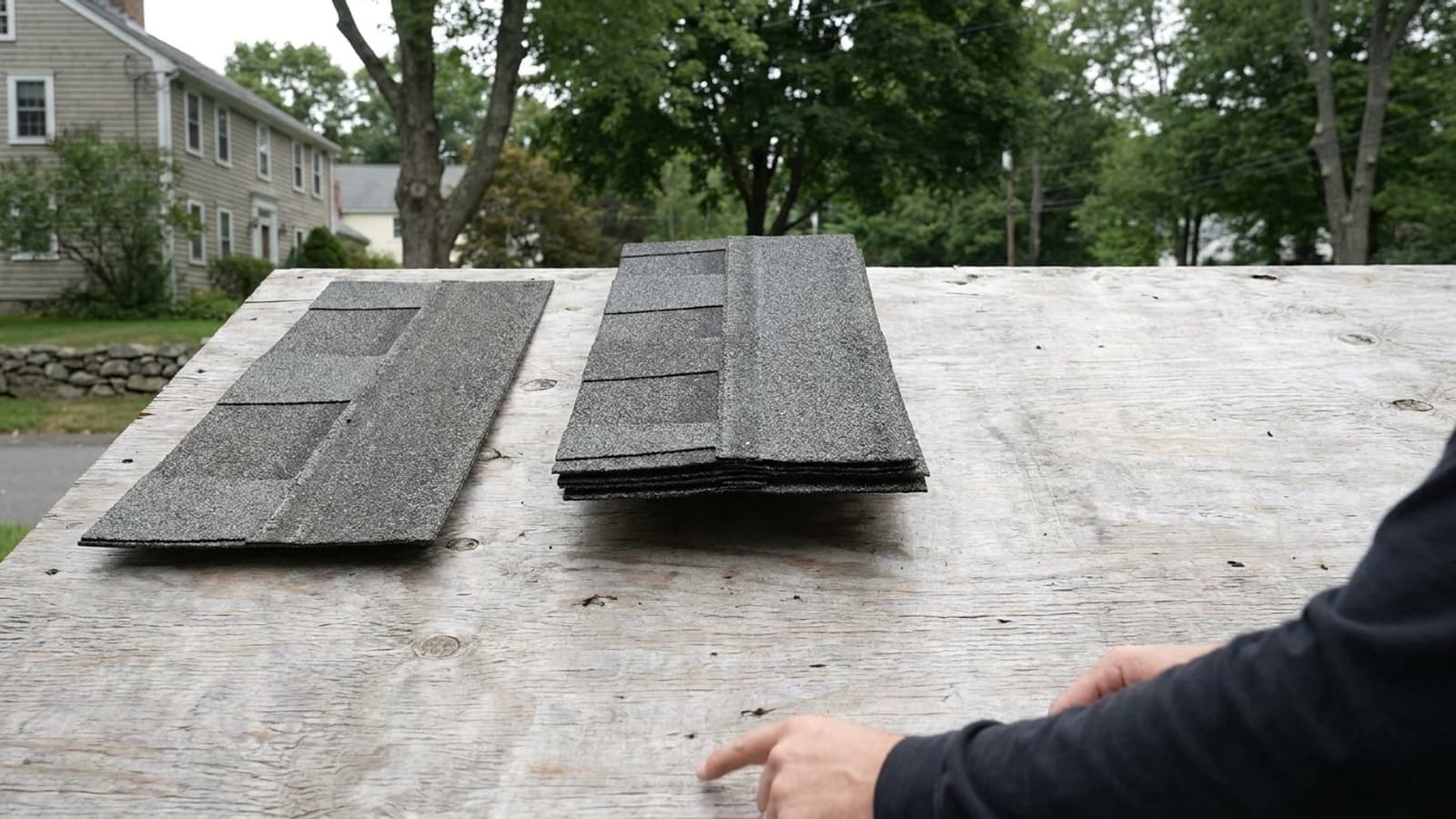
A three-tab shingle is a single flat layer with two slots cut into the exposed edge, creating three visible tabs per shingle. Every shingle is the same thickness across its whole face. The finished roof reads as a flat, uniform grid from the street. It is the shingle that covered most of Connecticut's post-war housing stock, and it is still the cheapest way to make a roof watertight.
Architectural, also called laminated or dimensional
An architectural shingle is two or more layers laminated together. A base layer runs the full width, and a second cut layer is bonded on top in a staggered pattern. That extra layer does two things. It roughly doubles the asphalt content in the exposed area, which is what drives durability, and it creates real shadow lines so the roof reads as texture rather than a grid. Products like GAF Timberline and HDZ, Owens Corning Duration and TruDefinition, CertainTeed Landmark and IKO Cambridge are all laminated shingles. You can see the range we install on the roofing materials section of our roofing page.
Lifespan in a Connecticut climate
Published lifespans assume the roof was ventilated and fastened correctly. In Connecticut, freeze-thaw cycling and summer attic heat are the two forces that shorten those numbers.
| Shingle type | Typical lifespan | Typical installed cost on a Connecticut home |
|---|---|---|
| Shingle typeThree-tab asphalt | Typical lifespan15 to 20 years | Typical installed cost on a Connecticut home$8,000 to $15,000 |
| Shingle typeArchitectural asphalt | Typical lifespan25 to 30 years | Typical installed cost on a Connecticut home$10,000 to $28,000 |
Those are general Connecticut ranges that depend on the specific house, not a quote. Roof size, pitch, number of valleys and dormers, and what the crew finds when the old roof comes off move a price inside that range far more than the shingle line does. We go through the drivers in more detail in our post on what a new roof costs in Connecticut.
The practical reading of that table: architectural shingles buy you roughly one extra decade. On a house you plan to hold for twenty years, you are choosing between one architectural roof and two three-tab roofs, and the second three-tab roof will cost more in future dollars than the upgrade costs today.
Wind ratings and the town numbers
Appendix AY of the 2022 Connecticut State Building Code assigns every municipality an ultimate design wind speed. In the towns we serve that figure is 120 mph, or 125 mph in Guilford, Madison and New Haven. Every one of them sits inside a designated hurricane-prone region.
A common point of confusion is worth clearing up. The high-wind underlayment provisions people sometimes hear about are keyed to Vasd, the allowable stress design wind speed, at values above 110 mph. Converted from the Vult figures above, Vasd in these towns lands around 93 to 97 mph. That trigger does not apply here. What does apply is the manufacturer's own fastening requirement.
Most three-tab products carry a wind rating in the range of 60 to 70 mph. Most laminated architectural products are rated at 110 mph and up, with the top figure available only when the shingle is fastened the way the manufacturer specifies to earn it.
Six nails, not four
For high-wind coverage, most manufacturers require six nails per shingle placed inside a defined nail zone, rather than the standard four. This is the single most common gap between a wind rating on paper and a wind rating that would survive a warranty claim. A crew that hand-nails four fasteners into a shingle sold as a 130 mph product has installed a shingle with no high-wind coverage.
Ask for the nail count in writing. It costs the contractor a little more time and a little more material, and it is the cheapest durability you can buy on a roof.
Snow load is a different question entirely. The ground snow load in these towns is 30 psf, or 35 psf in Avon, Farmington and Simsbury. That figure is a structural requirement carried by the framing, not by the roof covering. Neither shingle type changes it.
When three-tab is the honest choice
A good contractor should be willing to sell you the cheaper product when it is the right one. Situations where three-tab makes sense:
- A rental or investment property where the holding period is shorter than the life of an architectural roof and the cash matters more than the twenty-year math.
- A detached garage, shed or small outbuilding that does not need to match the house and does not shelter anything expensive.
- A sale within a couple of years where the objective is a sound, warrantable roof rather than a curb appeal upgrade, and the buyer's inspector is the audience.
- A repair matching an existing three-tab roof where only one slope needs replacing and a laminated shingle would be visually obvious.
- Very simple, low-profile roofs where the shadow lines of an architectural shingle add little visually.
Against that, three-tab has a real weakness in this state: the exposed tab slots and lower wind rating make it more vulnerable to uplift along rakes and ridges, and the thinner asphalt layer is less forgiving of the freeze-thaw cycling that follows every Connecticut January thaw. On the post-war Capes, Ranches and split-levels that make up much of the stock in towns like Manchester, where a lot of original roofing is at the end of its life, we usually recommend a laminated shingle at roof replacement rather than a second three-tab cycle.
When the upgrade is not the point
Spending more on shingles does not fix a roof that is failing for another reason. Two cases come up constantly.
Blocked attic ventilation. If air cannot enter at the soffit, the attic runs hot and the shingles age from below. An architectural shingle in a superheated attic will not reach 25 years. The airflow has to be corrected during the same project.
Layers. If there is already more than one layer of shingles on the deck, adding a third is not permitted, and even a second layer hides deck condition you should be looking at. That trade-off is covered in our post on going over the old roof versus a full tear-off.
A roof replacement in every Connecticut town we serve requires a building permit, pulled by a contractor registered as a Home Improvement Contractor, and the town inspects the work. That is true regardless of which shingle you pick.
How to compare two quotes
Put the two proposals side by side and look for four things:
- Manufacturer, product line and color. "Architectural" alone is not a spec.
- Nail count per shingle and whether it matches the manufacturer's high-wind requirement.
- Ice and water shield coverage at the eaves and in the valleys, stated in courses or in feet.
- Ventilation work included, if intake or exhaust is deficient.
A quote that names all four is comparable to another quote that names all four. A quote missing them is a number, not a scope.
If you want a written price on both options for your own house, request one through our estimate page. Someone comes out, measures the roof, looks at the deck and attic where accessible, and gives you an itemized written price. You can ask for the three-tab and architectural numbers separately and make the comparison yourself.