Short answer
Vinyl shake and scallop panels are priced at roughly two to three times the per square foot cost of standard vinyl lap siding, but they are normally applied to a small area, so on most Connecticut homes the accent adds a few hundred to a few thousand dollars to the job rather than changing its order of magnitude. A full vinyl siding project still falls inside the general Connecticut range of $8,000 to $35,000. The trim, flashing and transition details where the accent meets the lap siding often cost more than the panels themselves.
On this page
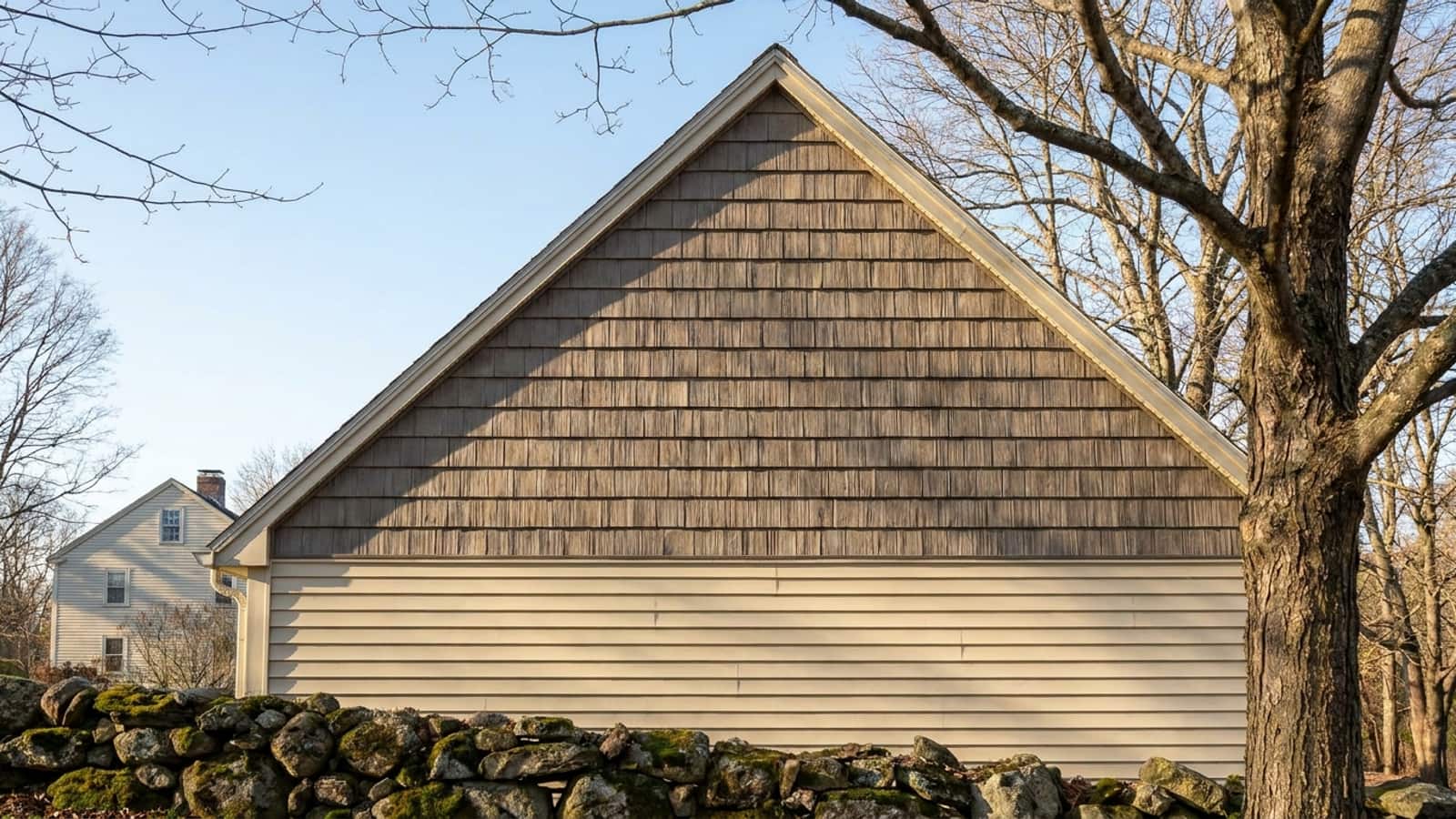
Vinyl shake and scallop panels are priced higher per square foot than standard lap siding, generally in the range of two to three times as much, and they install slower because every one of them meets a trim piece somewhere. What keeps the total reasonable is area. A gable triangle on a Connecticut Cape is a small share of the wall surface on the house, so the accent usually moves a siding estimate by a few hundred to a few thousand dollars rather than changing what kind of project it is.
That is the honest answer, and it cuts both ways. The accent is cheap relative to the house. It is expensive relative to the square footage it covers.
What you are actually buying
Shake panels imitate hand split or staggered cedar shingles. Scallop panels, sometimes called half rounds or fish scale, imitate the decorative shingle coursing found on Victorian era homes. Both are molded vinyl in panel form, usually with a deeper profile and heavier thickness than lap siding, and both are sold as accent products rather than whole house cladding.
Three things push the price above lap siding:
- Material. Deeper molds, thicker stock and more pigment per square foot. The texture that makes the panel look like wood is also what makes it cost more to produce.
- Coverage. A shake or scallop panel covers less wall per piece than a double four or double five lap panel, so a crew handles far more pieces per square.
- Cuts and trim. An accent is defined by its edges. Every rake, every transition band, every corner where the accent stops costs labor that a plain wall does not.
If you are already comparing panel grades, the thickness and lock quality discussion in our post on vinyl siding thickness grades applies to accent panels too. Accent products tend to sit at the heavier end by default, which is one reason the per square foot number looks steep.
Where the cost lands on a real house
| Accent location | Relative size | What drives cost there |
|---|---|---|
| Accent locationOne front gable end | Relative sizeSmall | What drives cost thereRake trim, staging height, cutting the triangle |
| Accent locationTwo or three gables | Relative sizeSmall to moderate | What drives cost thereRepeated setup and trim, not much more material |
| Accent locationDormer faces and cheeks | Relative sizeSmall | What drives cost thereHigh labor per square foot, many short cuts |
| Accent locationBay window skirt or porch gable | Relative sizeVery small | What drives cost thereDetail work, flashing at the roof line |
| Accent locationSecond story band above a transition | Relative sizeModerate | What drives cost thereA horizontal band course runs the full perimeter |
| Accent locationWhole house shake | Relative sizeLarge | What drives cost thereMaterial cost scales across every wall |
The first five rows are accents. The last one is a different project. Whole house vinyl shake pushes a siding job toward the upper part of the general Connecticut vinyl range of $8,000 to $35,000, and at that point the comparison is no longer shake versus lap. It is shake versus fiber cement or cedar at a similar spend, which is the trade off we work through in our guide to what new siding costs in Connecticut.
The details that cost more than the panels
An accent only works where it stops cleanly. The transition between shake above and lap below needs a trim piece, usually a band board or a J channel detail, and it needs to shed water. Done poorly, that horizontal line becomes a shelf that holds water against the wall.
Things worth seeing named on an estimate:
- The transition trim type and how many linear feet of it.
- Rake trim at the gable edges and how it meets the existing roof edge.
- Flashing where the accent meets a roof, porch or lower wall section.
- Whether the house wrap behind the accent area is being replaced or reused.
- The panel line and color, by name, including the trim color if it differs.
A quote that says "shake accent on front gable, allowance included" is not a price. It is a placeholder. Our vinyl siding page describes how we specify the system rather than the panel alone.
The case against doing it
There is a real argument for leaving the gable in plain lap siding.
It dates faster than plain siding. Scallop in particular reads as a period detail. On a Victorian in Hartford or Middletown it belongs. On a 1980s Colonial it is a style decision that may not age the way you expect.
Future matching is harder. Accent profiles get discontinued more often than mainstream lap lines. If a tree limb damages three shake panels in twelve years, the odds of an exact match are lower than they would be for a common lap profile.
Texture holds dirt. Deep shadow lines catch pollen, dust and mildew film, especially on shaded north walls. The panels still wash with a hose, but they do not stay clean as effortlessly as smooth lap siding.
The cost per visual impact is not always great at height. A shake accent on a second story gable that is forty feet up and partly hidden by mature trees is detail nobody sees from the street. Spending the same money on better trim at the entry or on heavier gauge lap siding often shows more.
Code, permits and historic districts
Vinyl siding is tested and labeled for wind resistance, and that label is only meaningful if the panels are fastened at the spacing the manufacturer requires and hung loose enough to expand and contract. Every town we serve sits inside a designated hurricane prone region under the 2022 Connecticut State Building Code, with ultimate design wind speeds of 120 mph in the Hartford and Fairfield County towns and 125 mph in Guilford, Madison and New Haven. Nailing a shake panel tight to hold it flat is the most common way a correct product performs incorrectly.
On permits, most Connecticut towns do not require one for a straightforward like for like siding replacement. A decorative panel inside a vinyl siding job generally stays in that category. A permit is typically required once the scope grows to include exterior insulation, sheathing replacement, altered openings or structural repair discovered after the old siding comes off.
If the house sits in a local historic district, the distinction in Connecticut General Statutes Sec. 7-147f(a) matters. Replacing in similar materials does not require a Certificate of Appropriateness. Changing the material type or the configuration does, and swapping wood shingles for molded vinyl shake is a material change. That is a commission meeting, not a phone call, so build the schedule around it.
How to decide
Ask for the accent priced as a separate line, not folded into the whole number. Then you can see what it actually costs and decide on its own merits. In our experience the conversation usually ends in one of three places: a single front gable, which is the best value; gables plus dormers, which is the complete look; or no accent at all, with the money moved into heavier panels or better trim across the whole house.
All three are defensible. What is not defensible is a quote where the accent is invisible in the pricing and you find out at the end what it cost.
If you want the number for your house, request a written estimate through our siding page or the estimate form. Someone comes out, measures the walls and the gables, looks at the existing trim and transitions, and sends back an itemized price you can compare against anyone else's.