Short answer
Rot behind siding is almost always billed on top of the base contract, as a unit rate rather than a guess, because nobody can measure it until the old siding is off. The common units are per sheet of wall sheathing, per linear foot of trim or framing, and per hour for structural carpentry. The number worth settling before work starts is the unit price and the proof requirement, not a vague allowance.
On this page
Rot behind siding is not something a contractor hides from you in the estimate. It is a condition that cannot be measured until the old siding is off the wall, which is why it shows up as a separate line rather than inside the base bid. What you can control is how it gets priced, how it gets proven, and how far the repair is allowed to travel before you are consulted.
The honest way to handle it is a unit price agreed in advance: a dollar figure per sheet of sheathing, per linear foot of trim, per linear foot of framing. The dishonest versions are a round allowance with no unit behind it, or no mention of rot at all, which guarantees a conversation on day two of the job with the wall already open and your leverage gone.
Why nobody can quote this before demolition
Wall sheathing sits under the siding and under the water resistive barrier. On a Connecticut house built since the 1960s it is usually plywood or oriented strand board. On older homes it may be board sheathing run diagonally, and on some mid-century construction there is no structural sheathing at all behind the siding, just let in bracing.
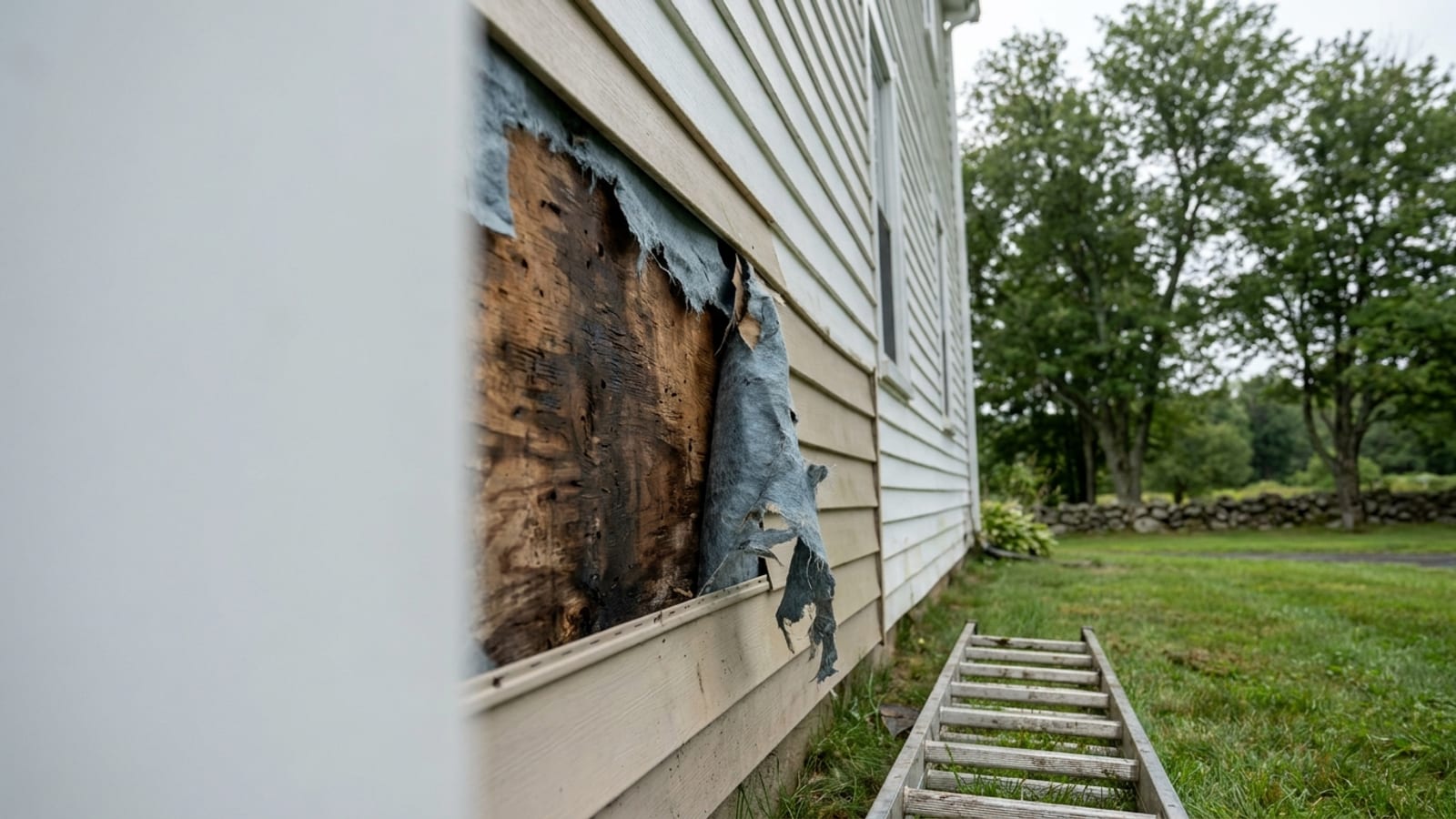
Rot rarely starts in the middle of a field of siding. It starts where water was supposed to be redirected and was not: a window head, a butt joint in trim, a deck ledger, a missing kickout at a roof to wall intersection. Water enters a small defect, runs down the back of the siding, and soaks a narrow vertical path. From the street, the siding above that path can look fine for years.
An experienced estimator can tell you the risk is elevated. Interior stains on an exterior wall, paint failing from the inside out, soft spots when the wall is pressed, siding that moves under hand pressure, and a history of a leaking gutter or a failed deck ledger all raise the odds. Our post on the difference between siding that has aged and siding that has failed covers those signals in detail. None of them tell you how many sheets of plywood are bad.
Where rot concentrates on Connecticut houses
Below windows and at trim joints
The bottom corners of window openings are the most common find. Water that gets past a sill or a butt joint in trim has nowhere to go and collects on the horizontal framing below. On a house where the original siding was installed without flashing over the window head, the damage is often directly above the opening as well.
The bottom course and the rim joist
Splashback, grade that was built up over the years, and snow that sits against the wall all attack the lowest foot of the wall. This is also where the rim joist sits, which is framing rather than sheathing, and repairs there cost more because the work is structural and sometimes requires temporary support.
Deck ledgers and roof to wall intersections
A deck ledger bolted through siding without flashing is one of the most reliable sources of hidden rot in the state. The same is true of a roof edge that dies into a wall with no kickout flashing, which dumps a roof's worth of runoff into one vertical stripe of sheathing.
North and shaded walls
Walls that dry slowly stay wet longer. On shoreline homes in Guilford and Madison, salt air and persistent humidity add to that, and fasteners corrode alongside the wood. The pattern is not unique to the shoreline, but drying time matters everywhere in a freeze thaw climate.
How rot repair should be priced
Ask for the units, not a lump sum. A contract that lists unit rates can be checked against what was actually removed and installed.
| What is found | How it is normally measured | What to get in writing |
|---|---|---|
| What is foundWet or delaminated wall sheathing | How it is normally measuredBy the 4 by 8 sheet, or by the square foot | What to get in writingAn installed price per sheet, including fasteners |
| What is foundRotten trim and corner boards | How it is normally measuredBy the linear foot, by profile | What to get in writingA separate rate for each profile and material |
| What is foundRim joist or sill plate damage | How it is normally measuredBy the linear foot of framing | What to get in writingThe rate, plus whether shoring is included |
| What is foundIndividual rotted studs | How it is normally measuredBy the piece, sistered or replaced | What to get in writingA per stud or hourly rate with photos required |
| What is foundHouse wrap and flashing | How it is normally measuredNormally inside the base bid | What to get in writingConfirmation that it covers the entire wall |
The base siding price itself still drives most of the invoice. General Connecticut ranges run roughly $8,000 to $35,000 for vinyl and $18,000 to $80,000 or more for James Hardie fiber cement, depending heavily on wall area and trim complexity, and those are ranges rather than quotes. Rot repair is an addition to whichever of those your house lands in, which is one reason the unit rate matters more than its headline sounds.
The point where repair becomes a permitted job
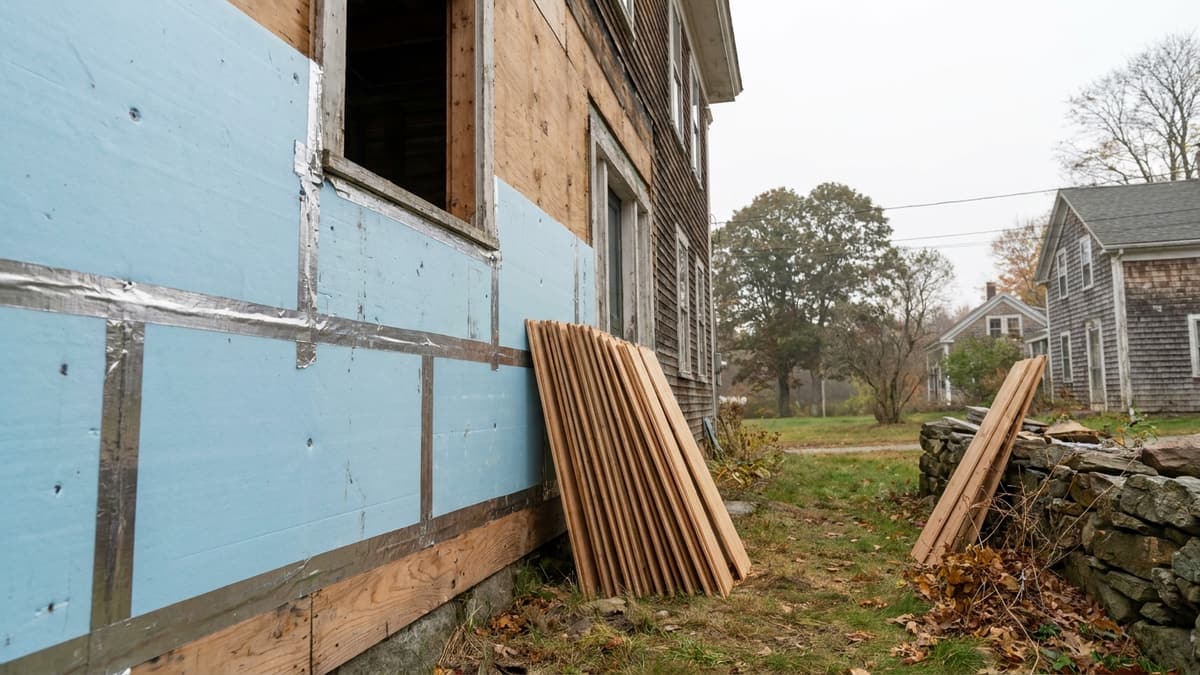
Most Connecticut towns do not require a permit for a straightforward like-for-like siding replacement. That changes once the scope grows. Replacing sheathing, repairing framing, altering an opening, or adding exterior insulation generally moves the job into permit territory, and the town then inspects the work.
This is not a reason to keep the scope artificially small. It is a reason to ask, before the first panel comes off, who pulls the permit if rot is found and whether the fee is already inside your contract. A contractor registered as a Home Improvement Contractor can pull it on your behalf. Our siding service page and the siding repair section explain how that process runs on a typical job.
What a proper sheathing replacement includes
Replacing bad sheathing is not just screwing a new panel over a hole. Done correctly it includes:
- Cutting back to sound wood and to the center of a stud so the new panel has bearing on both edges.
- Fastening the new panel to the code required nailing pattern. Every town we serve sits in a designated hurricane prone region, with an ultimate design wind speed of 120 mph in most towns and 125 mph in Guilford, Madison and New Haven. The wall covering only resists that load if what it is nailed to is sound.
- Blocking at horizontal seams where the panel edges do not land on framing.
- Continuing the water resistive barrier and integrating it with flashing at openings, shingle style, so water that gets behind the siding drains out instead of in. That detail is the actual fix, and we covered it separately in what belongs behind siding.
- Correcting whatever caused the rot. New sheathing behind the same unflashed deck ledger is a timer, not a repair.
The case for doing less
Not every dark stain is rot. Wood that got wet, dried, and stayed sound is discolored, not structurally compromised. A reasonable crew probes it, checks whether a screw bites, and leaves it if it is solid. Replacing every panel with a water mark on it inflates the bill without buying you anything.
There is also a legitimate argument for a smaller scope when the damage is isolated to one wall. If three walls are in good shape and one elevation took years of runoff from a failed gutter, repairing and re-siding that elevation can be the right call, particularly on a house you plan to sell within a few years. The counterargument is color matching, since weathered siding never matches new stock exactly, and mobilization cost, since bringing a crew back later costs more than doing it once.
Questions worth asking before you sign
- What is your installed price per sheet of sheathing, and does it change for plywood versus oriented strand board?
- Will I get dated photographs of every area repaired before it is covered?
- At what dollar amount do you stop and get my written approval?
- If a permit becomes necessary, who pulls it and is the fee inside my price?
- What are you doing to the detail that caused the rot, not just the wood it damaged?
A contractor who answers those five in writing has told you most of what you need to know about how the job will run.
Getting a real number
If you want the actual figures for your house, someone comes out, measures the walls, looks at the known problem areas and gives you a written, itemized price with the rot unit rates stated on it. You can request that estimate here. Bring the questions above to the appointment, because the answers are easier to get before the contract than after the wall is open.