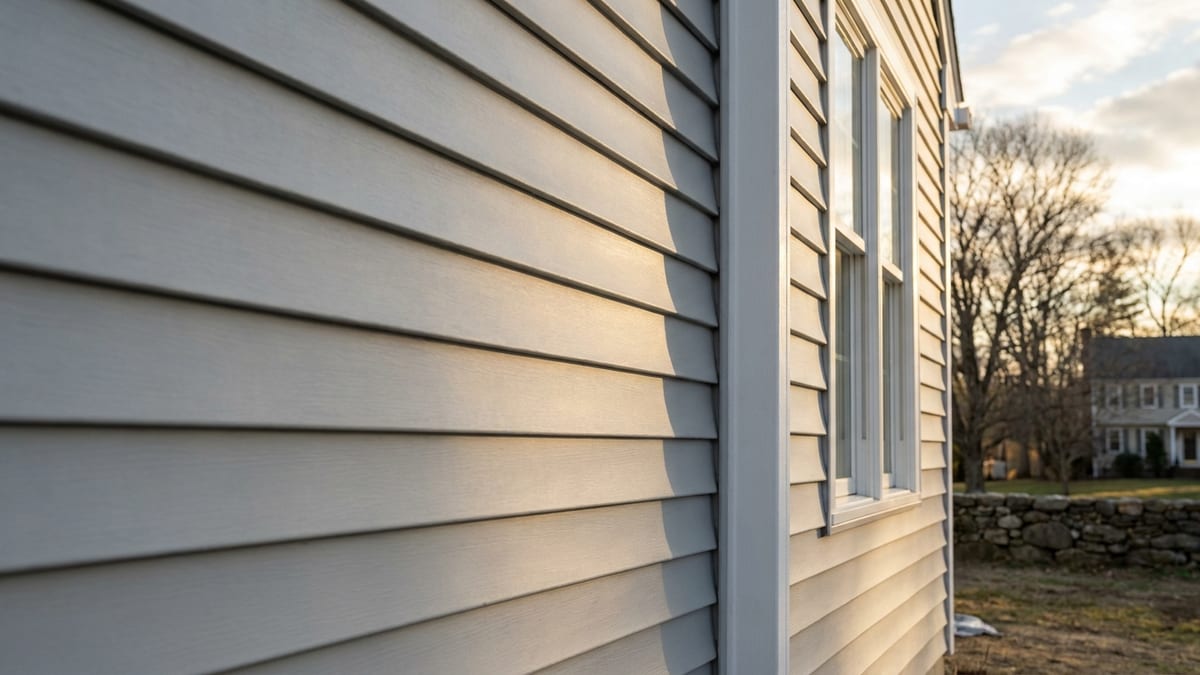
Short answer
In almost every case you wash it. Green growth on siding is algae and mildew living on the surface film of dirt, not evidence that the siding has failed, and a low pressure wash with the right cleaner removes it. Replacement becomes the honest answer only when the siding underneath is cracked, brittle, warped or hiding wet sheathing, which is a separate condition the green film does not cause.
On this page
Green streaks on a north wall are the most common siding complaint we hear, and the most common answer is the cheapest one. Wash it. The growth is algae and mildew living on a thin film of dirt and pollen on the surface, not a sign that the siding has given up.
The part worth your attention is what the washing reveals. A clean wall tells you whether you have a cosmetic problem or a wall problem, and those two have very different price tags.
What the green actually is
Two different organisms get called the same thing.
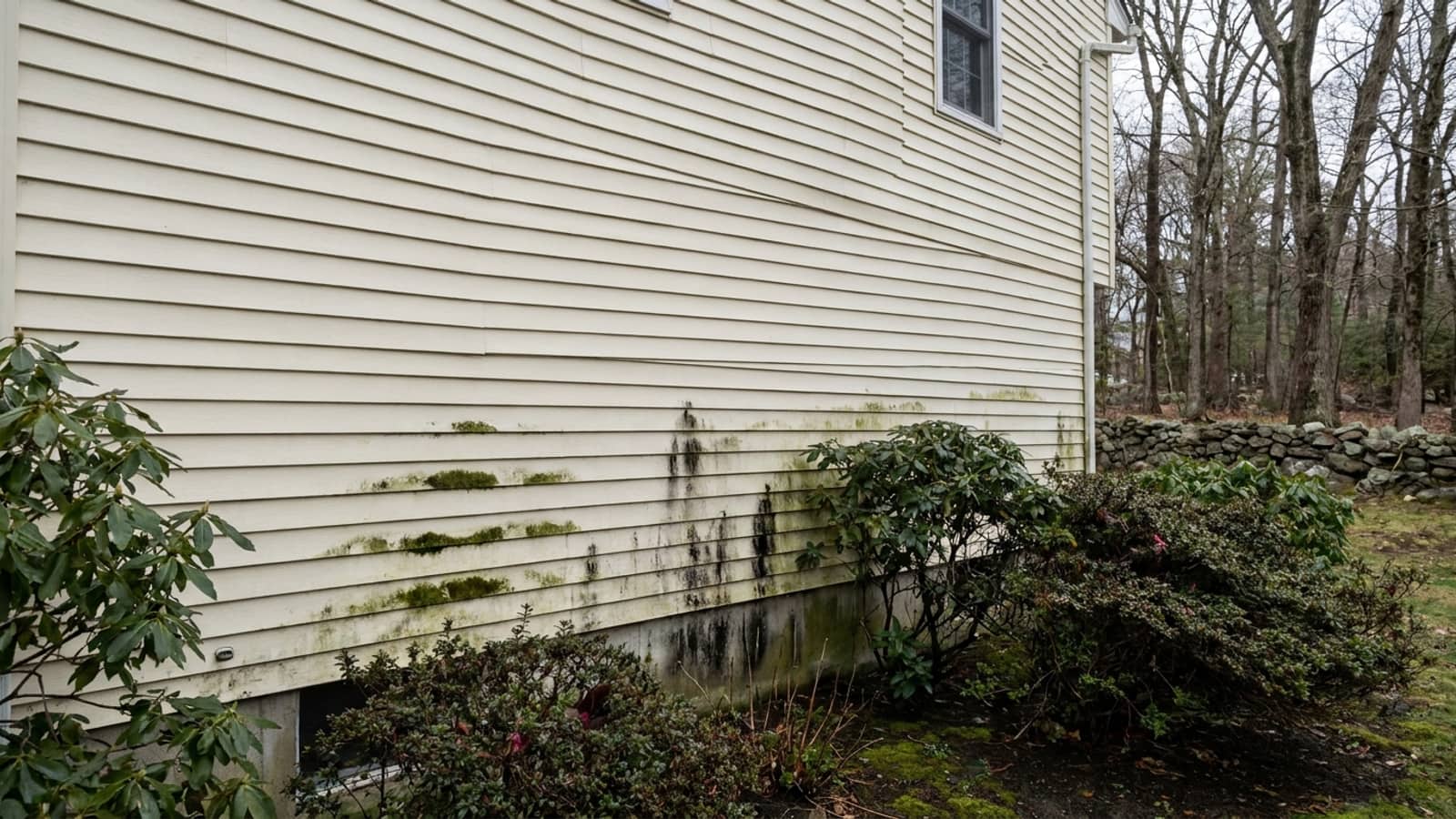
- Algae shows up as a green or gray-green film, usually broad and even, worst on walls that stay shaded and damp. It needs light, moisture and the dust layer that collects on any exterior surface.
- Mildew and mold show up as black or very dark green speckling, often concentrated near grade, behind shrubs, under eaves and around hose bibs and downspouts.
Neither one eats vinyl. Vinyl is not organic, so there is nothing in it for the growth to consume. On painted wood, cedar or fiber cement, the growth sits on the coating rather than the substrate, but it holds moisture against that coating, and sustained moisture is what breaks paint and stain down.
Connecticut gives these organisms a good season. Humid summers, heavy tree canopy in towns like West Hartford and Glastonbury, river valley humidity around Middletown, and salt air and fog along the Guilford and Madison shoreline all keep walls damp longer than a drier climate would.
Wash it correctly, because the wrong wash causes real damage
More siding is harmed by aggressive washing than by the algae.
Pressure is the thing to control
Siding is a drainage plane, not a sealed surface. Every lap is designed to shed water downward and to let any water that gets behind it drain out. A high pressure tip aimed upward under the laps does the one thing the system is not built for: it pushes water uphill, behind the siding and into the housewrap and sheathing. On a hot afternoon that water has nowhere fast to go.
Practical rules that work on vinyl siding and hold up for fiber cement and painted wood as well:
- Use a wide fan tip at the lowest pressure that does the job, or skip the machine entirely and use a garden hose with a soft bristle brush on a pole.
- Keep the spray angled slightly downward, never straight up into the laps.
- Stay off ladders with a wand in your hands. Wand recoil on a ladder is how people fall.
- Work in sections, keep the surface wet so cleaner does not dry on it, and rinse from the bottom up, then top down, so streaks do not set.
Chemistry does the work
The cleaner removes the growth. The water only rinses. Most siding manufacturers publish an accepted cleaning solution, typically a diluted sodium hypochlorite mixed with a surfactant, applied at low pressure and dwelled for several minutes. Oxygen bleach products act more slowly and are gentler on plantings. Pre-wet foundation beds with plain water, rinse them again afterward, and keep the solution off stained decks and off asphalt driveways where runoff pools.
One caution specific to older housing stock in Hartford, New Haven and Farmington village: on a pre-1978 home with painted wood siding, scrubbing or blasting chalking paint disturbs the coating. When a contractor disturbs paint on a pre-1978 home, EPA Renovation, Repair and Painting rules govern how that work is contained.
When washing is not the answer
Clean the wall first, then look at it in flat daylight. These are the conditions that move the conversation from cleaning to siding repair or replacement.
| What you find after washing | What it usually means |
|---|---|
| What you find after washingVinyl is brittle and cracks when flexed | What it usually meansThe material has aged out and will keep breaking during any repair |
| What you find after washingPanels warped, rippled or melted near a grill or reflective window | What it usually meansHeat damage, replacement of the affected field |
| What you find after washingDeep chalking that leaves color on your hand | What it usually meansSurface oxidation, a paint or replace decision, not a mildew problem |
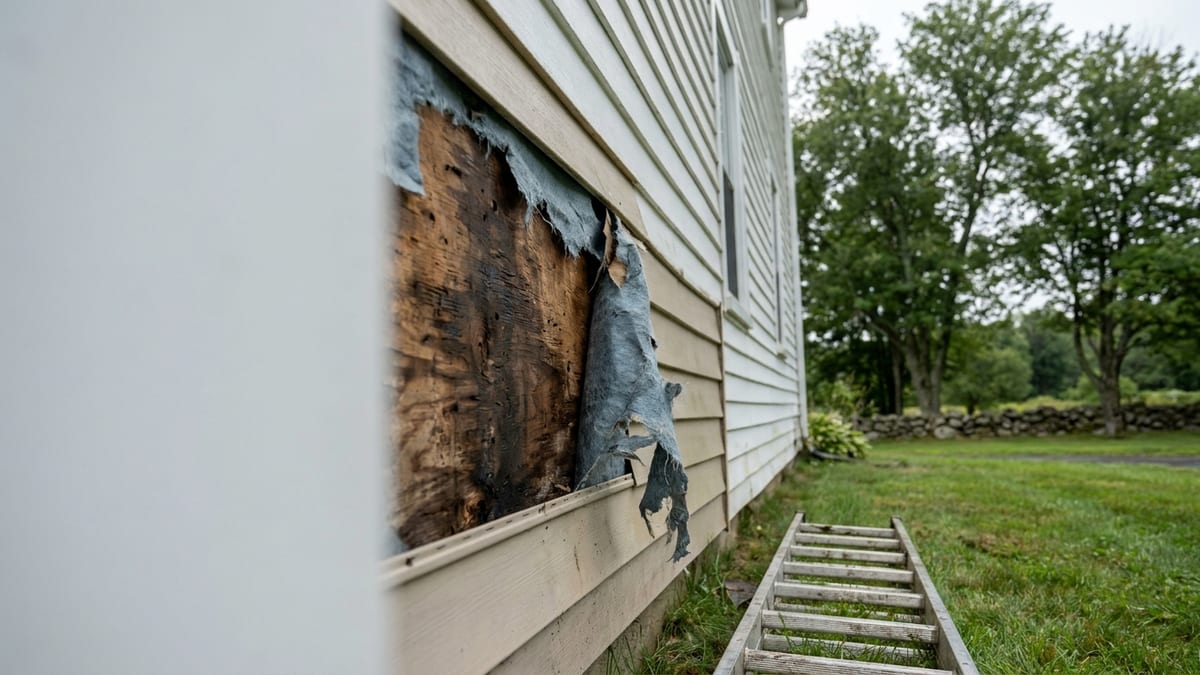
| What you find after washingSoft, springy sheathing when you press on it | What it usually meansWater has been in the wall, open it up before deciding anything |
| What you find after washingInterior stains or paint failing on the inside of an exterior wall | What it usually meansA moisture path, not a siding appearance issue |
| What you find after washingGaps opening at corners, trim and window returns | What it usually meansFastening or flashing problems worth investigating |
The last three are the ones that matter. We covered them in detail in our guide to telling failed siding from siding that is simply old, and they are the only findings that justify a full replacement budget.
The money comparison, honestly
A professional soft wash of a house is a few hundred dollars in most of Connecticut, and a careful homeowner with a hose, a pump sprayer and a Saturday can do it for the cost of the cleaner. Replacement sits in an entirely different bracket. General Connecticut ranges, dependent on wall area, trim complexity and what is found behind the old siding:
| Material | General Connecticut range | Typical service life |
|---|---|---|
| MaterialVinyl | General Connecticut range$8,000 to $35,000 | Typical service life20 to 30 years |
| MaterialJames Hardie fiber cement | General Connecticut range$18,000 to $80,000 or more | Typical service life40 to 50 plus years |
| MaterialCedar | General Connecticut range$25,000 to $60,000 or more | Typical service life20 to 40 years, with re-staining every 3 to 5 years |
Those are ranges for the state, not a quote for your house. The point of putting them next to a wash is scale. Spending the equivalent of a car on a wall because of a film you could remove in an afternoon is the wrong trade, and any company that walks up to a green wall and leads with a replacement number has told you something about how it sells.
Stop it from coming back
Growth returns when the wall stays wet. Cheap fixes that change the conditions:
- Cut shrubs and foundation plantings back 18 to 24 inches from the wall so air moves across it.
- Redirect sprinkler heads that spray the siding. This is the single most common cause of a persistent green band on one elevation.
- Clear gutters and add downspout extensions so water leaves the corner instead of splashing back onto the lower courses.
- Thin overhanging limbs where you reasonably can, which adds light and shortens drying time.
- Check that dryer and bath fan terminations actually exit the wall and are not dumping humid air into a soffit.
None of that is glamorous and all of it buys years between washes.
Where replacement does make sense anyway
If the siding is at the end of its life and you were already planning the project, chronic mildew is a reasonable tiebreaker rather than the reason. Factory finished fiber cement holds color and resists the freeze and thaw cycling that opens up tired wood siding, and the material options are laid out on our siding page. Worth knowing before you plan: most Connecticut towns do not require a permit for a straightforward like for like siding replacement, though one is generally required once the scope grows to exterior insulation, sheathing replacement or altered openings. In a local historic district, Connecticut General Statutes Sec. 7-147f(a) means like for like replacement needs no Certificate of Appropriateness, while changing the material type does.
What to do next
Wash the wall. Look at it clean. If what you find is smooth, sound siding, you are done for another two or three years and you spent almost nothing. If you find brittle panels, soft sheathing or stains working through to the inside, that is worth a second set of eyes.
When you want a written price, request an estimate. Someone comes out, measures the house, looks behind the siding where it can be opened without damage, and gives you an itemized written price for the work that is actually needed. If a wash and some shrub trimming is the right answer, that is what you will hear.