Short answer
Connecticut has adopted the 2021 International Residential Code, and Section R308.4 lists the locations where safety glazing is required. The ones that catch homeowners are glass in and beside doors, large panes close to the floor, glazing along stairs, and windows within 60 inches of a tub or shower. In those locations the pane must be tempered or laminated and carry a permanent mark identifying it.
On this page
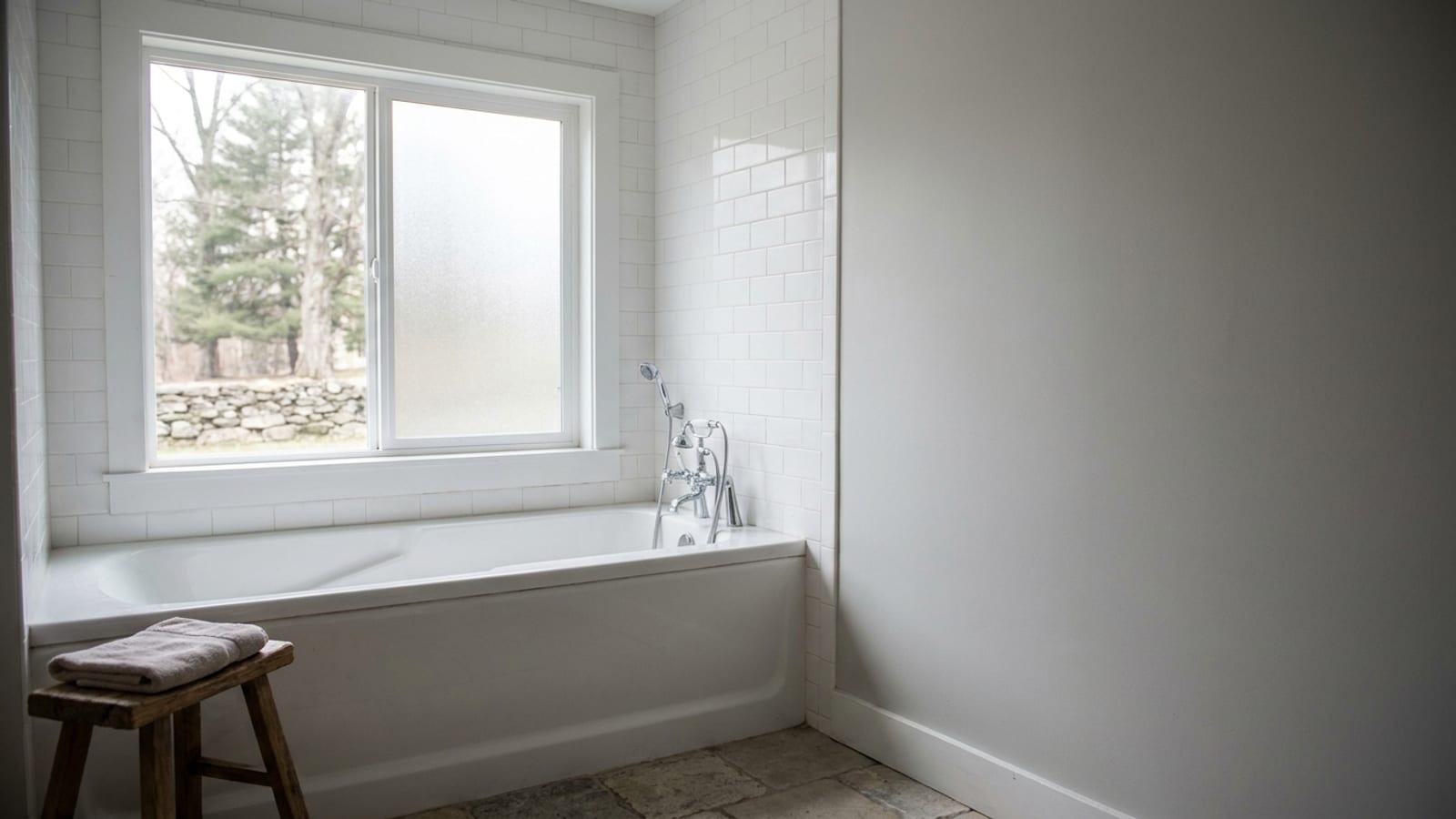
The window over a bathtub is the most commonly missed piece of code on a Connecticut window replacement. The homeowner orders the same window that was there, the installer sets it, and nobody checks whether the glass that came out was ordinary annealed glass that would not be permitted today.
Connecticut's 2022 State Building Code adopts the 2021 International Residential Code for one and two family homes, and safety glazing is covered in Section R308.4. The section does not say "bathrooms need tempered glass." It defines a list of hazardous locations by measurement. If a pane of glass sits in one of them, it has to be safety glazing: tempered or laminated, and permanently marked so an inspector can verify it from the ground.
What safety glazing actually means
Two products satisfy the requirement, and they fail in different ways.
Tempered glass is heat treated after it is cut to size, which puts the surface in compression. It is several times stronger than ordinary glass of the same thickness, and when it does break it fractures into small blunt pieces rather than long shards. It cannot be cut, drilled or notched after tempering, so every piece is made to final dimension.
Laminated glass is two sheets bonded to a plastic interlayer. When it breaks the pieces stay stuck to the interlayer instead of leaving the opening. It costs more than tempered in most sizes, and it brings a secondary benefit in sound reduction.
Both carry a permanent mark, normally etched into a bottom corner, naming the fabricator and the standard the glass was tested to. That mark is the whole compliance trail. Glass with no mark is treated as ordinary annealed glass, regardless of what anybody remembers about the original order.
The hazardous locations, in plain measurements
| Location | What triggers the requirement |
|---|---|
| LocationGlass in a door | What triggers the requirementAny glazed panel in a fixed or operable door, including a sliding patio door and a storm door |
| LocationGlass beside a door | What triggers the requirementWithin a 24 inch arc of either vertical edge of the door when closed, with the bottom edge of the glass less than 60 inches above the floor |
| LocationLarge low windows | What triggers the requirementA pane over 9 square feet, bottom edge under 18 inches, top edge over 36 inches, and a walking surface within 36 inches of it. All four conditions have to be true together |
| LocationTubs, showers and pools | What triggers the requirementBottom edge of the glass less than 60 inches above the standing surface and within 60 inches horizontally of the water's edge |
| LocationStairs and ramps | What triggers the requirementBottom edge less than 36 inches above the walking surface of a stair, landing or ramp |
| LocationBottom stair landing | What triggers the requirementGlass within 60 inches horizontally of the bottom tread and less than 36 inches above the landing |
| LocationGuards and railings | What triggers the requirementAny structural or infill glass panel in a guard |
Each line has exceptions in the code text, and the building official in your town has the final say on how one is applied. The exceptions cover things like decorative leaded glass, an intervening permanent barrier between the glass and the hazard, and a horizontal protective bar at the right height across a large low pane. None of those exceptions are worth engineering around on a replacement job. Ordering the pane tempered is simpler and cheaper than arguing the case.
The measurement people get wrong in bathrooms
The 60 inch vertical dimension for a tub or shower window is measured from the standing surface, and the floor of the tub counts as a standing surface. So you measure from inside the tub, not from the bathroom floor. On a standard tub that moves the reference point up roughly 14 to 16 inches, which pulls many windows that look high and safe straight into the hazardous zone.
The 60 inch horizontal dimension runs from the water's edge of the tub or shower, in a straight line. A window on the side wall several feet from the tub can still fall inside it.
Double-hung sashes are judged separately
The rule applies to each glazed panel, not to the window as a whole. On a double-hung window in a tub surround, the lower sash almost always qualifies while the upper sash may sit above the 60 inch line. Many manufacturers will temper both sashes anyway so the two panels match in appearance and in the way light reflects off them. Tempered glass goes through a furnace, and the heat leaves a faint waviness called roller wave distortion. On an all glass wall of a bathroom it is rarely noticeable. Side by side with an untempered pane in the same frame, some people see it.
Why nobody is going to catch this for you
Most Connecticut towns do not require a permit for a like for like window replacement where the opening size does not change. No permit means no inspection, and no inspection means no third party ever looks at the corner of the glass. The code requirement still applies to the new glazing. The enforcement simply is not there.
That puts the responsibility on two places: the quote and the order. A window quote should name which openings are specified with tempered glass. On a whole house job that is usually a short list, typically the bath, anything flanking the front or back door, a stairwell window and any oversized low unit in a living room. Ask for it in writing before the order goes in, because tempered glass is made to size and a sash ordered with the wrong glass is a reorder, not a field fix.
Glass only repairs count too
Replacing a single failed or broken pane in a hazardous location means the new glass has to be safety glazing. This surprises homeowners who are trying to save money on a glass only repair instead of a full window replacement. It does not make the repair a bad idea, but it does narrow the price gap, since the insulated glass unit has to be fabricated tempered rather than pulled from standard stock.
The case against tempering everything
Some companies quote every opening tempered because it removes a decision from the process. It is defensible, and on a small job the total difference may not be worth itemizing. There are real reasons not to do it.
- Tempered glass costs more per unit, and the upcharge is a percentage of the glass, so it grows with pane size.
- It cannot be field modified. A sash that needs to be trimmed or reworked on site cannot be, and the piece gets reordered.
- Lead times on tempered units are usually longer, because the glass goes through an extra fabrication step.
- Roller wave distortion exists, even if it is minor.
The honest position is that the code list is short and specific. Price tempering where the code requires it, add it anywhere you have small children and a low pane regardless of the measurement, and leave the rest alone.
One more check while you are measuring
If you are already holding a tape measure at the openings, check clear opening dimensions in the bedrooms at the same time. An insert replacement sits inside the old frame and reduces the opening, which is a separate code issue from glazing. We covered the arithmetic in how a replacement window can break bedroom egress. The two checks take ten minutes together and both are far cheaper to handle before the order than after.
When you are ready for real numbers on your own house, request an estimate. Someone comes out, measures every opening, identifies which ones fall into a hazardous location, and leaves you with a written price that shows the glazing specified for each.