Short answer
Often yes for vinyl over wood clapboard or over one existing layer of vinyl, provided the wall underneath is flat, dry and sound. The reason most Connecticut homes are still better off with a full tear-off is that leaving the old siding in place means nobody inspects the sheathing, the water-resistive barrier or the flashing around the windows. Fiber cement is the practical exception, because manufacturers generally require the old siding to come off first.
On this page
Installing new siding over old siding is allowed on many Connecticut homes and, on the right wall, it is a reasonable way to save money. It is also the single easiest way to buy a wall you cannot see. Everything a full tear-off exposes — the sheathing, the water-resistive barrier, the flashing at every window head — stays hidden, and the price you were quoted assumed all of it was fine.
This post covers when a layover is defensible, what it costs you in exchange, and what makes a wall a poor candidate.
What a layover actually involves
A true layover leaves the existing siding on the wall and installs the new material over it. In practice, that rarely means panels straight onto old clapboards. Old wood siding is beveled, so the wall face is not flat, and vinyl installed over an uneven surface reads as waves in raking afternoon light. To fix that, the crew installs furring strips — usually vertical, fastened through the old siding into studs — to create a flat plane. Rigid foam insulation sometimes goes on at the same time.
So the honest comparison is not "tear-off versus nothing." It is tear-off versus removal of trim, furring, insulation board, longer fasteners and deeper trim detailing. The savings are real but smaller than the phrase "we can just go right over it" suggests.
When going over the old siding makes sense
- A single existing layer of sound vinyl or aluminum with no interior water history and no soft spots when you press on the wall.
- A wall you have already opened somewhere — during a window replacement, a door swap or a repair — where you saw dry sheathing and intact house wrap.
- A rental or a property with a short holding period, where the objective is a weathertight, presentable exterior rather than a fifty-year wall assembly.
- A detached garage or outbuilding that does not need the same scrutiny as the house.
- A partial elevation that must match existing siding on the other three sides.
What you give up
Nobody inspects the sheathing
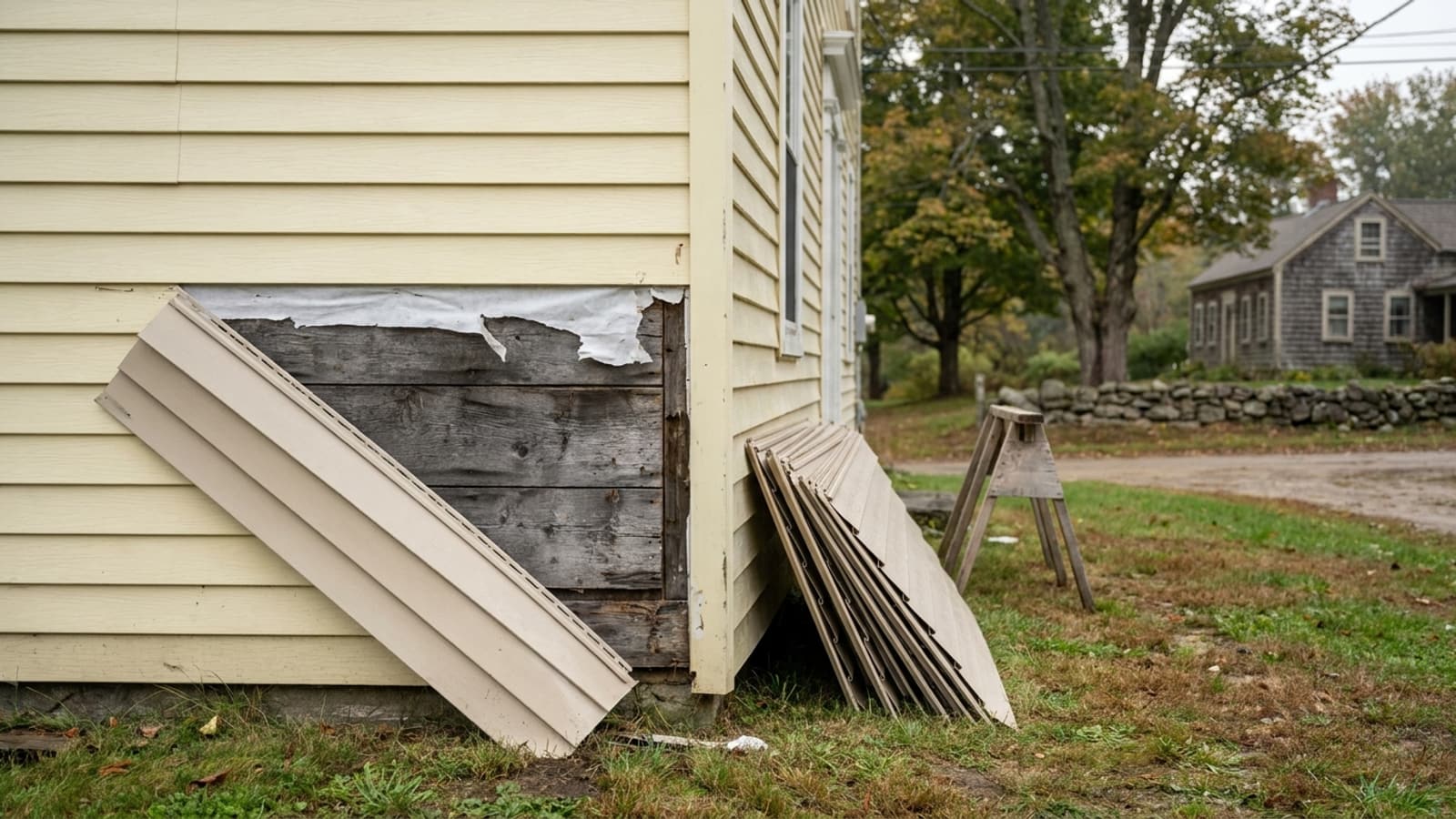
On a tear-off, the wall gets looked at square inch by square inch. Wet or delaminated sheathing gets replaced before the new siding goes on. On a layover, the crew never sees it. If there is a slow leak at a window head, it keeps running, and it now runs behind two layers instead of one. Our post on how to tell when siding has failed rather than just aged covers the interior signals that should rule a layover out entirely.
The old water barrier stays whatever it is
Siding is not the waterproofing layer. The water-resistive barrier behind it is, along with the flashing that hands water from the window back out onto the face of that barrier. On a house built before house wrap was common, or one where the original felt has torn, a layover locks that condition in for the life of the new siding. If you want to understand why this matters more than the panel you pick, read what belongs behind siding.
Windows, doors and trim get deeper
Adding a layer plus furring pushes the finished wall out by three quarters of an inch or more. Casings that were proud of the old siding can end up nearly flush with the new. Corner boards, frieze and rake trim all have to be built out to match. Done well this is invisible; done cheaply it looks like the house is wearing a coat two sizes too large.
Fastening gets harder
Fasteners have to pass through the new panel, the furring, the old siding and the sheathing and still bite into solid framing with adequate penetration. Longer fasteners cost more and are less forgiving of a crew working fast. This is worth asking about specifically, in writing, before you sign.
What generally cannot go over the old wall
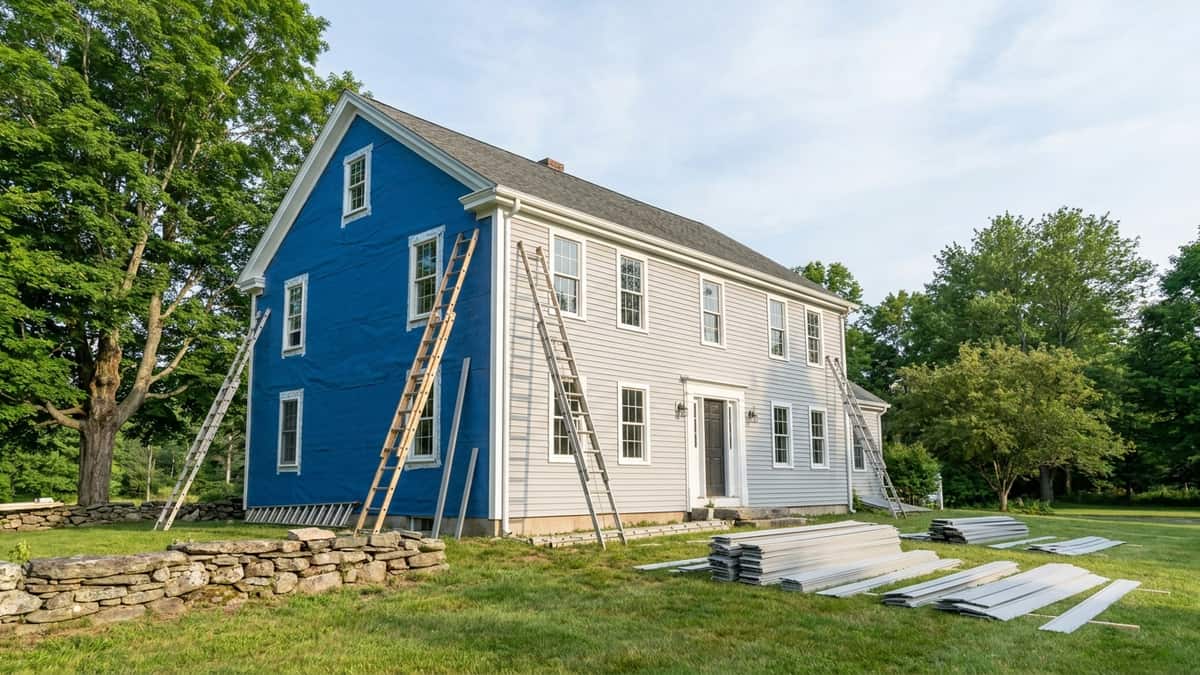
Fiber cement is the clear case. James Hardie and other fiber cement manufacturers generally require the existing siding to be removed so the product installs over a flat, nailable substrate with a code-compliant water-resistive barrier. If you are considering fiber cement, plan and budget for a tear-off. The same is usually true of real cedar, which needs a properly furred and ventilated rain screen to last.
Two other stop signs:
- More than one existing layer. Fastener penetration and wall flatness both become guesswork.
- Any wall with a known moisture problem. Interior stains, musty closets on an exterior wall, or paint that will not hold on the inside face.
| Wall condition | Reasonable approach |
|---|---|
| Wall conditionOne layer of sound vinyl, dry interior | Reasonable approachLayover is defensible with vinyl |
| Wall conditionWood clapboard, no water history | Reasonable approachLayover possible with furring; tear-off preferred |
| Wall conditionAny soft or springy sheathing | Reasonable approachTear-off, no exceptions |
| Wall conditionTwo or more existing layers | Reasonable approachTear-off |
| Wall conditionMoving to fiber cement or cedar | Reasonable approachTear-off |
What the numbers look like
General Connecticut ranges, not a quote: vinyl siding generally runs $8,000 to $35,000 depending on wall area and trim complexity, James Hardie fiber cement $18,000 to $80,000 or more, and cedar $25,000 to $60,000 or more. A layover removes the tear-off labor and the dumpster from that figure, then adds furring, longer fasteners and extended trim details back in. On most houses the net saving is a modest share of the job, not half of it — and it is the share that buys you the inspection.
The question worth asking yourself is what you would do if the crew opened the wall and found sixty square feet of soft sheathing. If the answer is "I would want that fixed," a layover is buying you the option not to know.
Permits and historic districts
Most Connecticut towns we serve do not require a permit for a straightforward like-for-like siding replacement. That changes once the scope grows — exterior insulation, sheathing replacement, altered openings or structural repair found after demolition. A layover with foam board added is exactly the kind of scope that commonly puts a permit back on the table, so the contractor should confirm with the building department rather than assume.
If the house sits in a local historic district, Connecticut General Statutes Sec. 7-147f(a) is the governing rule. Replacing siding with similar material does not require a Certificate of Appropriateness. Changing the material type — wood to vinyl, for instance — does, and that review happens on the commission's meeting schedule, not yours. A layover that changes the visible material is a material change for this purpose.
How to get a straight answer on your own house
Walk the exterior and press firmly on the wall below every window, at every corner, and anywhere within a foot of grade. Look inside for stains on exterior walls and for paint lifting near baseboards. Then have someone measure and price both options. A contractor who will only quote one approach is not giving you a decision to make.
You can see how we handle wall assemblies and the full range of materials on our siding page. When you want a written price, someone comes out, measures the house, looks at the existing wall, and gives you an itemized number for tear-off and for a layover where a layover is appropriate — request an estimate and we will put both in front of you.