Short answer
Removing asbestos cement siding adds a separate scope of work performed by a licensed abatement contractor, including controlled removal, containment of debris and disposal at a facility permitted to accept the material. That scope is priced and scheduled apart from the new siding, and it is the reason an asbestos-clad house takes longer to get on the calendar than a vinyl-clad one. On some houses the cheaper and equally valid path is leaving intact siding in place, which avoids abatement entirely.
On this page
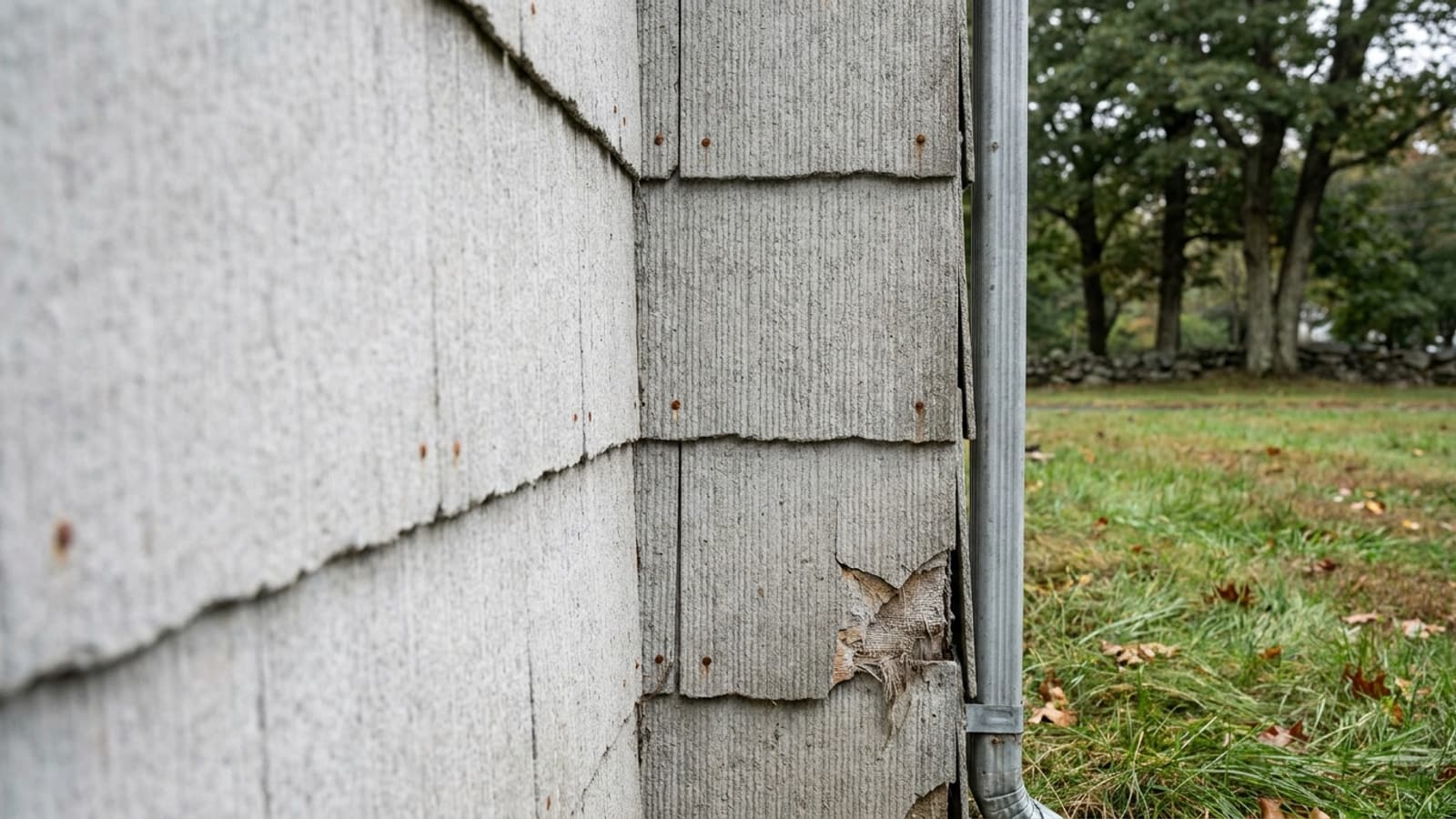
Asbestos cement siding shows up on a lot of Connecticut houses built before roughly 1980, especially the post-war Capes, Ranches and split-levels that fill entire neighborhoods in Hartford County and the older stock in Hartford and New Haven. It looks like a thin, brittle gray or pastel shingle, often 12 by 24 inches, with two nail heads visible near the bottom edge and corners that chip rather than dent. If your house has it, the siding conversation changes shape, because the removal becomes its own regulated project sitting in front of the one you actually wanted.
This post covers what that adds, what it does not add, and the case for leaving it alone.
What the material is
Asbestos cement siding is portland cement with asbestos fiber used as reinforcement, pressed into flat shingles or panels. It was cheap, fireproof and close to indestructible, which is why so much of it is still on walls seventy years later. It is also what the regulations call non-friable, meaning the fibers are bound in a hard matrix and do not release into the air while the shingle sits on the wall.
That single word governs everything that follows. Intact and undisturbed, the material is stable. Broken, sawn, sanded, dropped or blasted with a pressure washer, it becomes a fiber source, and at that point it is regulated waste that cannot go in a dumpster with the rest of the tear-off.
Testing, not guessing
Nobody should proceed on a visual identification. A bulk sample goes to an accredited laboratory, typically analyzed by polarized light microscopy, and the report is a document you keep. A negative result turns the project back into an ordinary siding job. A positive result defines the scope. Sampling is inexpensive relative to the job and it is the first thing to do if the house predates 1980 and the shingles look the part.
What removal actually adds
Three things, and they are separable.
A licensed scope of work. Connecticut licenses asbestos abatement contractors and workers through the Department of Public Health, and abatement projects carry notification requirements above defined thresholds. The removal is performed by that licensed contractor under its own scope, not folded into general siding labor. Verify licensing directly rather than taking it on faith.
Controlled removal and containment. Shingles are pulled whole rather than torn, wetted to suppress dust, lowered rather than dropped, and bagged or wrapped on site. The pace is slower than conventional siding demolition, which is most of what you are paying for.
Regulated disposal. The waste goes to a facility permitted to accept it, with manifesting. Volume drives this line, so a large two-story colonial costs materially more to abate than a small ranch.
Why there is no price in this article
Abatement is quoted by the licensed abatement contractor, usually by the square foot, and it varies with wall area, house height, access, the condition of the shingles and current disposal rates. Publishing a number that was not verified would be worse than publishing nothing. Ask for it as a separate written line item so you can see what removal costs and what siding costs, rather than one blended figure that hides both.
The case for leaving it in place
This is the part most articles skip. Asbestos cement siding that is sound, flat and reasonably intact does not have to come off. New cladding can be installed over it in many cases, which eliminates abatement, disposal and the schedule delay in one decision. We wrote separately about the general question of installing new siding over old siding, and the tradeoffs there apply here with more force, because the avoided cost is larger.
The limits are real:
- Fastening has to reach framing through the added thickness, and some fastening patterns mean drilling into the old material, which is itself a disturbance to plan for.
- Covering hides the wall. If anything behind the sheathing is wet, you have sealed it in.
- Trim, window and door details get thicker, and the result can look heavy if it is not detailed properly.
- It defers the problem. A future owner, a future addition or a future storm repair inherits it.
| Situation | Leave in place | Remove |
|---|---|---|
| SituationShingles intact, walls dry, budget tight | Leave in placeUsually the better value | RemoveHard to justify |
| SituationInterior stains, soft sheathing, suspected rot | Leave in placeNot advisable | RemoveNecessary, the wall has to open |
| SituationAdding exterior insulation or changing window openings | Leave in placeRarely workable | RemoveGenerally required |
| SituationMany broken or missing shingles already | Leave in placePoor substrate | RemoveCleaner path |
| SituationPlanning to own the house long term | Leave in placeDefers the decision | RemoveSettles it |
Permits, historic districts and the paperwork
Most Connecticut towns do not require a building permit for a straightforward like-for-like siding replacement. That changes once the scope grows, and asbestos removal tends to grow the scope: exterior insulation, sheathing replacement, altered openings or structural repair discovered after demolition all generally bring a permit into the picture. Abatement notification is a separate track from the building permit, handled under the state's asbestos rules.
If the house sits in a local historic district, Connecticut General Statutes Sec. 7-147f(a) matters. Replacing with similar materials does not require a Certificate of Appropriateness. Changing the material type does, and going from asbestos cement shingle to vinyl or fiber cement is a change of material type. That means a commission meeting on the calendar before work starts, which is a scheduling question, not a prohibition.
What goes back on the wall
Once the wall is bare, the siding decision is the ordinary one. These are general Connecticut ranges that depend on the specific house, not a quote, and they exclude abatement:
| Material | Cost range | Lifespan | Maintenance |
|---|---|---|---|
| MaterialVinyl | Cost range$8,000 to $18,000 | Lifespan20 to 30 years | MaintenanceEssentially none |
| MaterialJames Hardie fiber cement | Cost range$18,000 to $40,000 and up | Lifespan40 to 50 plus years | MaintenanceRepaint every 15 plus years |
| MaterialCedar | Cost range$25,000 to $60,000 | Lifespan20 to 40 years | MaintenanceRe-stain every 3 to 5 years |
The drivers inside those ranges are wall area, trim complexity and what is found behind the old siding, which we break down in our post on what new siding costs in Connecticut. On an older house in Hartford, where pre-1980 asbestos is a known consideration across much of the housing stock, we scope siding work with that assumption until a lab report says otherwise.
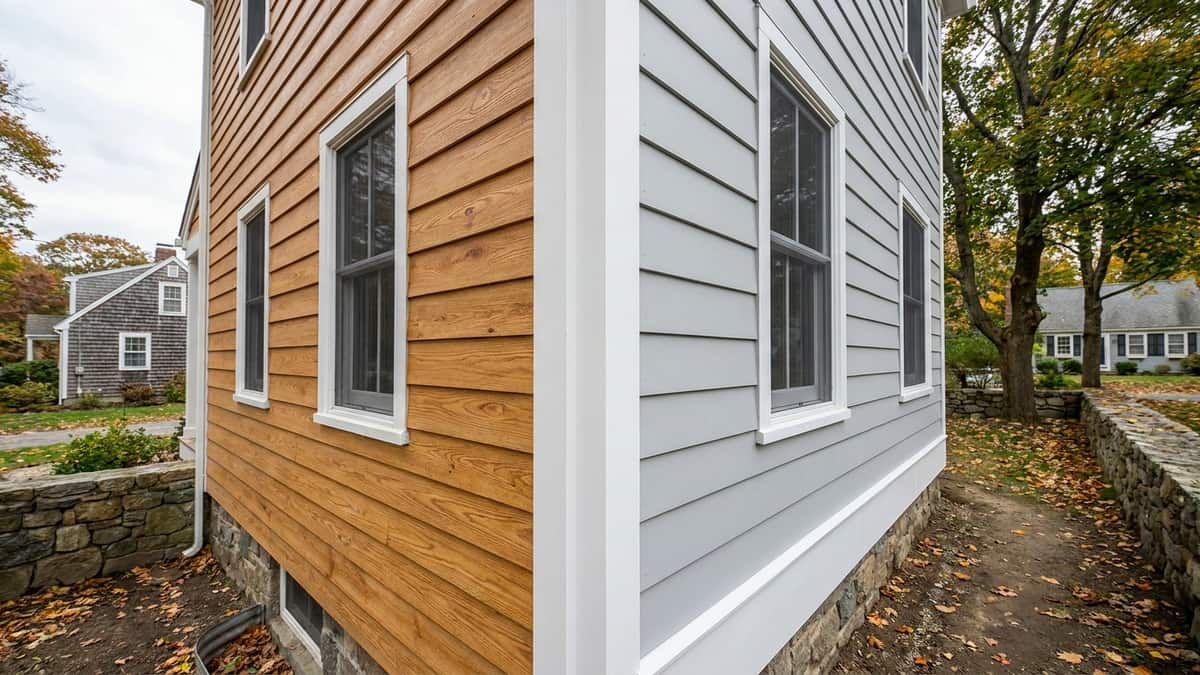
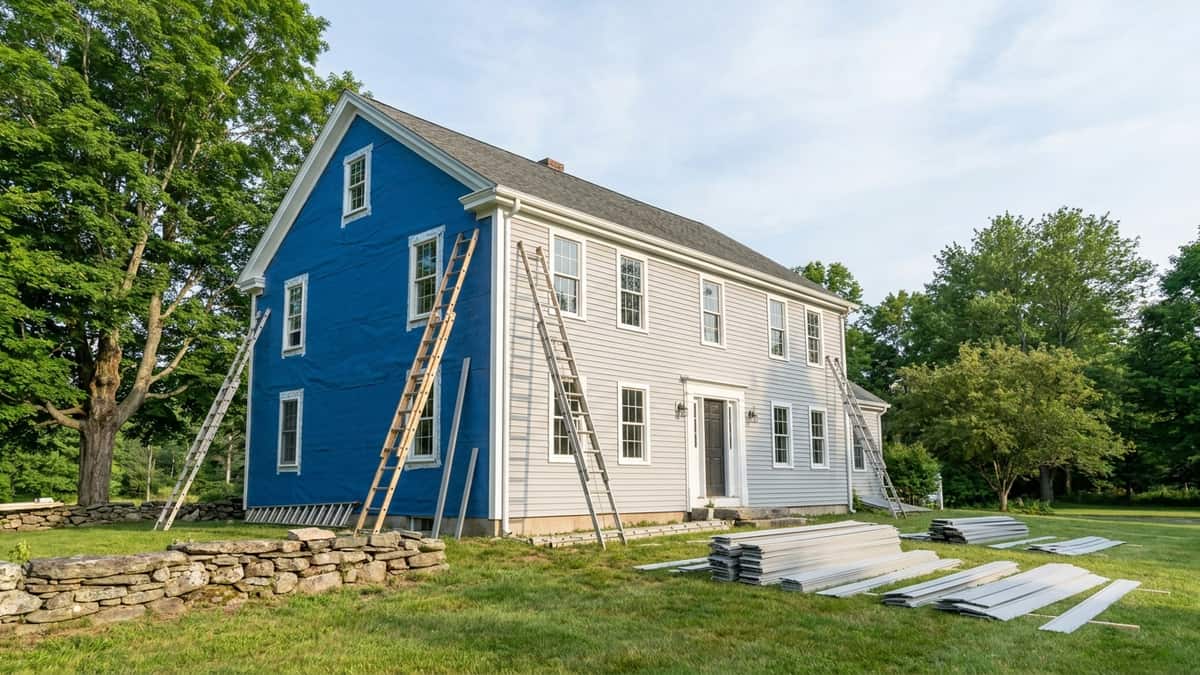
One genuine upside of full removal: with the wall open, house wrap and flashing go on correctly at every opening, which is the part of a siding job that determines whether the wall stays dry for the next thirty years. That detail is described on our siding page.
How to plan it
- Sample and test the siding. Get the lab report in writing.
- Decide, with the wall condition in mind, whether removal is required or optional.
- If removal is required, get the abatement quoted separately by a licensed contractor.
- Confirm whether your scope triggers a building permit, and whether a historic district review applies.
- Then compare siding quotes, all written against the same scope.
If you want a written price for the siding portion, request an estimate. Someone comes out, measures the house, looks at the condition of what is on it, and gives you a written number for the work we would perform. Where abatement is involved, that piece is identified as a separate scope so you can see exactly what each part of the project costs.