Short answer
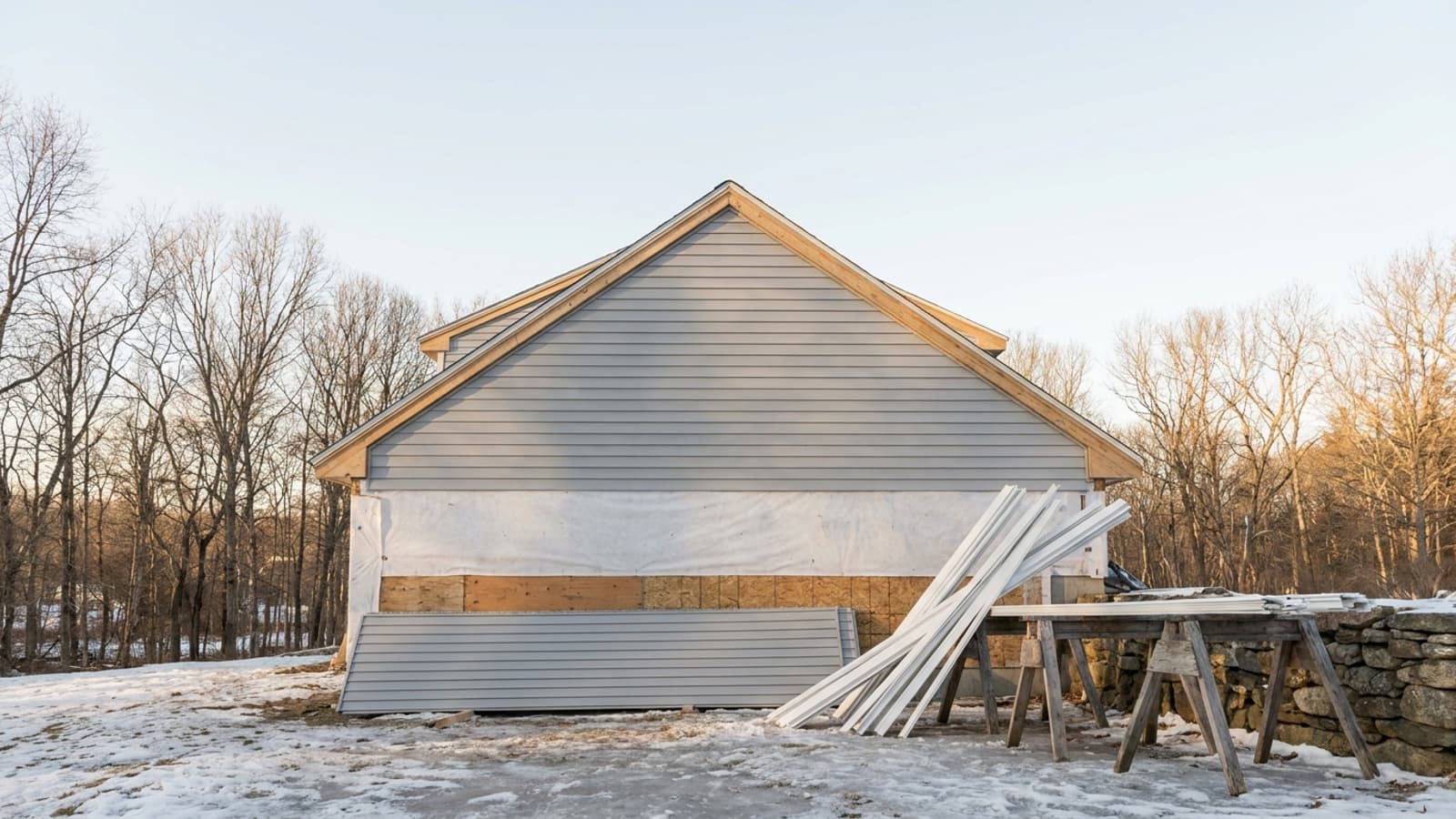
Yes. Vinyl siding has no sealing temperature the way asphalt shingles do, so crews install it through Connecticut winters without any loss of performance. What changes is the detail work, because cold panels are brittle and sitting at their shortest length, which means wider expansion gaps, more careful cutting, and tapes and sealants rated for the temperature.
On this page
Yes. Vinyl siding does not have to reach a temperature to bond or cure, so unlike asphalt shingles, which need warmth to seal, there is nothing about January that stops a vinyl panel from performing the way it is supposed to. Crews hang siding in Connecticut in December, January and February every year.
What changes in the cold is the margin for error. Vinyl is brittle at low temperatures and it is sitting at the short end of its range of movement, which means the two things that cause most vinyl siding failures — panels hung too tight and panels cracked during handling — are both easier to get wrong between November and March. A crew that knows the cold weather rules produces a wall that is indistinguishable from an August job. A crew that treats a 25 degree day like a 70 degree day produces buckled panels by July.
What cold actually does to a vinyl panel
Two physical changes matter.
It becomes brittle
Vinyl loses impact resistance as it gets colder. A panel that would flex and recover in warm weather can crack when it is dropped on a frozen driveway, pried with a zip tool, or snipped too aggressively at a corner. Thicker panels tolerate this better than thin ones, which is one of several practical reasons the thickness grade is worth asking about before you sign anything — we covered the grades and what the gauge numbers mean in a separate post on vinyl siding thickness.
It contracts
Vinyl moves a lot with temperature. A 12 foot panel can change length by roughly half an inch across the full swing between a Connecticut winter morning and a south facing wall in August. The panel you install in February is close to its minimum length. Everything it does from there is growth.
That is the whole reason cold weather instructions exist. Siding is not fastened to the wall the way a board is. It hangs on nails and slides.
The three rules that change below 40 degrees
Expansion gaps get wider
Standard instructions call for about a quarter inch of clearance where a panel butts into a receiving channel at a corner post, J-channel or trim. Below 40 degrees, manufacturers call for about 3 eighths of an inch. The cut panel is shorter than it will ever be again, and the extra eighth of an inch is the room it needs in July.
Nails are not driven home
This rule applies year round and gets violated more in the cold, when gloved hands and a fast gun make it easy to overdrive. Nails go in the center of the nailing slot, square to the wall, with roughly a thirty second of an inch left between the nail head and the panel so the siding can still slide. A nailed-tight panel cannot expand along the wall, so it expands by bowing outward instead.
Cutting technique changes
In cold weather, scoring and snapping a panel is more likely to produce a jagged break than a clean one, and tin snips closed all the way at the end of a stroke can split the panel. Clean cold weather cuts generally come from a fine tooth blade in a circular saw run at a moderate speed with the blade mounted in reverse, with the panel supported on both sides of the cut. Panels that have been sitting on a frozen pile all morning cut worse than panels that have been indoors.
The parts of the job cold affects more than the siding itself
The vinyl is actually the easy part. The temperature sensitive materials on a siding job are the ones behind it.
- Flashing tape. Many acrylic housewrap tapes list a minimum application temperature around 40 degrees. Butyl and certain all weather tapes are rated well below freezing. Using a warm weather tape at 28 degrees produces a seal that looks fine on the day and releases later.
- Sealant. Every tube has a minimum application temperature printed on it. Some are 40 degrees, some go to zero. Surfaces also have to be dry and frost free, which on a shaded north wall in January is not a given.
- House wrap. It still installs fine in the cold, but wind on an open wall in winter makes it harder to keep flat and properly lapped, and it has to be shingle lapped so water sheds outward at every horizontal seam.
- What is behind the old siding. If the crew finds soft sheathing, winter gives you no help drying anything out. The repair is cut out and replaced rather than dried, which is the right answer in any season but is not optional in February.
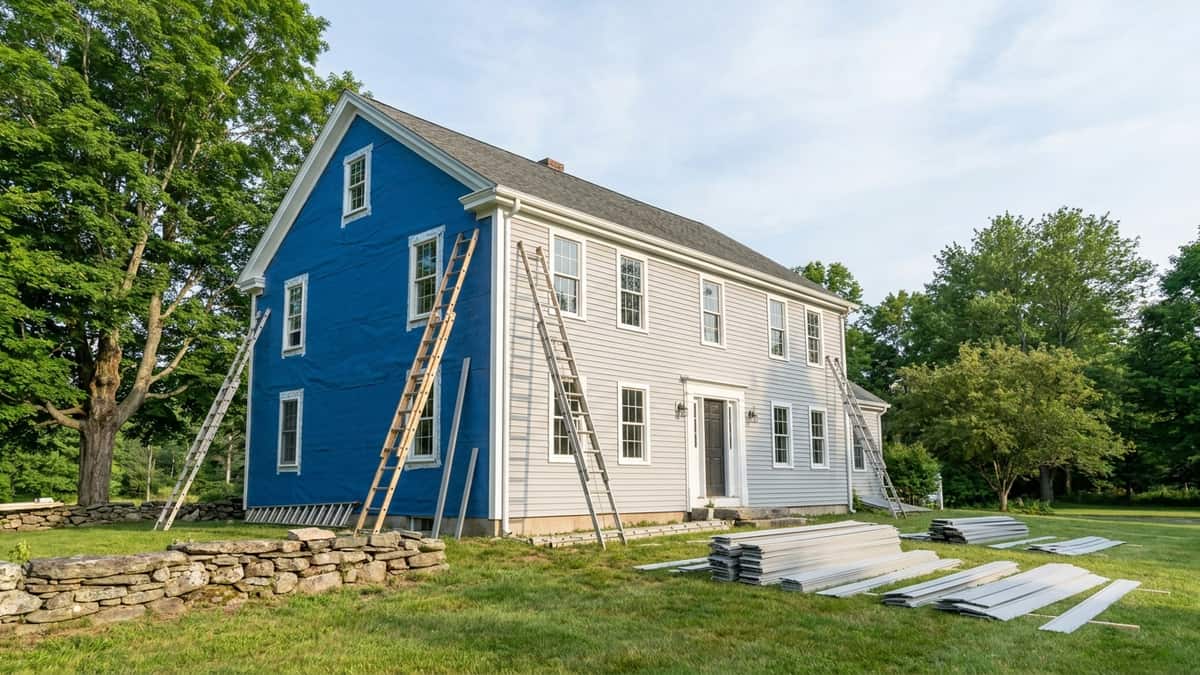
The sequence we follow on a siding project is on the siding process section of the main service page. In winter it is the same sequence, just executed in smaller sections so no wall stands open overnight.
Wind loads do not take the winter off
Every town we serve sits inside a designated hurricane prone region under Appendix AY of the 2022 Connecticut State Building Code. Guilford, Madison and New Haven carry an ultimate design wind speed of 125 mph, higher than Greenwich, Stamford, Westport and Fairfield at 120 mph, because exposure to open water along the central shoreline drives the number rather than distance from New York. The rest of the towns on our service areas page are 120 mph.
Vinyl's wind resistance is a function of fastener spacing, nail penetration into solid framing or sheathing, and the panel being allowed to hang properly on its nails. The irony of cold weather work is that the mistake that ruins the look of the wall — nailing tight — also compromises how the wall handles wind, because a stressed panel is more likely to unlock from its neighbor. Details on the product lines and locking profiles we install are on the vinyl siding section of our siding page.
The honest case for waiting until spring
There is one, and it is not about the siding failing.
| Factor | Winter install | Spring or fall install |
|---|---|---|
| FactorPanel performance once installed | Winter installNo difference if gaps and nailing are right | Spring or fall installNo difference |
| FactorDaylight working hours | Winter installShort, so the job spans more calendar days | Spring or fall installLong, fewer days on site |
| FactorSealant and tape options | Winter installLimited to cold rated products | Spring or fall installAny product |
| FactorHandling damage risk | Winter installHigher, panels are brittle | Spring or fall installLower |
| FactorFinding rot behind old siding | Winter installRepair only, no drying out | Spring or fall installSame repair, easier conditions |
| FactorCrew scheduling | Winter installGenerally more availability | Spring or fall installPeak season, longer lead times |
If your siding is intact and the project is cosmetic, there is no urgency in booking it for January. If water is getting into the wall, if a storm opened a section, or if you are selling in the spring and need the work finished, winter installation is a legitimate option rather than a compromise.
As a general Connecticut range that depends heavily on the specific house, vinyl siding runs roughly $8,000 to $35,000, driven far more by wall area, trim complexity and what is behind the old siding than by the month you schedule it.
What to ask before you sign a winter siding contract
- What clearance are your installers leaving at corner posts and J-channel on this job, and does it change with temperature.
- Which flashing tape are you using, and what is its minimum application temperature.
- How much of the wall will be open at one time, and will any sheathing be left exposed overnight.
- Is sheathing replacement priced per sheet in the written estimate, so a discovery does not become an open-ended number.
- Does the scope stay like for like, or does it grow into something the town will want a permit for.
A contractor who answers those five questions specifically is telling you how the crew works. A quote that is a single number with the word "siding" next to it is telling you something too.
If you want a price on a winter siding project, request one through our estimate request page. Someone comes out, measures the house, looks at the existing siding and trim, and sends back a written, itemized price. If the honest recommendation is to wait for spring, that is what we will tell you.