Short answer
Patch when the damage is confined to a handful of panels, the siding still has years of service left, and a matching panel is still available. Redo a full wall or the whole house when the sheathing or house wrap behind the panels got wet, when the color has been discontinued, or when the siding was already near the end of its life. The deciding factor is usually what is behind the panels, not how many are broken.
On this page
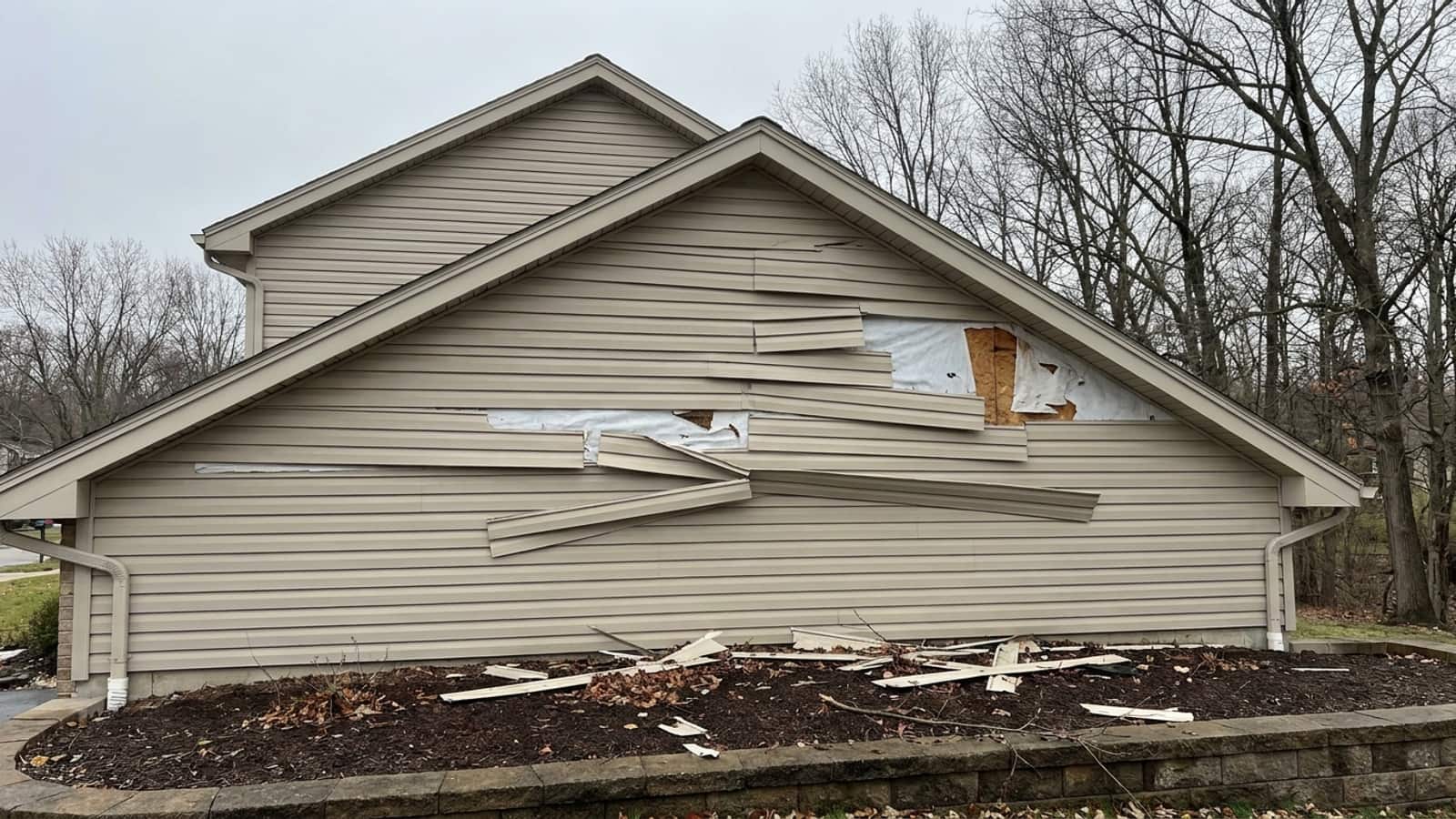
Storm damage to siding is a scope question before it is a material question. Wind that cracks four panels on one gable is a repair. Wind that unzipped a full course and drove rain into the wall cavity is something else, and the difference is decided by what the crew finds behind the panels, not by how bad the wall looks from the driveway.
Here is how to think through it before anyone gives you a number.
Look at what the wind actually reached
Vinyl and fiber cement are both rain screens over a water-resistive barrier. The panels shed most of the water, and the house wrap and flashing behind them handle what gets through. When a storm takes panels off, the question is whether that secondary layer did its job for the hours or days it was exposed.
Walk the wall and look for three things:
- Torn or flapping house wrap. Intact wrap that is simply exposed is usually fine. Wrap that is shredded, or that has water stains running below a tear, means water reached the sheathing.
- Soft sheathing. Press on the exposed plywood or OSB with your thumb. It should feel hard. Springy, spongy or delaminated sheathing changes the job.
- Interior evidence. Go inside the same wall. Stains at the top of a wall, blistering paint on an exterior-facing surface, or a musty smell in a closet on that side all point to water in the assembly.
If all three are clean, you have a cosmetic and weather-tightness problem confined to the panels. That is a repair.
The three honest options
Patch the damaged panels
Vinyl siding locks course to course. A panel in the middle of a wall is removed with a zip tool that unhooks the course above it, so a competent installer can swap individual panels without stripping the wall. Fiber cement is nailed and lapped, and individual boards can be cut out and replaced, though the cut edges need priming and the seams need to be detailed properly.
This is the right answer when the damage is localized, the wall behind is dry, and the siding has years left. Our siding repair work covers exactly this scenario.
Redo one wall or one elevation
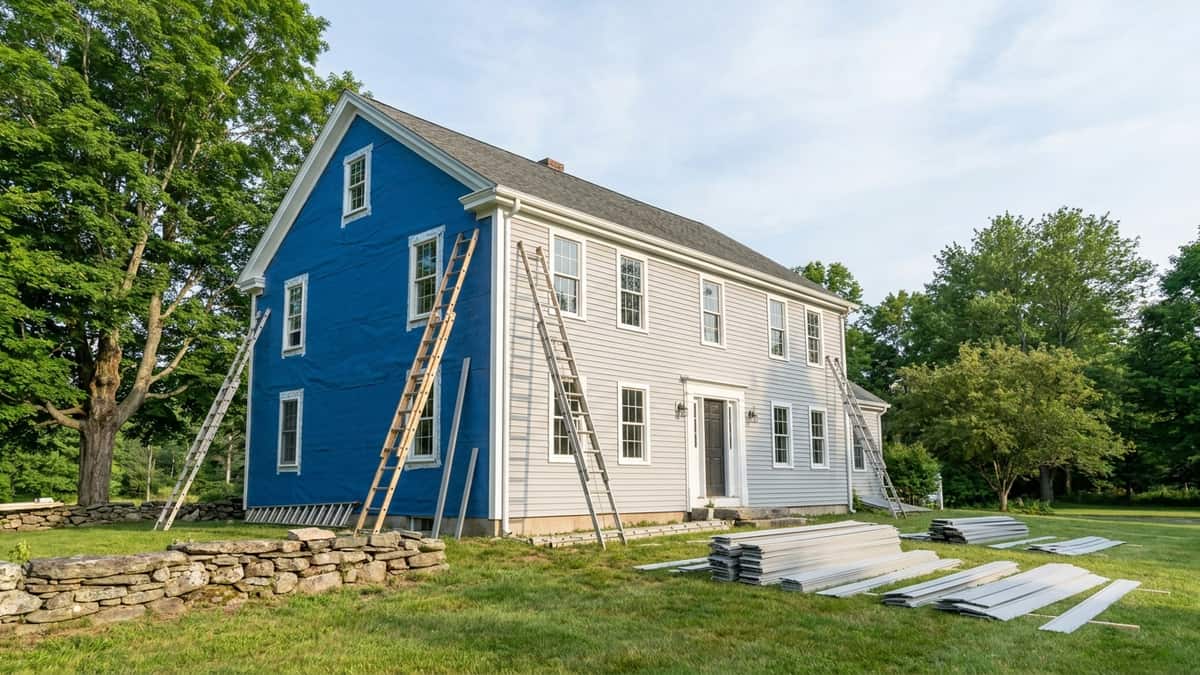
Sometimes the panels are fine but the wall is not, or the damage is spread across a whole elevation and a patch would read as a quilt. Redoing one full wall gives you clean starting and stopping points at the corners, lets the crew inspect and replace sheathing, and lets them install new house wrap and flashing as a continuous system rather than a taped-in square.
The drawback is honest and worth stating: one new wall next to three weathered walls is visible, especially on a south or west elevation that has faded more than the others.
Replace the siding on the whole house
This makes sense when the storm damage lands on siding that was already aging, when the color has been discontinued, or when opening one wall reveals a problem that is likely present on the others. Quality vinyl lasts 20 to 30 years and fiber cement 40 to 50 or more, so a house at year 22 with a damaged gable is a different decision than a house at year 8.
The color match problem
This is the practical issue that pushes more storm repairs into full replacements than anything else. Vinyl fades. Even the correct manufacturer color code, ordered from the same product line, will not match a wall that has taken fifteen summers of sun. Manufacturers also retire colors, and a discontinued profile may have no current equivalent at all.
There is a workaround that costs nothing but planning. Pull good panels from a wall nobody sees, such as the back of an attached garage or a wall facing a fence line, use those weathered panels on the visible damaged area, and hang the new panels on the hidden wall. It does not solve a discontinued profile, but it solves an imperfect color match on most jobs.
Permits and historic districts
Most Connecticut towns do not require a permit for a straightforward like-for-like siding replacement. That changes once the scope grows. Sheathing replacement, added exterior insulation, altered openings, or structural repair found after demolition generally trigger a permit, and storm damage is one of the most common ways a job crosses that line partway through. Ask your contractor what happens to the schedule and the price if the sheathing has to come off.
If the house sits in a local historic district, Connecticut General Statutes Sec. 7-147f(a) is the governing point. Replacing siding with similar materials does not require a Certificate of Appropriateness. Changing the material type does, so patching wood clapboard with vinyl is a review item even though it is a smaller job than a matching wood repair.
Why the panels came off, and what to ask about the reinstall
Every town we serve sits in a designated hurricane-prone region, with an ultimate design wind speed of 120 mph, or 125 mph in Guilford, Madison and New Haven. Those figures come from Appendix AY of the 2022 Connecticut State Building Code. Shoreline exposure is what drives them, which is why siding in Madison is specified against a higher wind number than Greenwich or Westport.
Vinyl is designed to hang, not to be pinned. It expands and contracts with temperature, so nails go in the center of the slot, straight, and are left roughly a thirty-second of an inch loose so the panel can slide. Overdriven nails are the single most common installation error behind wind loss, because a panel that cannot move buckles, and a buckled panel gives the wind an edge to grab. If your original siding failed in a wind event that left the neighbors alone, ask the contractor to look at the nailing pattern on the panels that are still up.
What it costs
These are general Connecticut ranges that depend on the specific house, not a quote.
| Scope | What it involves | General range |
|---|---|---|
| ScopePanel patch | What it involvesSwap damaged panels, no wall opened | General rangeSmall job, priced by the visit |
| ScopeOne wall redone | What it involvesNew wrap, flashing, panels, possible sheathing | General rangeA fraction of a full job, but not proportional |
| ScopeFull vinyl replacement | What it involvesWhole house, all walls | General range$8,000 to $35,000 |
| ScopeFull James Hardie replacement | What it involvesWhole house, all walls | General range$18,000 to $80,000 or more |
| ScopeCedar | What it involvesWhole house, all walls | General range$25,000 to $60,000 or more |
The reason a small repair feels expensive per square foot is that mobilization is a fixed cost. A crew, a truck, staging and disposal cost about the same for two hundred square feet as for two thousand. We break the drivers down further in our post on what new siding costs in Connecticut.
The case against replacing everything
A contractor who looks at one damaged gable and quotes the whole house should be asked why. If the siding is under about fifteen years old, the color is still in production, and the sheathing is dry, a repair is the better use of the money and leaves the full replacement budget intact for when the siding actually reaches the end of its life. The case for going bigger has to rest on something specific: a discontinued color, wet sheathing, or siding already near the end of its service life.
Insurance
Storm damage to siding is often a covered loss, and the useful step is documentation. Photograph the wall before anything is cleaned up, including the debris on the ground, and photograph any exposed wrap and sheathing before it is covered again. Keep the panels that came off. Matching is frequently the point of disagreement in a siding claim, so establishing early that the color is discontinued, if it is, matters more than the count of broken panels.
Getting a real number
The next step is having someone look behind the panels rather than at them. You can see the full range of materials and the installation sequence on our siding page, and when you are ready, request a visit through our estimate form. Someone comes out, measures the affected walls, checks the sheathing where it is exposed, and gives you a written price for the scope that the house actually needs.