Short answer
Stone veneer is priced separately from the siding, by square foot of face area plus linear foot of corner pieces, and it costs several times what vinyl costs per square foot of wall. On a normal accent, such as a water table at the base of the walls or a surround at the front entry, it is a real line item on the contract rather than a small upgrade. Most of the swing in price comes from prep and detailing, because adhered stone needs its own water-resistive barrier, lath, scratch coat and a flashed base termination.
On this page
Stone veneer is not a siding upgrade in the way a thicker vinyl profile is. It is a second trade, with its own materials, its own prep and its own detailing, priced separately from the siding and added to the same contract. That is why homeowners are often surprised when a modest-looking band of stone across the front of the house comes back as one of the larger line items on the estimate.
This post covers how that number is built, what has to happen behind the stone for it to last, and when the honest answer is to skip it and put the money into the siding.
How stone veneer is priced
Siding is quoted by the square, meaning 100 square feet of wall. Stone veneer is quoted differently, and the difference matters when you compare bids.
Face area plus corners
Flat stone is sold and installed by the square foot of face area. Corner pieces, the L-shaped units that wrap an outside corner so you do not see the edge of a flat piece, are sold by the linear foot and cost substantially more per unit of coverage. A design with many corners, columns and returns uses far more corner stock than a single long band on a flat wall, and the price follows.
This is the single most common reason two stone quotes for the same house differ. One measured corners properly and one buried them in a square-foot average.
Prep is most of the labor
The stone itself is the visible part. The labor is in what goes under it. A correctly built adhered stone wall in Connecticut generally includes a water-resistive barrier, a metal lath fastened through the sheathing into framing, a scratch coat of mortar, a mortar setting bed, the stone, and then either grouted or dry-stacked joints. Flashing, a weep screed at the bottom and terminations at windows, doors and the top of the stone band all take time.
That is several days of a mason's time on a wall a siding crew would have covered in an afternoon.
It is a second crew on the schedule
Masonry is weather-dependent in a way vinyl is not. Mortar does not want to be placed in freezing conditions, which narrows the window for the stone portion of a job and can add a return trip. On a combined project, the stone usually goes on before the siding meets it, so the two trades have to be sequenced rather than overlapped.
What this does to a siding budget
The published general Connecticut ranges for siding are wide because wall area, trim complexity and what is found behind the old siding drive them more than the material name does. We covered that in detail in our breakdown of what new siding costs on a Connecticut home.
| Cladding | General Connecticut range |
|---|---|
| CladdingVinyl siding | General Connecticut range$8,000 - $35,000 |
| CladdingJames Hardie fiber cement | General Connecticut range$18,000 - $80,000+ |
| CladdingCedar siding | General Connecticut range$25,000 - $60,000+ |
Stone veneer sits on top of whichever of those you choose, and it is priced per square foot at a multiple of what vinyl costs per square foot of wall. We do not publish a stone number here because the honest figure depends almost entirely on the ratio of flat area to corners on your specific elevation, and any per-foot average quoted before someone measures your house is a guess dressed up as a price.
The practical planning point is this: a stone accent is a deliberate allocation of budget, not a rounding error. On many houses, the same money moves the whole exterior from vinyl to fiber cement.
The code and detailing that decide whether it lasts
Adhered masonry veneer is a reservoir cladding. It absorbs water, holds it, and releases some of it inward. Nothing about that is a defect. It means the assembly behind the stone, not the stone, is what keeps the wall dry.
Weight limit
Adhered masonry veneer is limited to 15 pounds per square foot. Manufactured stone is engineered to stay under that ceiling so it can be applied to ordinary framed walls without a supporting ledge. Full-thickness natural stone is heavier and needs structural support at its base, which is a foundation question and a different conversation with a different price.
Barrier, lath and weep screed
The assembly behind adhered stone needs a water-resistive barrier, flashing where the stone terminates, and a weep screed at the bottom that lets water that gets in drain back out. The base of the lath is kept clear of grade, generally at least 4 inches above earth and 2 inches above paved surfaces. Stone run down into the soil or tight to a walkway has nowhere to drain and wicks moisture into the wall.
If a quote for stone does not mention the barrier, the lath or the weep screed, those are the items being left out, and they are the items that fail.
Horizontal surfaces need a cap
Wherever stone stops and something horizontal begins, at the top of a water table or a column base, water and snow will sit. That transition wants a sloped cap or sill with a drip edge and a flashed connection back to the barrier. Flat mortar wash is the detail that cracks first.
Salt air on the shoreline
In Guilford and Madison, salt air corrodes fasteners and metal lath faster than it does inland. Corrosion-resistant lath and fasteners are worth specifying, and they should be written on the contract rather than assumed.
Permits and historic districts
Most Connecticut towns do not require a permit for a straightforward like-for-like siding replacement. Adding stone is not like-for-like. Whether it triggers a permit depends on the town and on whether the scope touches sheathing, insulation or structure, so ask the building department before the job is scheduled rather than after.
Historic districts are clearer. Under Connecticut General Statutes Sec. 7-147f(a), replacing materials with similar materials does not require a Certificate of Appropriateness, but changing the material type does. Adding stone to a wall that never had it is a change of material and goes in front of the commission.
The case against stone veneer
There is a real one, and it deserves saying.
- It does not improve performance. A stone band does not make the wall warmer, drier or stronger. It is an appearance decision with a maintenance liability attached.
- It is hard to undo. Vinyl comes off in an afternoon. Stone comes off with demolition, and it takes the lath, scratch coat and often the sheathing surface with it.
- Style risk is real. Cladding trends move. A full-height stone front that reads as current today may read as dated at resale in a way a plain painted elevation does not.
- Bad stone looks worse than no stone. Veneer that stops at an arbitrary vertical line with no trim or return, or that has an obvious repeating pattern from too few molds, draws the eye for the wrong reason.
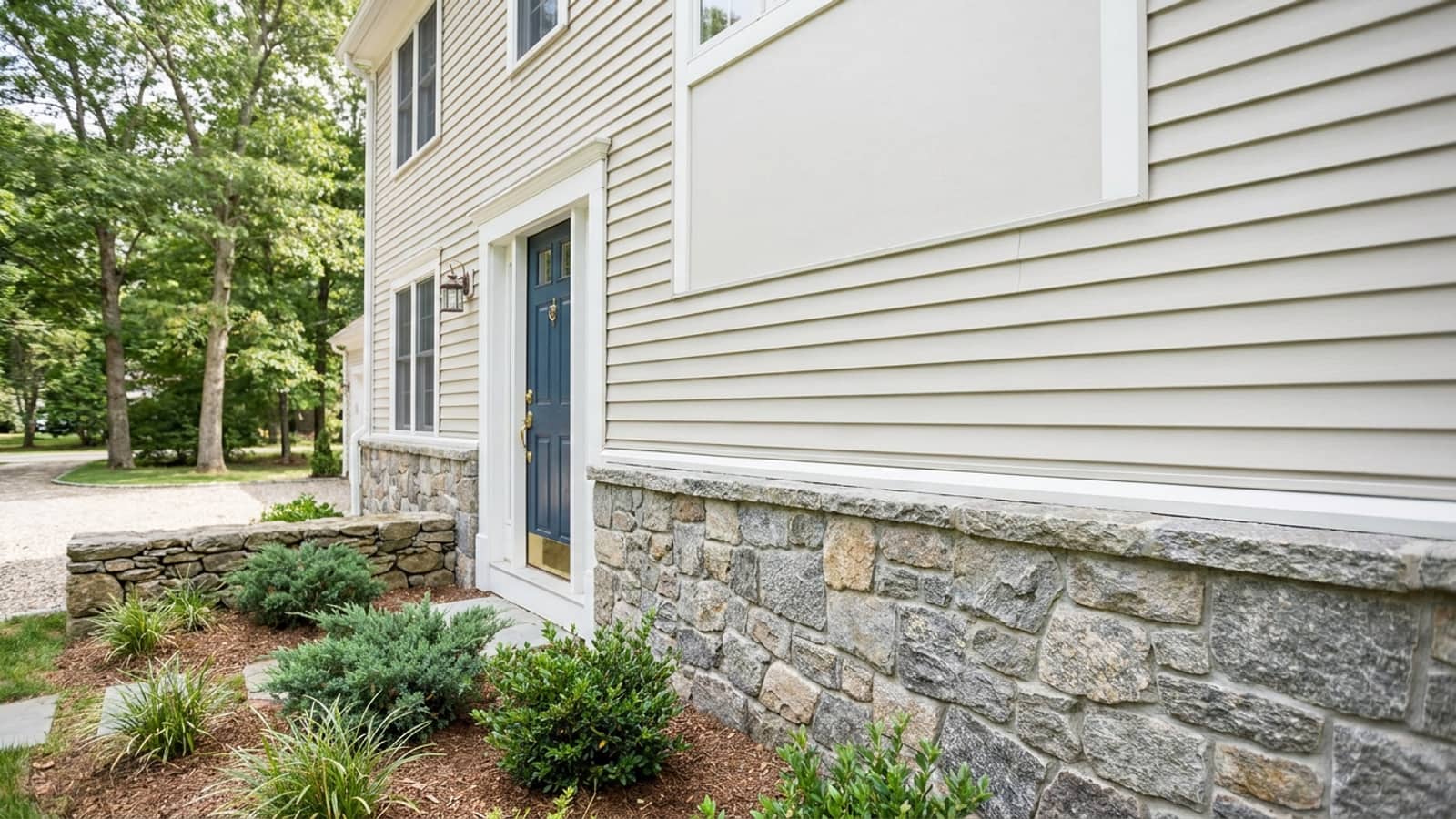
Where stone earns its money is at the base of the walls. A water table that wraps exposed concrete foundation, runs level around the house and dies into a corner board gives the elevation a base it did not have and solves a visual problem nothing else solves as cleanly. Entry surrounds and chimney chases are the other two places it reliably works.
Getting a number for your house
A useful stone quote requires someone standing at the elevation with a tape measure, separating flat area from corner footage and naming the assembly that goes behind it. That is part of a normal siding estimate visit. Someone comes out, measures the house, discusses where the stone should start and stop, and gives you a written price with the stone broken out as its own line.
If you want the stone priced alongside a full siding replacement so you can see both numbers and decide between them, request an estimate and say so up front. Comparing the accent against the cladding upgrade is the comparison worth making before anything is ordered.