Short answer
For most Connecticut shoreline homes, James Hardie fiber cement and premium vinyl hold up best, because neither rots and neither depends on a field-applied coating to survive salt spray. Cedar still looks right on a shingle-style house near the water, but it asks for re-staining every three to five years and it will weather unevenly on the exposed elevations. What matters as much as the material is the fasteners, flashing and trim behind it, which is where salt air does most of its real damage.
On this page
Salt air does not rot vinyl and it does not rot fiber cement. It corrodes metal and it strips finishes off wood. That single distinction is the most useful thing a shoreline homeowner can carry into a siding decision, because it moves the conversation away from panel brands and toward the parts of the wall nobody photographs: fasteners, flashing, trim, and the water-resistive barrier behind everything.
On a house in Guilford, Madison, Fairfield or the Shippan side of Stamford, the ranking is straightforward. James Hardie fiber cement and premium vinyl are the two materials that ask the least of you over thirty years. Cedar is still the right answer on some houses, but it is a maintenance commitment, not a set-and-forget choice.
What salt air actually attacks
Metal, first and worst
Airborne chloride accelerates corrosion of steel and, to a lesser degree, aluminum. In a siding assembly the metal is everywhere: nails, screws, starter strip, J-channel, drip cap over windows and doors, kickout flashing at roof-to-wall junctions, and the lintels over masonry openings.
When a fastener corrodes, three things happen in sequence. It stains the face of the siding with rust streaks. It loses holding power, so panels rattle and cup in wind. Then the corroded shank leaves a path for water into the sheathing. None of that is a siding failure. It is a hardware failure that looks like a siding failure.
On shoreline work we specify corrosion-resistant fasteners and marine-grade hardware rather than standard electro-galvanized. It is a small line item on a project that runs into the tens of thousands, and it is the difference between a wall that is sound at year twenty-five and one that has to be opened up at year twelve.
Coatings, second
Salt crystals are abrasive and hygroscopic. They sit on a surface, hold moisture against it, and get driven into it by wind. A field-applied stain or paint on cedar takes that abuse directly. A factory-baked finish on fiber cement, or color that runs through the body of a vinyl panel, does not have the same vulnerability.
The wall behind the siding, third
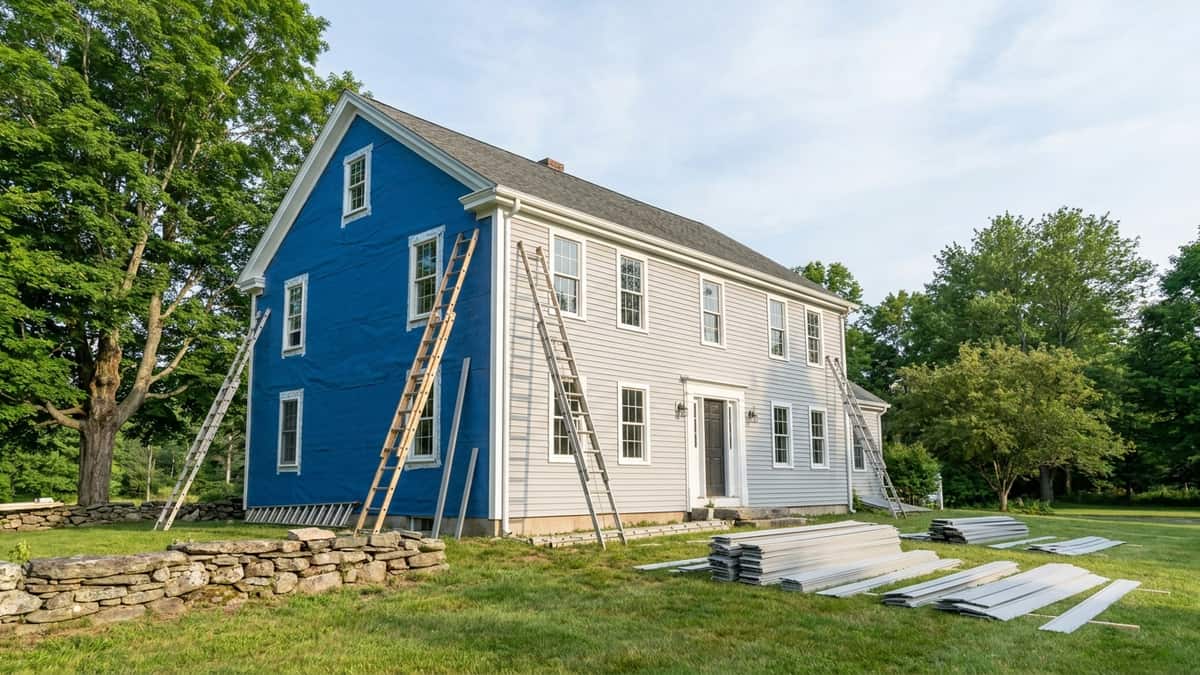
Wind-driven rain on the shoreline arrives horizontally and sometimes upward. Siding is a shedding layer, not a waterproof one, on every house. What keeps the wall dry is the drainage plane and the flashing details behind it. If you read nothing else about siding, read how house wrap and flashing work behind the panels — it applies everywhere in Connecticut and it is decisive within a mile of the water.
The three materials, honestly compared
| Material | General CT cost range | Lifespan | Shoreline maintenance |
|---|---|---|---|
| MaterialVinyl | General CT cost range$8,000-$18,000 | Lifespan20-30 years | Shoreline maintenanceRinse with a hose; no coating to maintain |
| MaterialJames Hardie fiber cement | General CT cost range$18,000-$40,000+ | Lifespan40-50+ years | Shoreline maintenanceRepaint at 15+ years; caulk joints inspected periodically |
| MaterialCedar | General CT cost range$25,000-$60,000 | Lifespan20-40 years | Shoreline maintenanceRe-stain every 3-5 years, sooner on water-facing walls |
Those are general Connecticut ranges that depend on the specific house, not a quote. Wall area, trim complexity, story height and what is found behind the old siding move a price inside those ranges far more than the material name does.
Vinyl
Vinyl's shoreline case is simple. It does not corrode, does not rot, does not need a coating, and the color is through the panel rather than on it. The failure modes are mechanical: panels that were nailed too tight and buckled, or thin panels that oil-can and rattle in wind off the Sound.
The fix for both is thickness and fastening discipline. On exposed shoreline elevations, a heavier panel with a deeper nail hem holds its line in wind far better than an entry-grade panel, and the installed price difference is modest. Panels must be hung, not pinned — a nail driven home flat against the hem prevents the thermal movement vinyl requires and is the most common cause of waviness. You can see the vinyl options we install on our siding page.
The honest weakness: vinyl reads as vinyl at close range, and on a period shingle-style or antique Colonial that matters. It also does not accept a new color, so a change of mind means a change of siding.
James Hardie fiber cement
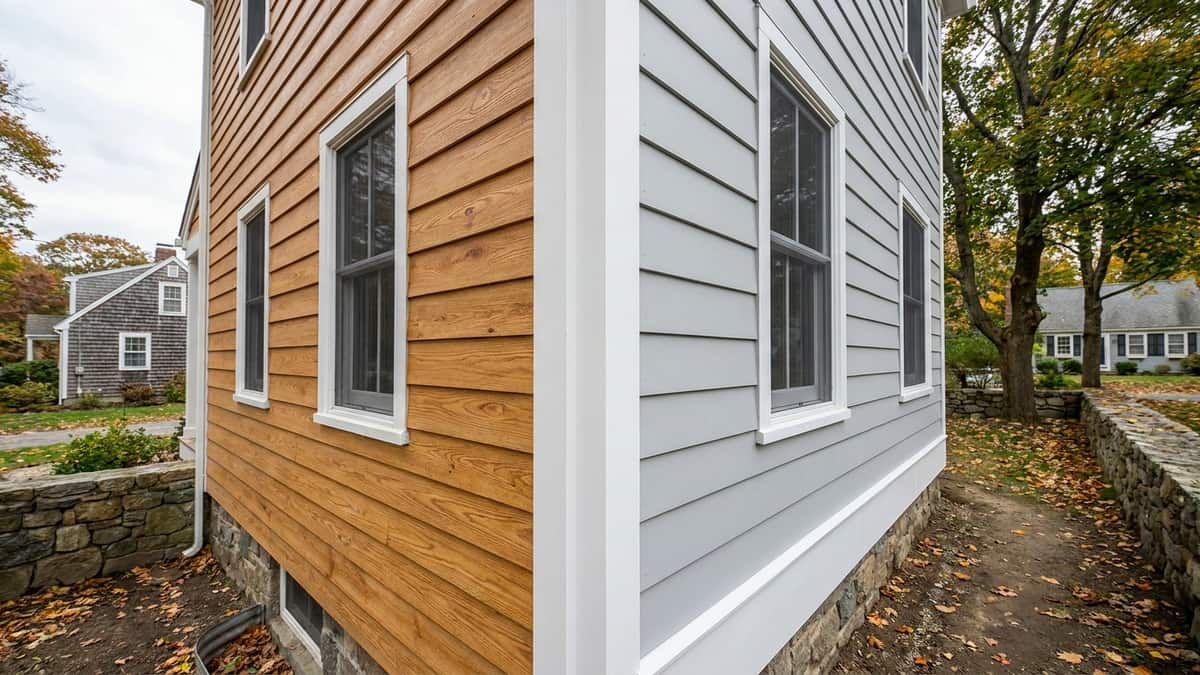
Fiber cement is dimensionally stable, non-combustible, and unaffected by salt in the air. The ColorPlus factory finish carries a 15-year color warranty and the product carries a 30-year non-prorated warranty, and we install it as a James Hardie Elite Preferred contractor.
On the shoreline the real advantages are edge behavior and detailing. Hardie holds a crisp line at corner boards, window trim and frieze boards, so a house with substantial trim looks correct rather than approximated. It also does not soften at cut ends the way wood does when wind-driven rain finds them.
The honest weaknesses: it costs roughly double vinyl installed, it is heavier and slower to hang, and the caulked joints are a maintenance item. Caulk on an exposed shoreline elevation is doing real work and should be inspected, not ignored for thirty years.
Cedar
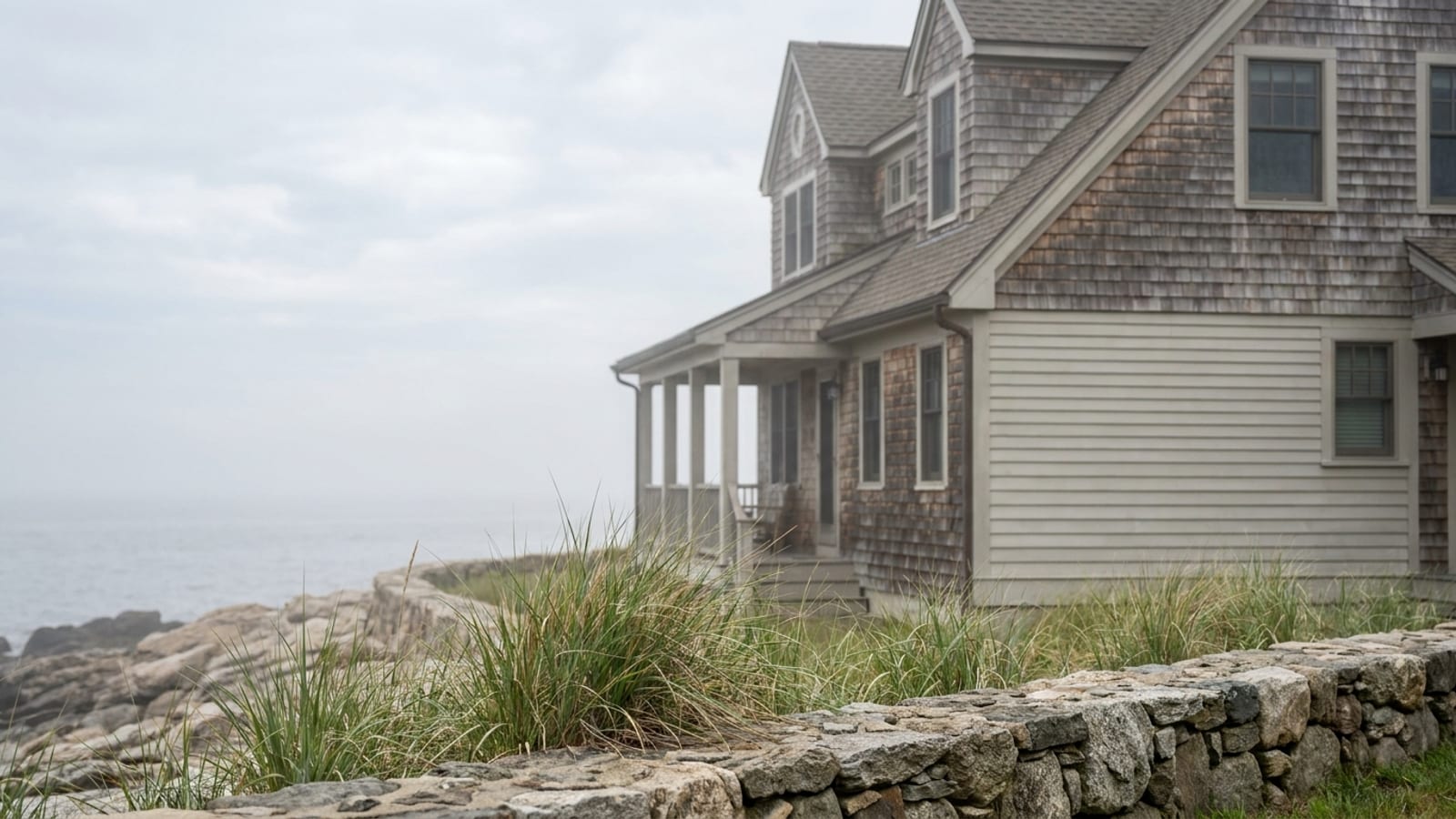
Cedar is the material the shoreline architectural vocabulary was built around, and on a shingle-style house in Guilford or a cottage being upgraded in Madison, replacing it with anything else changes the building. It also has a real technical merit: individual shingles can be replaced without disturbing a run.
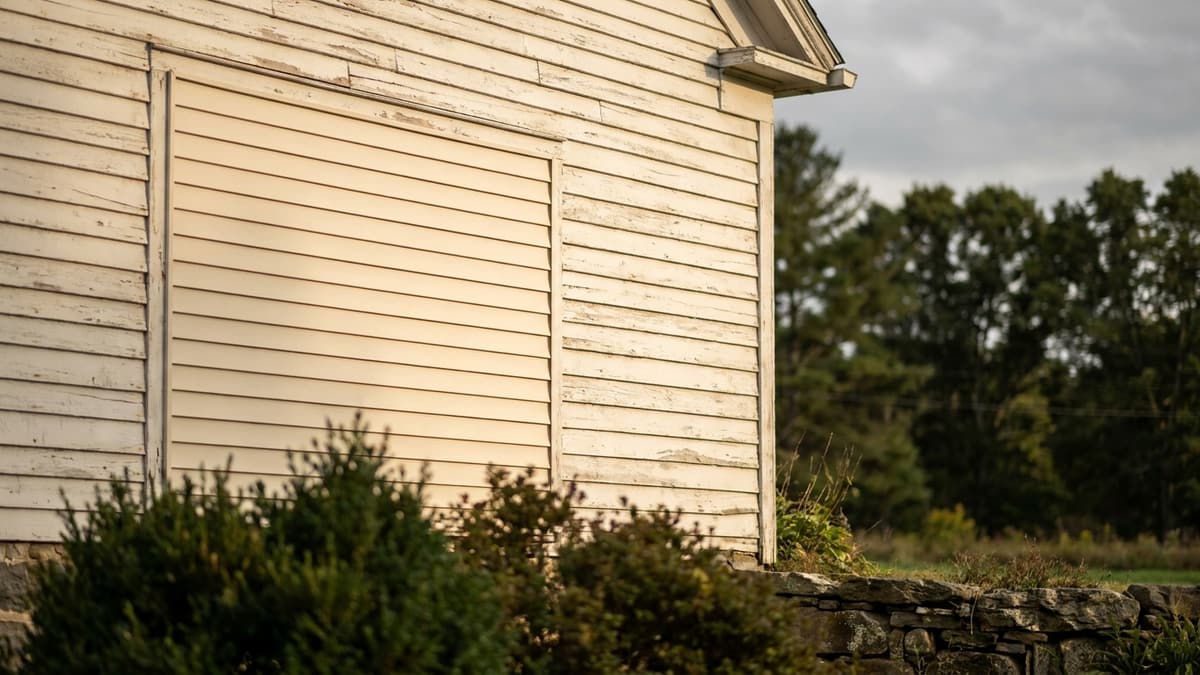
What it asks in return is attention. Re-stain every three to five years, sooner where wind carries salt spray directly onto a wall. Left alone, cedar on the shoreline weathers unevenly — the water-facing elevation goes silver years ahead of the back of the house — and untreated wood in a chronically damp, salt-loaded environment will eventually check and cup.
One planning note that catches people: within a local historic district, replacing cedar with cedar is like-for-like and needs no Certificate of Appropriateness under CGS Sec. 7-147f(a). Changing from wood to vinyl or fiber cement is a change of material type and does require review.
Wind is not a Fairfield County story
Appendix AY of the 2022 Connecticut State Building Code assigns each municipality an ultimate design wind speed. The shoreline numbers surprise most homeowners.
| Town | Design wind speed (Vult) |
|---|---|
| TownGuilford | Design wind speed (Vult)125 mph |
| TownMadison | Design wind speed (Vult)125 mph |
| TownNew Haven | Design wind speed (Vult)125 mph |
| TownFairfield | Design wind speed (Vult)120 mph |
| TownWestport | Design wind speed (Vult)120 mph |
| TownStamford | Design wind speed (Vult)120 mph |
| TownGreenwich | Design wind speed (Vult)120 mph |
The central shoreline carries the higher figure because of exposure to open water, not proximity to New York. Every town listed sits inside a designated hurricane-prone region.
For siding, that number does not translate into a single prescriptive rule the way it does for a roof covering, but it should shape two decisions: panel grade on exposed elevations, and fastening schedule. A manufacturer publishes a wind rating for its product and an installation instruction that earns it. A panel installed with fewer fasteners than the printed instructions specify has the appearance of a wind rating and none of the coverage.
The case against spending more
There are shoreline houses where vinyl is the better decision, not the compromise.
- A seasonal cottage where the priority is a wall that survives being left alone from October to May.
- A house with simple wall planes and little trim, where fiber cement's edge crispness buys you nothing visually.
- A holding period under ten years, where the durability gap between 25 and 50 years never gets realized by the person paying for it.
- A budget that would otherwise force cutting the flashing and fastener upgrades. A vinyl job detailed properly outperforms a fiber cement job detailed badly, every time.
The reverse is also true. On a substantial house with deep trim, a long expected hold, and walls that take direct weather off the water, the fiber cement premium is spread across decades and is usually the better arithmetic.
What to ask for in writing
- Fastener type and material, stated by name, not "appropriate fasteners."
- Water-resistive barrier product and how it is lapped and sealed at openings.
- Flashing at every window head, door head, deck ledger and roof-to-wall junction, including kickout flashing.
- Panel manufacturer, product line and grade, not just "vinyl siding."
- Who is responsible if sheathing is found rotten after tear-off, and at what unit price.
If you want a written price for your house, someone from Hoffman Exteriors comes out, measures the walls, looks at the existing details, and gives you an itemized number. You can start that at get an estimate or by phone at (860) 703-7663.