Short answer
Old vinyl shutters rarely come off a wall intact, because the spikes that hold them on are designed to go in once and not come back out. Wood and composite shutters in sound condition are worth saving if you accept the cost of careful removal, prep and refinishing. Treat shutters as a separate line on the siding quote and decide on appearance and condition, not on the hope of salvage.
On this page
- What is actually holding your shutters on
- Why old vinyl shutters rarely survive
- How new siding changes the mounting surface
- Sizing, which is where most shutters look wrong
- What this means for the budget
- Historic districts and configuration changes
- Decorative shutters are not opening protection
- Deciding on your house
Shutters are the smallest decision on a siding project and one of the most commonly skipped on the quote. They come off the wall whether you want them to or not, because siding runs continuously behind them. What happens next is a choice, and the honest default is that old vinyl shutters get recycled rather than reinstalled.
This post covers what is holding your shutters on, why removal destroys so many of them, how a new wall surface changes the mounting, and how to keep the cost visible rather than buried in a lump sum.
What is actually holding your shutters on
The answer determines whether reuse is even on the table.
Shutter spikes
Most vinyl shutters installed since the 1980s are held by nylon shutter spikes: a long barbed shank driven through a molded boss in the shutter panel and into the sheathing or framing. The barbs are one-directional. They are engineered to resist withdrawal, which is exactly the property you do not want on removal day. Pulling one usually means prying against the panel, and the panel is the part that gives.
Screws and panel pegs
Better installations use shutter screws with a matching color cap, or two-part pegs where a sleeve is set in the wall and the pin snaps in. Both can be reversed with some patience. If you look at the face of your shutters and see small color-matched caps rather than flush nylon heads, your odds of a clean removal go up considerably.
Through-bolts and hinges on real wood
Operable wood shutters on hinges and holdbacks come off at the hinge pin and reinstall the same way. They are the one category where reuse is usually the right call, because the hardware is the valuable part and the panels can be rebuilt.
Why old vinyl shutters rarely survive
Three things happen to a hollow vinyl shutter over two decades on a Connecticut wall.
- Color fade. Dark shutter colors are the most popular and the least stable. A black or hunter green panel that has faced south since the Clinton administration is a different color than the same part number off the shelf today, which means a partial replacement will not match.
- Embrittlement. Vinyl loses impact resistance as plasticizers migrate out and UV exposure accumulates. Cold makes this worse, so a shutter removed in March cracks more readily than the same shutter removed in July.
- Mounting boss damage. The molded boss the spike passes through is thin. Once it splits, the shutter cannot be refastened in the same holes and will sit proud of the wall.
Crews can and do get old shutters off intact. The problem is that you cannot know the survival rate in advance, and a half-salvaged set is worse than none, because the replacements will not match the originals.
How new siding changes the mounting surface
Even with undamaged shutters, the wall they go back on is not the wall they came off.
Vinyl siding has to be able to move
A vinyl panel expands and contracts measurably across its length with temperature. That is why the nailing slots are oblong and why panels are hung rather than pinned. A shutter fastened tight through that panel into the sheathing pins the siding at that point, and the panel will buckle somewhere else to relieve the stress. Correct practice is an oversized hole through the siding and a fastener long enough to reach solid substrate, set so the shutter is snug to the siding without clamping it. Ask how your installer handles this; the answer tells you a lot. Our vinyl siding page covers how the panels are hung in the first place.
Fiber cement and cedar change the fastener length
James Hardie and cedar are thicker and denser than the hollow vinyl they often replace, and if exterior insulation goes on under the cladding, the distance from the shutter face to framing grows again. Reused screws will be too short. This is a small cost, but it is a cost, and it is a frequent reason a reinstall does not go as planned.
New trim can eliminate the space
If the project includes wider window casings — a common upgrade when switching from vinyl J-channel detailing to a trimmed look in PVC or Hardie — the flat wall between the casing and the corner board shrinks. A shutter that used to fit may no longer. Measure before you promise yourself a reinstall.
Sizing, which is where most shutters look wrong
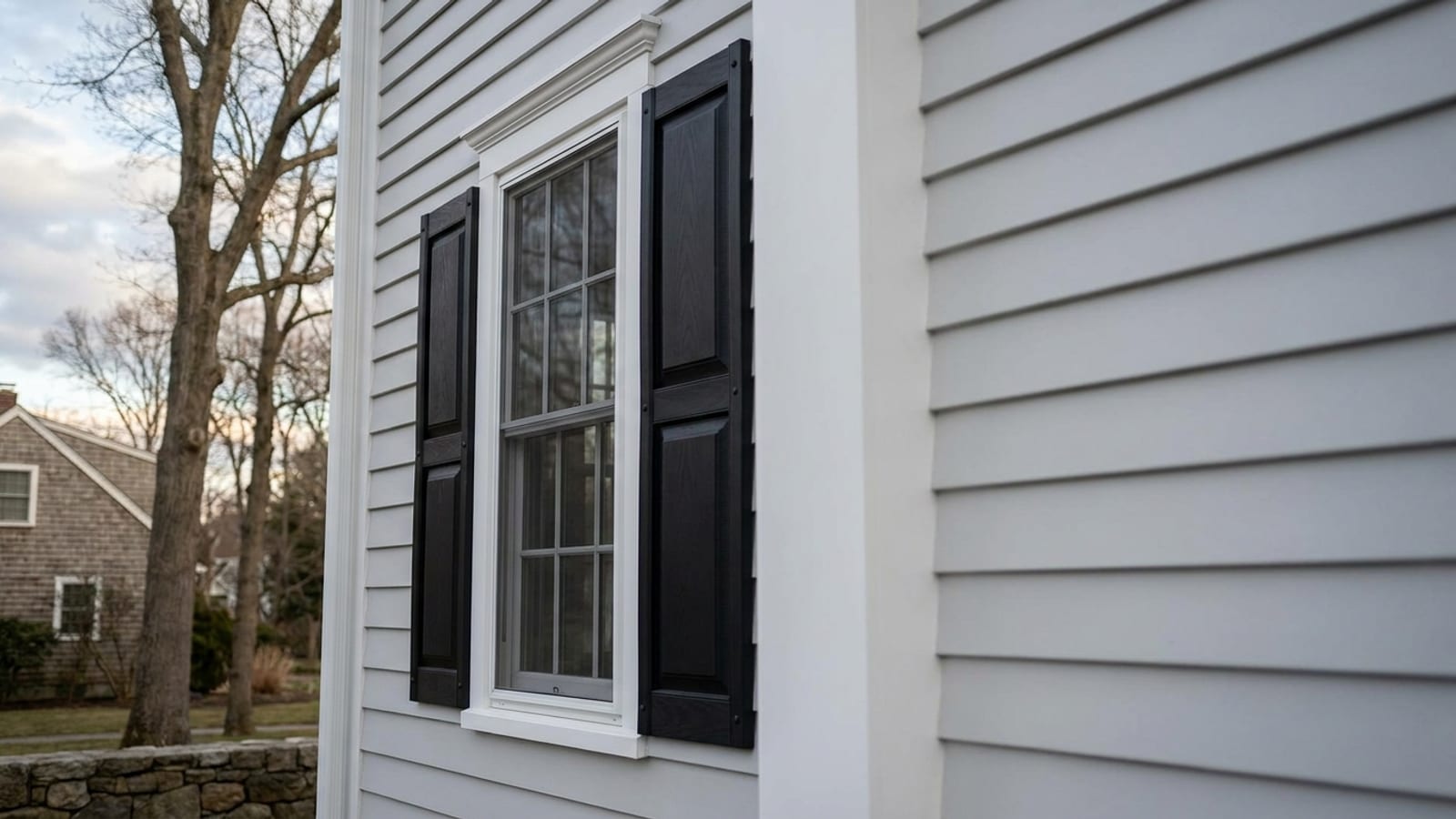
The test is simple: a pair of shutters should look like it could close over the window. Each panel should be roughly half the width of the window opening and the same height as the opening. Shutters that are obviously too narrow read as applied decoration rather than architecture, and they are extremely common on houses where the windows were replaced with wider units and the original shutters were put back.
If your windows have changed size since the shutters went up, that alone is a reason to replace rather than reuse.
What this means for the budget
Siding itself is the number that moves. General Connecticut ranges, which depend heavily on wall area, trim complexity and what is found behind the old cladding:
| Material | General Connecticut range | Lifespan |
|---|---|---|
| MaterialVinyl | General Connecticut range$8,000 - $35,000 | Lifespan20-30 years |
| MaterialJames Hardie fiber cement | General Connecticut range$18,000 - $80,000+ | Lifespan40-50+ years |
| MaterialCedar | General Connecticut range$25,000 - $60,000+ | Lifespan20-40 years |
Shutters sit outside those ranges and are priced per pair plus labor. Rather than quote a figure that will not match your house, insist the estimate shows shutters as their own line with a count, a product, and whether removal of the existing ones is included. A quote that says "siding, trim and accessories" with no shutter count is a quote you cannot compare against another one. The same logic applies across the whole proposal; see the siding service page for what else belongs on it.
The case for leaving them off
There is a real argument against reinstalling anything. Shutters were originally functional, and on a mid-century ranch or a 1970s raised ranch they were never anything but applied trim. Removing them gives you a cleaner wall, eliminates a few dozen fastener penetrations through new cladding, and costs nothing. On the 1920s and 1930s colonials common in towns like West Hartford, the opposite is usually true — the facade was designed with them, and siding one of those houses without shutters tends to look unfinished. Ask the installer for a photo rendering before deciding.
Historic districts and configuration changes
If your house is in a local historic district, this is not purely an aesthetic call. Under Connecticut General Statutes Sec. 7-147f(a), replacing exterior elements with similar materials is ordinary maintenance and does not require a Certificate of Appropriateness. Changing the material type — wood shutters to vinyl — or changing the configuration, which includes removing shutters that are part of the documented facade, generally does. We cover the distinction in detail in our post on historic district rules for exterior work. A commission meeting is not a disaster, but it is a date on a calendar, and it should be on the schedule before materials are ordered.
Decorative shutters are not opening protection
Every town we serve is inside a designated hurricane-prone region under Appendix AY of the 2022 Connecticut State Building Code, with ultimate design wind speeds of 120 mph inland and in Fairfield County and 125 mph in Guilford, Madison and New Haven. Fixed decorative shutters have no role in that. They are not tested, rated or recognized as impact protection, and no one should sell them to you on that basis. If you want genuine opening protection on a shoreline house, that is a separate product and a separate conversation.
Deciding on your house
Walk the exterior and answer four questions. Are the shutters spiked or screwed? Is the color still true? Do they match the current window sizes? Is the house in a historic district? Those four answers resolve most of the decision before anyone comes out.
When you are ready for numbers, request an estimate. Someone comes out, measures the walls and the window openings, counts the shutters, and leaves you with a written price that shows siding, trim and shutters as separate lines so you can see exactly what each piece costs.